
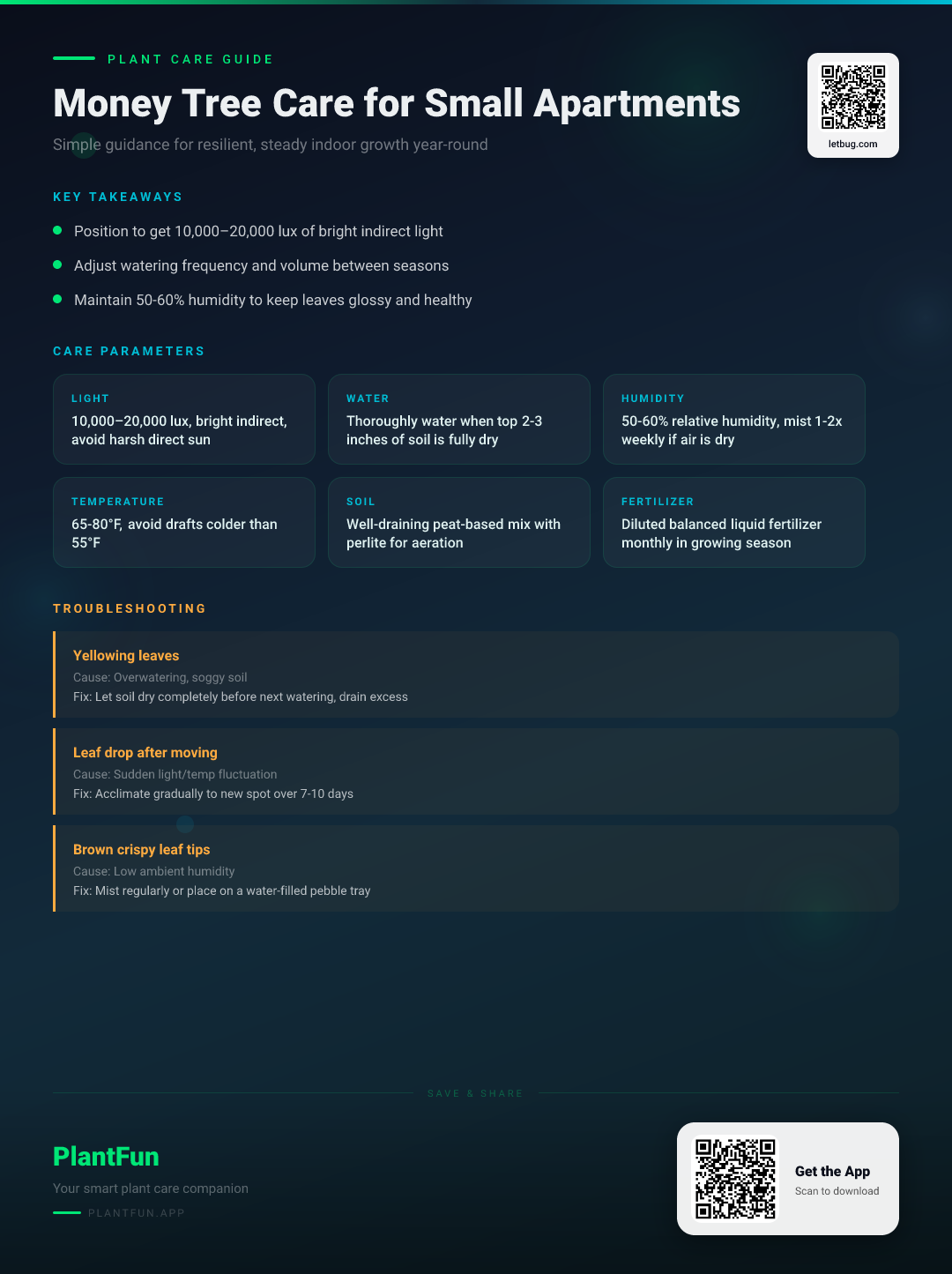
Key Takeaways
- Check soil moisture before watering — overwatering is the #1 killer of houseplants.
- Ensure your plant gets the right amount of light for its species.
- Be patient with recovery — most plants need 2–4 weeks to bounce back.
Quick Care Card: The Essentials at a Glance
| Feature | Requirement |
|---|---|
| Light | 10,000–20,000 Lux (Bright, indirect) |
| Watering | Allow top 50% of soil to dry out |
| Humidity | 50–60% Relative Humidity |
| Temperature | 65–80°F (18–27°C) |
| Soil | Well-draining, peat-based mix |
| Fertilizer | Balanced liquid feed, monthly in growth season |
| Toxicity | Non-toxic to cats and dogs (ASPCA, 2026) |
TL;DR: The Apartment Survival Summary
To keep your Money Tree (Pachira aquatica) thriving, focus on three pillars: stable light, deep but infrequent watering, and protection from drafts. Provide bright, filtered light—ideally 10,000 to 20,000 lux. Water only when the top half of the pot feels dry to the touch, and never let the plant sit in standing water. If your apartment has low airflow, be careful not to over-mist, as stagnant air increases the risk of fungal issues.
Why Money Trees Struggle in Typical Apartments
When I first got my Pachira aquatica, I made the mistake of placing it in a dark corner of my studio. I thought because it was a “sturdy” plant, it would adapt. It didn’t. Most apartments lack the consistent air movement and light intensity this species craves. Unlike outdoor specimens, indoor Money Trees often suffer from “wet feet” because their potting medium stays saturated longer in cool, low-light apartment corners (NC State Extension, 2026). Recognizing that your indoor climate is a micro-environment is the first step to success.
Mastering Light: Finding 10,000–20,000 Lux in Limited Spaces
Your Money Tree needs significant light to maintain its signature braided trunk and glossy leaves. In an apartment, avoid direct, harsh afternoon sun which can scorch the foliage. Instead, aim for a spot near an east-facing window. If you aren’t sure about the light levels, a simple lux meter app can help you find that sweet spot between 10,000 and 20,000 lux. If you are struggling with low natural light, supplemental LED grow lights can bridge the gap, helping your plant maintain its vigor throughout the year.
The Irrigation Protocol: When to Water (and How Much)
Overwatering is the number one killer of indoor Money Trees. I recommend the “finger test”: stick your index finger two inches into the soil. If it feels moist, wait three days. When it is dry, irrigate until water flows from the drainage holes. For an average 10-inch pot, this usually means about 500ml of water. Always discard excess water from the saucer; leaving the plant in standing water causes root rot (NC State Extension, 2026).
Maintaining 50-60% Relative Humidity for Glossy Leaves
Apartments are notorious for bone-dry air, especially during winter heating months. While Pachira aquatica is resilient, it prefers 50-60% humidity to keep its leaves supple. A small ultrasonic humidifier placed nearby is my preferred method for maintaining this range. Avoid misting the leaves directly, as in low-airflow apartments, this simply promotes fungal leaf spot.
Temperature Control: Keeping Your Plant Between 65-80°F
Your Money Tree is a tropical native. It thrives when kept between 65°F and 80°F. The biggest danger in small homes is proximity to heating vents or drafty, poorly insulated windows. Ensure your plant is at least three feet away from any forced-air heat source, which can dehydrate the plant rapidly and cause crispy leaf tips.
Step-by-Step Recovery Plan for Yellowing Leaves
[Root Rot Diagnosis]
Symptom: Leaves turn yellow and drop; soil smells musty.
Likely cause: Overwatering or lack of drainage.
Fix:
- Remove the plant from the pot and inspect roots.
- Trim away mushy, brown, or rotting roots with sterilized scissors.
- Repot in fresh, well-draining soil and reduce water frequency.
[Light Stress]
Symptom: Pale yellowing leaves and slow, “leggy” growth.
Likely cause: Insufficient light.
Fix:
- Move the plant closer to a window.
- Introduce a supplemental grow light if natural light remains below 10,000 lux.
Voice Search FAQ: How often should I water my Money Tree in winter?
During the cooler months, the plant’s metabolic rate slows down. You will likely find yourself watering every 14–21 days instead of weekly. Always rely on the soil moisture test rather than a strict calendar.
Voice Search FAQ: Why is my Money Tree dropping leaves after moving it?
Pachira aquatica is sensitive to sudden changes in environment. Moving it from a high-light to a low-light area (or vice versa) triggers a shock response. Keep it in one location to allow it to acclimate to the specific light and temperature of that spot.
Seasonal Calendar: Adjusting Care from Summer to Winter
- Spring/Summer: Peak growth period. Increase fertilizer frequency to once per month and maintain consistent moisture.
- Fall/Winter: Dormancy phase. Reduce watering volume by 30% and pause all fertilization. Focus on keeping the plant away from cold window drafts (NC State Extension, 2026).
Common Mistakes That Kill Apartment Money Trees
-
Mistake: Using a pot without a drainage hole.
-
What happens: Water pools at the bottom, leading to hypoxia and root rot.
-
Instead: Always use a pot with bottom holes; if using a decorative cachepot, ensure you remove the nursery pot to drain it.
-
Mistake: Over-fertilizing in winter.
-
What happens: Salts build up in the soil, potentially burning the root system.
-
Instead: Cease all fertilization from November to March.
References
- Sharpe, D. (2011). Money, money, money. Child Care. https://doi.org/10.12968/chca.2011.8.10.6. Accessed 2026-03-10.
- Zhao, Y.; Quan, X.; Wang, T. (2024). Food poisoning due to money tree seeds: a case report of toxic encephalopathy. Emergency and Critical Care Medicine. https://doi.org/10.1097/ec9.0000000000000119. Accessed 2026-03-10.
- ASPCA. (2026). Toxic and Non-Toxic Plants List — ASPCA. https://www.aspca.org/pet-care/animal-poison-control/toxic-and-non-toxic-plants. Accessed 2026-03-10.
- NC State Extension. (2026). Money Tree Care — NC State Extension Gardener Plant Toolbox. https://plants.ces.ncsu.edu/plants/tree-care/. Accessed 2026-03-10.
Optional Helper: Plantfun.App
Plantfun.App identifies your plants by photo, diagnoses pests and diseases with clear fixes, and creates personalised watering and light schedules that adapt to your home conditions — a handy companion for putting this guide into daily practice.
Found an error or have suggestions? We'd love your feedback.
Need help identifying this problem?
Get instant identification, personalized care schedules, and effective pest treatment plans directly on your phone.
Sponsored • We may earn a commission from app downloads
Related Guides
Money Tree Care for Busy Apartments: The Complete Guide to Resilient Indoor Growth
Transform your apartment into a lush sanctuary. Master Money Tree care with expert light, water, and humidity thresholds designed to keep your plant thriving.
Care GuideMoney Tree Care in Small Apartments: The Essential Guide to Resilient Growth
Transform your cramped corner into a lush sanctuary. Master Money Tree care with specific light levels and watering schedules tailored for small apartment living.
Care GuideThe Complete Pachira Aquatica (Money Tree) Care Checklist for Resilient Growth in Typical Apartments
Stop guessing at money tree care. Get exact light, water, humidity thresholds and a 12-point checklist tailored to typical apartment conditions to keep your plant resilient and lush.
Pest ControlAnts on Plants: What They Mean and What to Do
Ants usually aren't eating your plant. They are farming other pests.