
Key Takeaways
- Check soil moisture before watering — overwatering is the #1 killer of houseplants.
- Ensure your plant gets the right amount of light for its species.
- Be patient with recovery — most plants need 2–4 weeks to bounce back.
Money Tree Care for Small Apartments: A 4-Season Guide to Resilient Indoor Growth
When I first bought my Pachira aquatica, I treated it like a cactus—neglecting it until the soil was bone-dry and the trunk felt soft. I quickly learned that this tree isn’t a desert survivor; it’s a tropical swamp dweller that demands a consistent rhythm. Mastering Money Tree care in an apartment means mimicking those tropical origins while navigating the artificial limitations of indoor living.
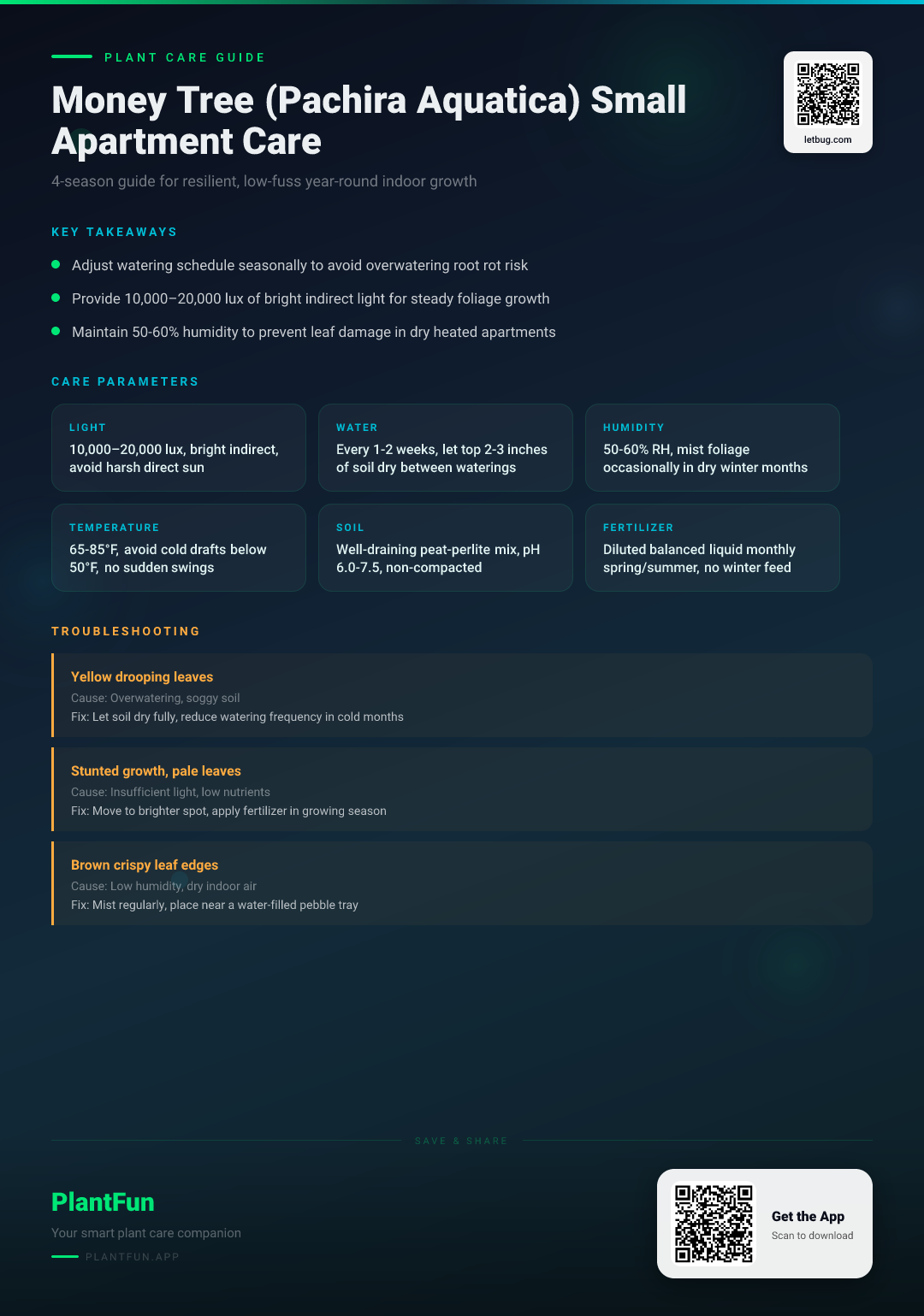
Quick Care Card: Essential Parameters for Apartment Success
| Parameter | Requirement |
|---|---|
| Light | 10,000–20,000 Lux (Bright, indirect) |
| Watering | When top 2-3 inches of soil are dry |
| Humidity | 50-60% Relative Humidity |
| Temperature | 65°F–80°F (18°C–27°C) |
| Soil | Well-draining, peat-based mix |
| Fertilizer | Balanced liquid 10-10-10, monthly (growing season) |
| Toxicity | Non-toxic to humans; check ASPCA for pets |
TL;DR: The 30-Second Money Tree Success Summary
To keep your Money Tree thriving, provide bright, indirect light and water only when the top 3 inches of soil are dry. Avoid the “overwatering trap” by ensuring your pot has drainage holes. In winter, pull the plant away from cold drafts and reduce watering frequency to match the slower growth rate. If you have pets, keep this plant out of reach, as ingestion can cause distress (ASPCA, 2026).
Why Your Apartment is a Micro-Habitat for Pachira Aquatica
Your apartment acts as a controlled micro-habitat. While the Pachira aquatica thrives in the wild in floodplains (NC State Extension, 2026), your living room lacks the constant airflow of an outdoor environment. This means moisture stays in the soil longer. Understanding this balance is the key to preventing root rot and stunted growth.
Seasonal Care Calendar: Adapting Your Routine from Summer to Winter
- Spring/Summer (Growth Season): Water thoroughly once the top 2 inches of soil feel dry. Feed monthly with a diluted balanced fertilizer to support new foliage.
- Autumn/Winter (Dormancy): Growth slows. Allow the soil to dry out to 4 inches deep before watering. Hold off on fertilizer entirely until the days lengthen in March.
Light Requirements: Mapping 10,000–20,000 Lux in Typical Apartments
Money Trees love bright, indirect light. In an apartment, this usually means placing your tree within 3 feet of an east-facing window. If you only have north-facing light, consider a supplemental LED grow light to maintain the required 10,000–20,000 lux levels for healthy photosynthesis.
Watering Protocols: Precise Volumetric Care for Root Health
How often to water your Money Tree? Stop relying on a calendar and start using the “finger test.” Insert your finger 2-3 inches into the soil. If it feels damp, wait. When you do water, use room-temperature water and soak the soil until it runs out of the drainage holes. Remove the excess water from the saucer immediately to prevent root rot.
Humidity & Temperature: Maintaining 50-60% Humidity in Dry Living Rooms
Apartments are notorious for low humidity, especially in winter. I maintain my plant’s health by grouping it with other tropicals or using a small humidifier. Keep the plant away from HVAC vents, as forced-air heating causes rapid leaf drop.
Soil and Fertilizer: Long-Term Nutrition for Braided Trunks
The best soil for a Money Tree is a fast-draining mix—think two parts potting soil, one part perlite, and a handful of orchid bark. This ensures the root system gets the oxygen it needs.
FAQ: Why are my Money Tree leaves turning yellow in the winter?
Yellowing leaves during the cold season are often a symptom of overwatering or cold drafts. Because the plant’s metabolic rate slows in winter, it uses less water (Sharpe, 2011). Ensure your watering frequency is adjusted accordingly.
FAQ: How do I know if my Money Tree is getting enough light?
If the petioles (leaf stems) start stretching out long and thin, your plant is “reaching” for light. Healthy plants should have compact, sturdy growth.
Common Mistakes: Avoiding the Overwatering Trap
- Mistake: Watering on a rigid “every Monday” schedule. What happens: The soil stays permanently waterlogged, leading to root rot. Instead: Test the soil moisture with your finger before every watering.
- Mistake: Leaving the plant in a decorative pot without drainage. What happens: Water accumulates at the bottom, rotting the base of the trunk. Instead: Always use a nursery pot with holes inside your decorative cover pot.
The Resilience Checklist: Troubleshooting Stunted Growth
Yellowing Leaves
Symptom: Leaves turn yellow and fall off prematurely.
Likely cause: Overwatering or poor drainage.
Fix:
- Check for standing water in the saucer.
- Repot into a container with adequate drainage holes.
Crispy Leaf Tips
Symptom: Brown, crunchy edges on the foliage.
Likely cause: Low humidity or inconsistent watering.
Fix:
- Increase ambient humidity using a pebble tray or humidifier.
- Implement a consistent watering schedule once the top 3 inches are dry.
Soft or Mushy Trunk
Symptom: The base of the trunk feels squishy to the touch.
Likely cause: Advanced root rot.
Fix:
- Remove the plant and inspect the roots; trim any black, slimy parts.
- Repot in fresh, well-draining soil and reduce watering significantly.
References
- Sharpe, D. (2011). Money, money, money. Child Care. https://doi.org/10.12968/chca.2011.8.10.6. Accessed 2026-03-18.
- Zhao, Y.; Quan, X.; Wang, T. (2024). Food poisoning due to money tree seeds: a case report of toxic encephalopathy. Emergency and Critical Care Medicine. https://doi.org/10.1097/ec9.0000000000000119. Accessed 2026-03-18.
- ASPCA. (2026). Toxic and Non-Toxic Plants List — ASPCA. https://www.aspca.org/pet-care/animal-poison-control/toxic-and-non-toxic-plants. Accessed 2026-03-18.
- NC State Extension. (2026). Money Tree Care — NC State Extension Gardener Plant Toolbox. https://plants.ces.ncsu.edu/plants/tree-care/. Accessed 2026-03-18.
Optional Helper: Plantfun.App
Plantfun.App identifies your plants by photo, diagnoses pests and diseases with clear fixes, and creates personalised watering and light schedules that adapt to your home conditions — a handy companion for putting this guide into daily practice.
Found an error or have suggestions? We'd love your feedback.
Need help identifying this problem?
Get instant identification, personalized care schedules, and effective pest treatment plans directly on your phone.
Sponsored • We may earn a commission from app downloads
Related Guides
Money Tree Care for Busy Apartments: The Complete Guide to Resilient Indoor Growth
Transform your apartment into a lush sanctuary. Master Money Tree care with expert light, water, and humidity thresholds designed to keep your plant thriving.
Care GuideMoney Tree Care for Small Apartments: A 5-Step Guide to Resilient Indoor Growth
Revive your Money Tree with our simple 5-step checklist. Get exact lux, watering ml, and apartment-specific tips to ensure resilient growth all year long.
Care GuideMoney Tree in a Dim Apartment: The Complete Care Guide for Resilient Growth
Revive your Money Tree with our apartment-tested care plan. Discover exact watering ml, light lux, and 3 simple steps for resilient growth in dim rooms.
Pest ControlAnts on Plants: What They Mean and What to Do
Ants usually aren't eating your plant. They are farming other pests.