
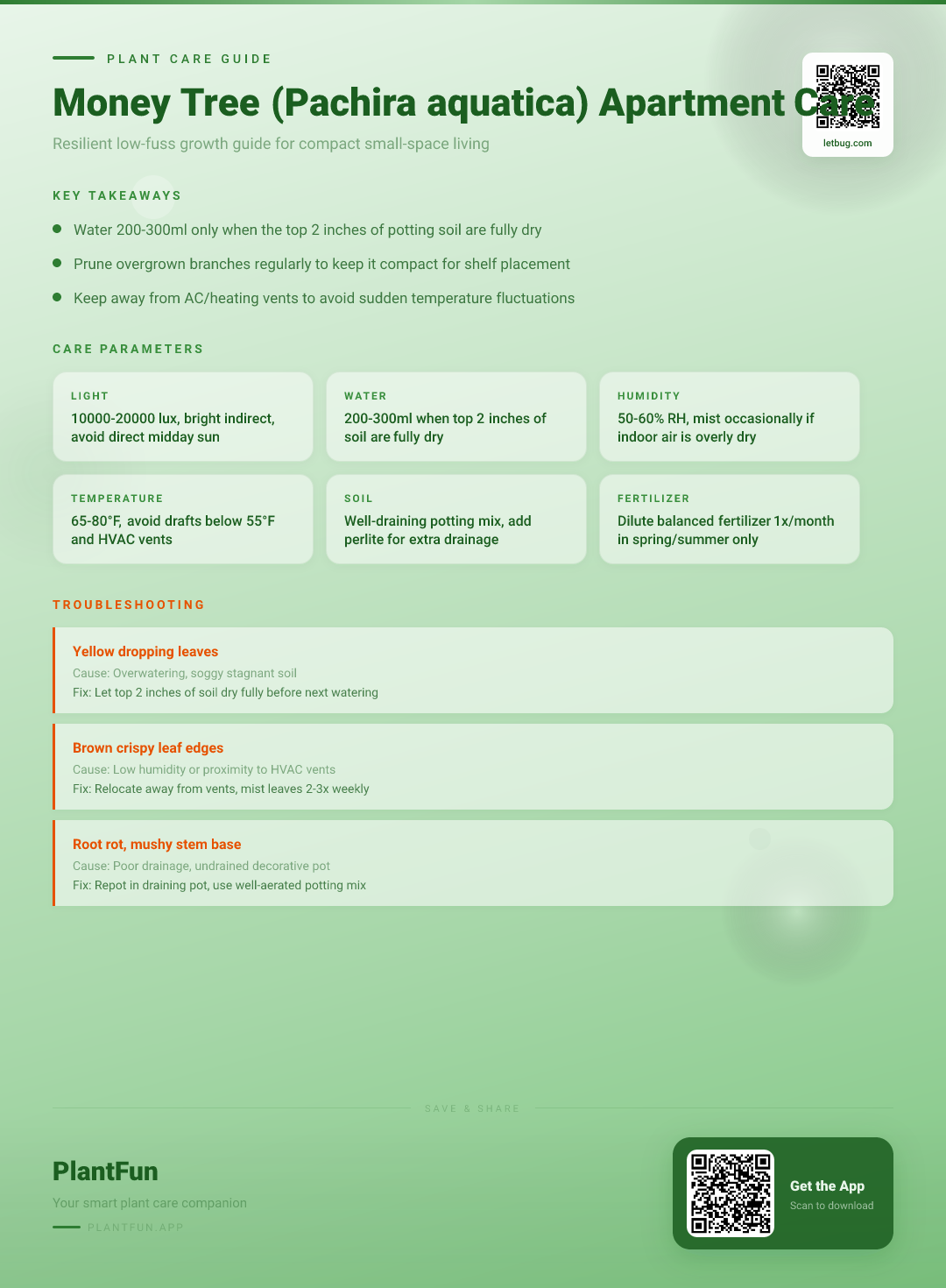
Key Takeaways
- Check soil moisture before watering — overwatering is the #1 killer of houseplants.
- Ensure your plant gets the right amount of light for its species.
- Be patient with recovery — most plants need 2–4 weeks to bounce back.
Quick Care Card: Essential Data
| Feature | Requirement |
|---|---|
| Light | 10,000–20,000 lux (bright, indirect) |
| Water | 200–300ml when top 2 inches of soil are dry |
| Humidity | 50–60% |
| Temperature | 65–80°F (18–27°C) |
| Soil | Well-draining, peat-based mix |
| Fertilizer | Balanced liquid 10-10-10 (monthly, spring-summer) |
| Toxicity | Non-toxic to cats and dogs (ASPCA, 2026) |
TL;DR: The Small-Space Money Tree Manifesto
Success with Pachira aquatica in an apartment isn’t about luck; it’s about physics. To keep your Money Tree thriving, place it where it receives bright, indirect light (avoid direct afternoon sun), and only irrigate when the top two inches of soil are completely dry. Most failures occur due to overwatering in stagnant air, so ensure your pot has drainage and avoid placing it directly in front of HVAC vents. When I first started keeping these, I killed my first one by ignoring the “dry-down” period, leading to root suffocation.
Why Money Trees Struggle in Typical Apartments: Understanding the ‘Stagnant Air’ Syndrome
In my experience, the biggest hurdle to Pachira aquatica care in small apartments is the lack of airflow. While these plants originate from tropical wetlands, their indoor counterparts often suffer from “stagnant air”—a condition where high humidity is trapped without air circulation, leading to fungal issues (NC State Extension, 2026). In an apartment, you aren’t just managing the plant; you are managing a micro-environment. If your room feels stuffy, your plant will struggle to transpire correctly, leading to yellowing leaves and slow root rot.
Step-by-Step Care Guide: Lighting Your Pachira in a North-Facing or Obstructed Living Area
- Assess the Lux: Use a light meter app to ensure your spot hits at least 10,000 lux. A north-facing window might be too dark; if you measure below 8,000 lux, move the plant closer to the glass or add a full-spectrum LED grow light.
- Avoid Thermal Shock: Keep the foliage at least 2 feet away from window glass during the peak of winter to prevent cold-draft damage.
- Rotation: Rotate your pot 90 degrees every time you water to ensure even growth. This is critical in small spaces where light often comes from a single, unidirectional source, causing the plant to “lean” awkwardly.
The Golden Rule of Hydration: Calculating Water Needs for Indoor Containers
Forget the weekly watering myth. Instead, adopt the finger-test method: insert your index finger 2 inches into the soil. If you feel moisture, wait. When you do water, use approximately 200–300ml of room-temperature water. Pour slowly to ensure the root ball is saturated, then discard any excess that collects in the saucer. Excess water left sitting at the roots is the primary driver of root rot in indoor environments.
Environmental Thresholds: Temperature Stability and Humidity Hacks for Urban Dwellers
Apartments are notorious for temperature fluctuations. Maintain a stable range of 65–80°F (NC State Extension, 2026). If you live in a dry apartment, group your Pachira with other plants to create a micro-climate or use a small pebble tray to elevate local humidity to the 50–60% range. Avoid placing your plant directly in the path of a heater or air conditioner, as these create rapid, localized moisture loss.
Seasonal Care Calendar: Navigating Apartment Climate Changes from Summer to Winter
- Spring/Summer: This is the growth phase. Increase light exposure and begin monthly fertilization. If the plant becomes too tall for your bookshelf, this is the time to prune.
- Autumn/Winter: Growth naturally slows. Reduce watering frequency by 25% and stop fertilizing entirely. The plant needs a “rest” period during the shorter days (Sharpe, 2011).
Voice Search FAQ: Why is my Money Tree losing yellow leaves despite watering?
Symptom: Lower leaves yellow and drop.
Likely cause: Overwatering or poor drainage.
Fix: Check that the soil drains freely. If the soil is soggy, pull the plant out of the pot to inspect for mushy, brown roots. Trim away rotting tissue and repot in fresh, well-draining soil.
Voice Search FAQ: How do I prune my Money Tree so it doesn’t outgrow my bookshelf?
Symptom: The plant is becoming too top-heavy.
Fix: Identify a node (where a leaf meets the stem). Use clean, sterilized shears to cut just above the node at a 45-degree angle. This encourages lateral branching and helps maintain a manageable height for indoor spaces.
Voice Search FAQ: Can I keep my Money Tree near an air conditioner or heater vent?
Symptom: Brown, crispy leaf tips.
Fix: Move the plant immediately. Vents cause rapid, uneven transpiration that the root system cannot match. Keep the plant away from any direct airflow to prevent premature leaf drop.
Common Mistakes: Avoiding the ‘Decorative Pot’ Trap That Causes Root Rot
- Mistake: Planting directly into a decorative pot without drainage holes.
- What happens: Water collects at the bottom, creating a swamp where roots suffocate.
- Instead: Keep the plant in its plastic nursery pot and nest it inside the decorative cachepot. Always remove the nursery pot to water it in the sink.
References
- Sharpe, D. (2011). Money, money, money. Child Care. https://doi.org/10.12968/chca.2011.8.10.6. Accessed 2026-03-13.
- Zhao, Y.; Quan, X.; Wang, T. (2024). Food poisoning due to money tree seeds: a case report of toxic encephalopathy. Emergency and Critical Care Medicine. https://doi.org/10.1097/ec9.0000000000000119. Accessed 2026-03-13.
- ASPCA. (2026). Toxic and Non-Toxic Plants List — ASPCA. https://www.aspca.org/pet-care/animal-poison-control/toxic-and-non-toxic-plants. Accessed 2026-03-13.
- NC State Extension. (2026). Money Tree Care — NC State Extension Gardener Plant Toolbox. https://plants.ces.ncsu.edu/plants/tree-care/. Accessed 2026-03-13.
Optional Helper: Plantfun.App
Plantfun.App identifies your plants by photo, diagnoses pests and diseases with clear fixes, and creates personalised watering and light schedules that adapt to your home conditions — a handy companion for putting this guide into daily practice.
Found an error or have suggestions? We'd love your feedback.
Need help identifying this problem?
Get instant identification, personalized care schedules, and effective pest treatment plans directly on your phone.
Sponsored • We may earn a commission from app downloads
Related Guides
Money Tree Care for Small Apartments: A 5-Step Guide to Resilient Indoor Growth
Revive your Money Tree with our simple 5-step checklist. Get exact lux, watering ml, and apartment-specific tips to ensure resilient growth all year long.
Care GuideMoney Tree Care for Busy Apartments: The Complete Guide to Resilient Indoor Growth
Transform your apartment into a lush sanctuary. Master Money Tree care with expert light, water, and humidity thresholds designed to keep your plant thriving.
Care GuideThe Complete Money Tree Care Guide for Typical Apartments: Light, Water, Soil & More
Transform your Money Tree into a resilient apartment centerpiece. Follow these 4 vital care thresholds and our seasonal routine to stop yellowing leaves today.
Pest ControlAnts on Plants: What They Mean and What to Do
Ants usually aren't eating your plant. They are farming other pests.