
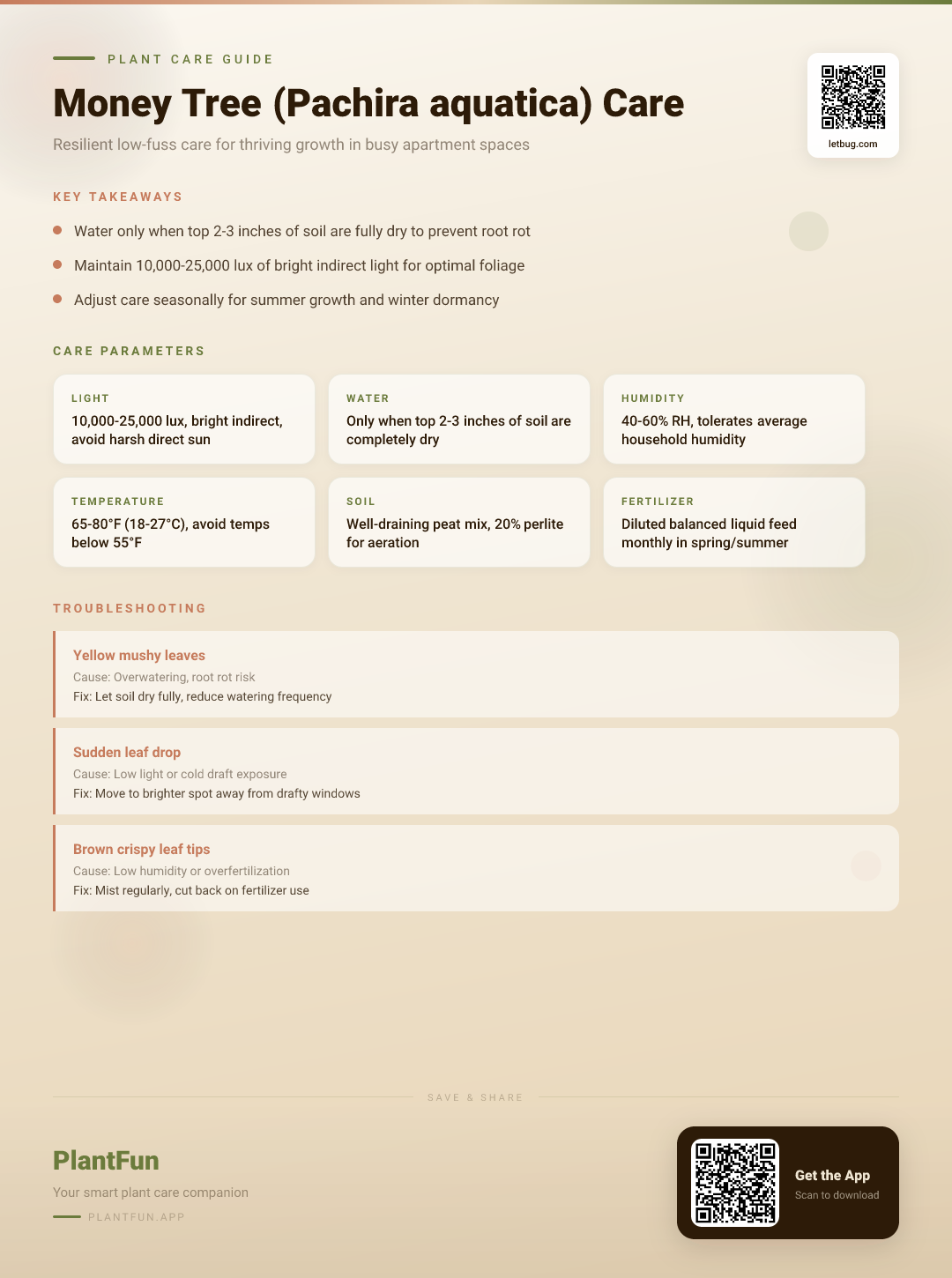
Key Takeaways
- Check soil moisture before watering — overwatering is the #1 killer of houseplants.
- Ensure your plant gets the right amount of light for its species.
- Be patient with recovery — most plants need 2–4 weeks to bounce back.
Quick Care Card: Essential Thresholds for Your Money Tree
| Feature | Requirement |
|---|---|
| Light | 10,000–25,000 Lux (Bright, indirect) |
| Watering | Dry top 2–3 inches of soil |
| Humidity | 50%–60% relative humidity |
| Temperature | 65–80°F (18–27°C) |
| Soil | Well-draining peat or coco-coir mix |
| Fertilizer | Balanced liquid 10-10-10 (monthly in summer) |
| Toxicity | Non-toxic to humans; use caution with pets (ASPCA, 2026) |
TL;DR: Why Your Money Tree Needs a Seasonal Strategy
If you want your Pachira aquatica to thrive in an apartment, stop treating it like a cactus or a fern. It requires bright, indirect light and a strict “dry-down” period between waterings. Because apartment microclimates fluctuate, you must adjust your care: water sparingly in winter to prevent root rot, and lean into regular hydration during the high-growth summer months. Monitoring soil moisture at the 2-inch depth mark is your most effective tool for long-term health.
Understanding the Pachira aquatica: Natural Habitat vs. Apartment Realities
When I first brought home my braided Money Tree, I assumed it was indestructible. I tucked it into a dim corner and watered it on a weekly schedule. Predictably, it began dropping leaves. I learned the hard way that while Pachira aquatica is resilient, it isn’t magic. In its native tropical wetlands, it experiences consistent warmth and high humidity (NC State Extension, 2026). In an apartment, we must simulate these conditions by managing light intensity and ensuring we don’t accidentally mimic the saturated swamp floor, which leads to fatal root suffocation.
Light Requirements: Maintaining 10,000–25,000 Lux for Optimal Foliage
Money Trees crave “bright, indirect” light. If you can, place your tree within three feet of a south- or east-facing window. If your apartment feels dark, remember that light intensity drops off sharply with distance. I use a simple light meter app to ensure my plant receives at least 10,000 lux. Without this, your plant will grow “leggy”—stretching its stems out as it desperately hunts for a sun source that isn’t there.
Hydration Science: Why You Should Water Only When Top 2–3 Inches of Soil Dry Out
Overwatering is the primary cause of decline for indoor Money Trees. My golden rule: never water on a calendar day. Instead, use the “finger test.” Push your index finger 2–3 inches into the soil. If it feels damp, walk away. If it is dry, it’s time to hydrate. Proper drainage is non-negotiable; always ensure your pot has drainage holes so the root ball isn’t sitting in an anaerobic “swamp” environment.
Humidity & Temperature: Keeping Your Plant Happy Between 65–80°F (18–27°C)
Most apartments are desert-dry, especially in winter. Your Money Tree prefers humidity levels above 50%. If you notice crispy leaf tips, consider a humidifier or a pebble tray. Keep the plant away from drafty windows or air conditioning vents, as rapid temperature fluctuations outside the 65–80°F range can shock the plant and trigger leaf drop (NC State Extension, 2026).
Seasonal Care Calendar: Adjusting Care from High-Growth Summer to Dormant Winter
- Spring/Summer (Growth Phase): Increase water frequency as temperatures rise. Apply a balanced liquid fertilizer once a month to support new leaf production.
- Fall/Winter (Dormancy): Growth slows down. Cut your watering frequency by half. Keep the plant away from cold glass surfaces which can chill the roots.
Voice Search FAQ: How do I know if I’m overwatering my Money Tree?
Look for yellowing leaves, especially near the bottom of the stem, and a mushy texture in the trunk. If you notice a faint, musty smell coming from the soil, pull the plant out of its pot to inspect the roots. Healthy roots should be firm and white; rotted roots will be black and slimy.
Voice Search FAQ: Can my Money Tree survive in a low-light apartment corner?
While it may survive for a short time, it will not thrive. Low light limits the plant’s ability to photosynthesize, eventually causing it to shed leaves to conserve energy. If you lack natural light, consider a full-spectrum LED grow light to reach that 10,000-lux threshold.
Yellowing Leaves
Symptom: Leaves turn yellow and drop off frequently.
Likely cause: Overwatering or poor drainage.
Fix:
- Check the soil moisture depth.
- Ensure the pot has drainage holes.
- Repot with a fresh, well-draining potting mix if the soil is compacted.
Drooping Stems
Symptom: Stems lose their rigidity and sag.
Likely cause: Underwatering or severe temperature stress.
Fix:
- Water thoroughly until liquid runs from the base.
- Move the plant away from direct drafts or heat sources.
Common Mistakes to Avoid: From Root Rot to Leaf Drop
- Mistake: Leaving the plant in the original grower’s pot for years. What happens: Root binding leads to nutrient deficiency. Instead: Repot every 2–3 years in a pot one size larger.
- Mistake: Handling seeds or sap without care. What happens: While the plant is non-toxic to humans, improper handling of seeds has been linked to severe health issues in specific cases (Zhao, Y.; Quan, X.; Wang, T., 2024). Instead: Wash hands after pruning.
The 5-Step Resilient Growth Checklist for Apartment Dwellers
- Check soil moisture weekly using the 2-inch rule.
- Dust leaves with a damp cloth to maximize light absorption.
- Keep the plant at least 2 feet away from AC vents.
- Rotate the pot 90 degrees every time you water to ensure even growth.
- Monitor for pests like spider mites, especially in winter heating months.
References and Further Reading
- ASPCA. (2026). Toxic and Non-Toxic Plants List — ASPCA. https://www.aspca.org/pet-care/animal-poison-control/toxic-and-non-toxic-plants. Accessed 2026-03-12.
- NC State Extension. (2026). Money Tree Care — NC State Extension Gardener Plant Toolbox. https://plants.ces.ncsu.edu/plants/tree-care/. Accessed 2026-03-12.
- Sharpe, D. (2011). Money, money, money. Child Care. https://doi.org/10.12968/chca.2011.8.10.6. Accessed 2026-03-12.
- Zhao, Y.; Quan, X.; Wang, T. (2024). Food poisoning due to money tree seeds: a case report of toxic encephalopathy. Emergency and Critical Care Medicine. https://doi.org/10.1097/ec9.0000000000000119. Accessed 2026-03-12.
Optional Helper: Plantfun.App
Plantfun.App identifies your plants by photo, diagnoses pests and diseases with clear fixes, and creates personalised watering and light schedules that adapt to your home conditions — a handy companion for putting this guide into daily practice.
Found an error or have suggestions? We'd love your feedback.
Need help identifying this problem?
Get instant identification, personalized care schedules, and effective pest treatment plans directly on your phone.
Sponsored • We may earn a commission from app downloads
Related Guides
The Complete Money Tree Care Checklist for Small Apartments: Resilient Growth That Lasts
Stop watching your money tree droop in your apartment. Get exact light, water, and humidity thresholds, plus a 12-point checklist for lush, resilient growth year-round.
Care GuideThe Budget Money Tree Care Checklist for Resilient Growth in Small Urban Apartments
Grow a lush, thriving money tree in your small urban apartment without expensive supplies. Grab our free printable checklist with exact light, water, and humidity thresholds for resilient, low-fuss growth.
Care GuideThe Complete Money Tree Care Checklist for Resilient Growth in Typical Apartments
Stop guessing at money tree care. Get a 12-step apartment-specific checklist, exact light, water, and humidity thresholds to grow a lush, resilient plant with zero extra effort.
Pest ControlAnts on Plants: What They Mean and What to Do
Ants usually aren't eating your plant. They are farming other pests.