
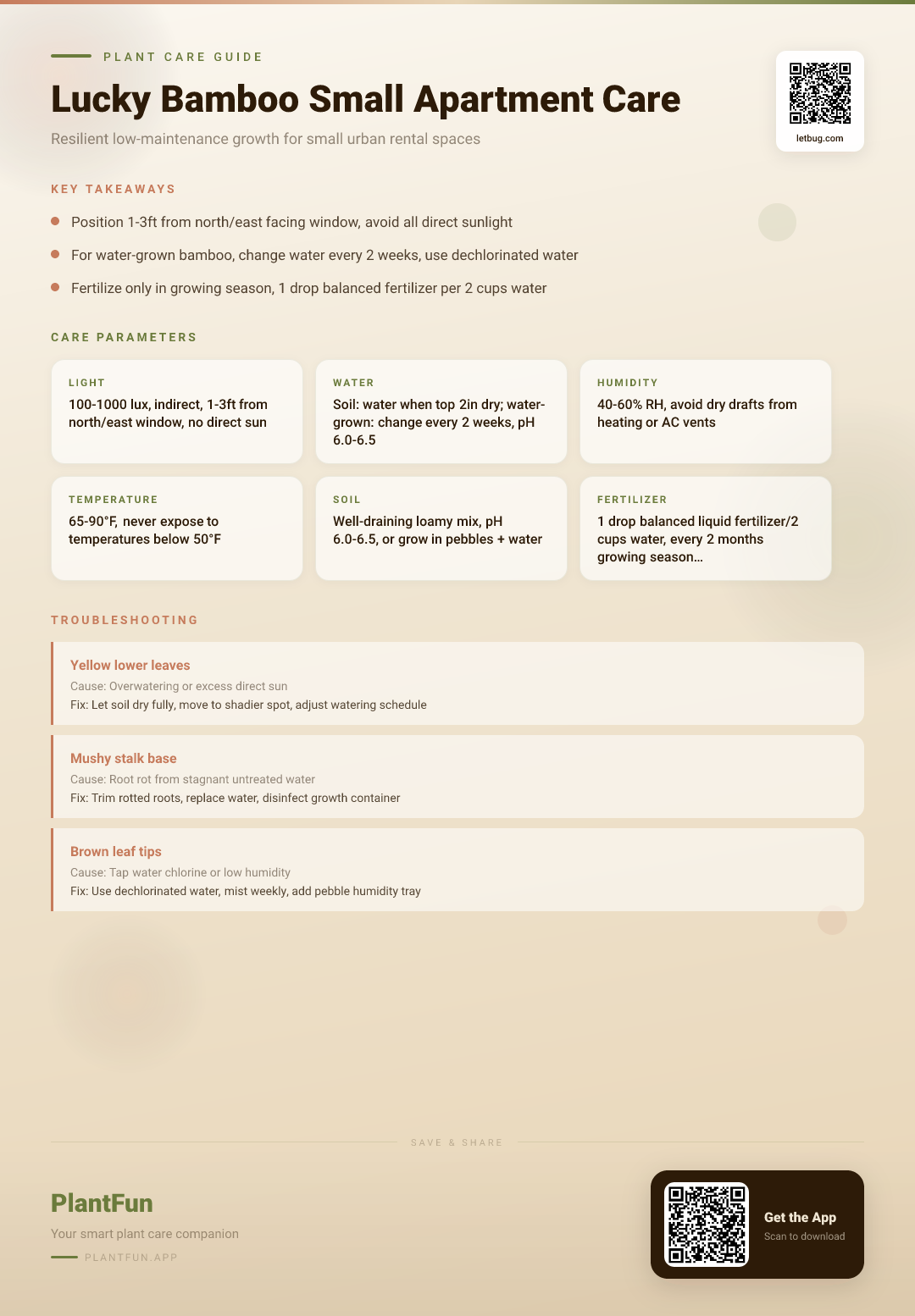
Key Takeaways
- Check soil moisture before watering — overwatering is the #1 killer of houseplants.
- Ensure your plant gets the right amount of light for its species.
- Be patient with recovery — most plants need 2–4 weeks to bounce back.
Quick Care Card
| Parameter | Measurable Threshold for Small Apartments |
|---|---|
| Light | 1000-2500 lux, bright indirect, no direct sun; 1-3ft from north/east facing window (NC State Extension, 2026) |
| Water (water-grown) | Dechlorinated tap water, pH 6.0-6.5; change every 2-4 weeks only as needed |
| Water (soil-grown) | Water only when top 2 inches of soil are completely dry |
| Humidity | 40-60% |
| Temperature | 65-85°F (18-29°C), no direct HVAC drafts |
| Fertilizer | 1 drop balanced 10-10-10 liquid fertilizer per 2 cups of water, once every 2 months only March-October (Plant Archives, 2025) |
| Toxicity | Non-toxic to humans, toxic to cats and dogs (ASPCA, 2026) |
Intro: Why Lucky Bamboo Is Perfect (and Perfectly Prone to Struggles) in Small Urban Apartments
Lucky bamboo (Dracaena sanderiana) is a staple for beginner apartment plant owners thanks to its reputation for hardiness, compact size, and low-fuss care needs. But for renters in 500-700 sqft urban units, unique stressors like low natural light, forced air HVAC, tap water high in chlorine, and limited counter space often lead to common issues like yellowing leaves, mushy stalks, and stunted growth. This lucky bamboo apartment care checklist is calibrated exclusively for these conditions, with 2-minute or less fixes, no fancy grow lights or humidifiers required, and a symptom-first framework to solve problems before they kill your plant.
Symptom-to-Action Quick Reference Table
| Visible Symptom | Root Cause | 1-Minute Fix |
|---|---|---|
| Yellow lower leaves | Overwatering or early root rot | Pour out all excess standing water, trim any soft brown roots with sterile shears, replace with fresh dechlorinated water if water-grown |
| Mushy stalk base | Bacterial overgrowth from stagnant water | Cut off the mushy portion 1 inch above the rot with sterile shears, reroot the healthy green stalk in fresh dechlorinated water |
| Brown leaf tips | Chlorine/fluoride in tap water or low humidity | Mist leaves with aged tap water, move the plant at least 2ft away from nearby HVAC vents |
| Stunted growth | Insufficient light or under-fertilization | Move the plant 1ft closer to a north/east facing window; add 1 drop of liquid fertilizer to water if it is growing season (March-October) |
Core Care Rule 1: Light Placement for Apartment Spaces
Lucky Bamboo light requirements indoors sit at 1000-2500 lux of bright indirect light, with zero exposure to direct midday sun (NC State Extension, 2026). For most small apartments, the ideal spot is 1-3ft back from a north or east facing window, where it gets gentle morning light but no harsh afternoon rays. For windowless apartments, Lucky Bamboo in low light apartments thrives placed 1ft below a standard 3000-5000K overhead LED ceiling light, left on for 8 hours per day, no special grow light needed.
Core Care Rule 2: Watering for Tap Water and Fluctuating Humidity
A common myth we’re busting first: you do not need to do weekly full water changes for water-grown lucky bamboo. Research from a 2024 coliform study of lucky bamboo growing mediums shows that frequent water changes disrupt beneficial microbial colonies, and only need to be done when water becomes cloudy, or on a set schedule aligned with your apartment’s humidity (P. & D., 2024).
For water-grown plants: Leave tap water out in an open container for 24 hours before use to let chlorine evaporate, maintaining a pH of 6.0-6.5. For soil-grown plants: Do the 2-inch finger test: stick your index finger 2 inches into the soil, only water if it is completely dry. This answers the most common question for beginners: how often to water lucky bamboo depends entirely on your apartment’s temperature and humidity, not a rigid weekly schedule.
Core Care Rule 3: Temperature and Humidity Calibration for HVAC-Heated/Cooled Apartments
Lucky bamboo grows best in a 65-85°F (18-29°C) temperature range, and lucky bamboo humidity requirements are 40-60% (NC State Extension, 2026). Most urban apartments fall outside this range when HVAC is running, but you don’t need a humidifier to fix it, try these 3 no-cost hacks:
- Place your lucky bamboo pot on a tray filled with pebbles and water, making sure the base of the pot never sits directly in standing water
- Group it with other houseplants to take advantage of the shared transpirational humidity they release
- Mist the leaves once per week with aged tap water on days you run your heater or AC
Core Care Rule 4: Fertilizing for Resilient Stalk Growth
Overfertilization is one of the top causes of Lucky Bamboo yellow stalks, so we use a strict, measured dosing schedule to avoid burn. Add exactly 1 drop of balanced 10-10-10 liquid fertilizer per 2 cups of water, once every 2 months only during the March-October growing season (Plant Archives, 2025). Skip fertilization entirely in fall and winter, when growth slows. This measured dose is exactly enough to boost growth for anyone wondering how to make lucky bamboo grow faster, without risking overfertilization damage.
Seasonal Care Calendar for Apartment Dwellers
Adjust your care routine with these monthly prompts tailored to apartment conditions:
- Spring (March-May): Add your first annual fertilizer drop, move the plant 1ft closer to your window if you kept it further away during dark winter months
- Summer (June-August): Lucky Bamboo summer watering calls for checking soil moisture 1 extra time per week, and changing water every 2 weeks if humidity is below 40% from AC use. Keep the plant 3ft away from all AC vents
- Fall (September-November): Stop fertilizing entirely, reduce watering frequency for soil-grown plants by 50% as growth slows
- Winter (December-February): Lucky Bamboo winter care requires keeping the plant 3ft away from heating vents, misting leaves twice per week to counteract dry forced air, and only changing water if it becomes cloudy
5 Common Apartment Care Mistakes That Kill Lucky Bamboo Fast
- Mistake: Placing your plant directly next to heating or AC vents What happens: Constant dry air drafts cause rapid leaf moisture loss, leading to widespread Lucky Bamboo yellow leaves and brown tips Instead: Keep all lucky bamboo at least 2ft away from any HVAC outlet
- Mistake: Fertilizing more than once every 2 months, or using more than the 1 drop per 2 cups dose What happens: Excess mineral buildup in soil or water burns root tissue, leading to stunted growth and yellow mushy stalks Instead: Set a recurring phone reminder for fertilizing every 2 months during growing season only, and stick to the measured dose
- Mistake: Using straight tap water straight from the faucet without aging it first What happens: Chlorine and fluoride in municipal tap water damage leaf cell tissue, causing permanent brown tip discoloration Instead: Fill a jug with tap water and leave it open on your counter for 24 hours before using it for your plant
- Mistake: Leaving water-grown lucky bamboo in the same stagnant water for 6+ weeks What happens: Bacterial and fungal overgrowth in stagnant water causes root rot and mushy stalk base decay (P. & D., 2024) Instead: Follow the humidity-aligned water change schedule, or change water immediately if it becomes cloudy
- Mistake: Placing your plant in direct midday sun from a south or west facing window What happens: Direct sun exceeding 3000 lux scorches leaf tissue, leading to bleached yellow leaves and permanent damage Instead: Keep plants in bright indirect light only, or hang a sheer curtain over south/west windows if you want to place your plant on the sill
FAQ: Why is my lucky bamboo turning yellow in my apartment?
The top 3 causes of yellowing lucky bamboo in apartments are, in order:
- Too much direct sun: Move the plant to a spot 1-3ft back from a north or east facing window, away from direct rays
- Unconditioned tap water: Drain all existing water, replace with aged dechlorinated water, and trim off any fully yellow leaves
- Overfertilization: Flush the growing medium (soil or water) with 3x the volume of fresh aged water to remove excess mineral buildup, and skip fertilizing for 6 months
FAQ: Can I keep lucky bamboo on my apartment windowsill?
It depends on your window orientation:
- North or east facing windowsill: Yes, as long as the plant is not touching the cold glass, and gets no direct midday sun
- South or west facing windowsill: Only if you hang a sheer curtain over the window to filter out harsh midday rays, which exceed the 2500 lux maximum threshold for lucky bamboo (NC State Extension, 2026). Unfiltered south/west midday sun will burn leaves in less than 2 hours
FAQ: How often do I need to change my lucky bamboo’s water?
Your water change frequency is aligned directly with your apartment’s humidity level, no rigid weekly schedule needed:
- <40% humidity (winter when heating is running, summer when AC is running): Every 2 weeks
- 40-60% humidity (spring and fall mild weather): Every 3 weeks
-
60% humidity (summer rainy season): Every 4 weeks This is one of the easiest ways to cut down on maintenance time for busy renters, skipping the unnecessary weekly water changes promoted in generic care guides.
Final Quick Tip for Renters: No-drill display ideas for small apartment spaces that keep your lucky bamboo in ideal light without taking up counter space
Short on counter space? Try these renter-friendly display hacks that require zero drilling or permanent modification:
- Use an adhesive wall shelf installed 1-3ft from your north/east facing window, to hold your lucky bamboo at eye level without taking up surface space
- Hang a macramé plant holder from an over-the-door hook on your bedroom or bathroom door, which fits between the door and frame with zero damage
- Tuck a tiered rolling cart next to your couch or fridge, and place your lucky bamboo on the top shelf where it gets consistent bright indirect light
References
- ASPCA. (2026). Toxic and Non-Toxic Plants List — ASPCA. https://www.aspca.org/pet-care/animal-poison-control/toxic-and-non-toxic-plants. Accessed 2026-02-26.
- NC State Extension. (2026). Lucky Bamboo — NC State Extension Gardener Plant Toolbox. https://plants.ces.ncsu.edu/plants/bamboo-care/. Accessed 2026-02-26.
- P., -. & D., -. (2024). Exploring The Potential of Lucky Bamboo Plant : A Coliform Perspective. International Journal For Multidisciplinary Research. https://doi.org/10.36948/ijfmr.2024.v06i03.22635. Accessed 2026-02-26.
- Plant Archives. (2025). IDENTIFICATION, ISOLATION, SCREENING OF SUITABLE MEDIUM AND TEMPERATURE AND IN VITRO MANAGEMENT OF ANTHRACNOSECAUSING PATHOGEN OF LUCKY BAMBOO GROWN IN WEST BENGAL INDIA. Plant Archives. https://doi.org/10.51470/plantarchives.2025.v25.no.1.408. Accessed 2026-02-26.
Optional Helper: Plantfun.App
Plantfun.App identifies your plants by photo, diagnoses pests and diseases with clear fixes, and creates personalised watering and light schedules that adapt to your home conditions — a handy companion for putting this guide into daily practice.
Found an error or have suggestions? We'd love your feedback.
Need help identifying this problem?
Get instant identification, personalized care schedules, and effective pest treatment plans directly on your phone.
Sponsored • We may earn a commission from app downloads
Related Guides
The Complete Lucky Bamboo Care Checklist for Resilient Growth in Small Urban Apartments
Grow lush, resilient Lucky Bamboo in your urban apartment with our seasonal care checklist, exact light/water thresholds, and easy fixes for common issues like yellow leaves. Stop guessing and get consistent, long-term growth.
Care GuideThe Complete Lucky Bamboo Care Checklist for Resilient Growth in Low-Light Apartments
Stop watching your lucky bamboo turn yellow in your apartment. Get an actionable checklist with exact light, water, and humidity thresholds that keep your plant lush and resilient for years.
Care GuideLucky Bamboo in Standard City Apartments: The Only Care Checklist You’ll Ever Need
Grow thick, vibrant lucky bamboo even in tiny, low-light city apartments. Get exact light, water, humidity thresholds, a printable checklist, and fast fixes for yellow leaves or stunted growth.
Pest ControlAnts on Plants: What They Mean and What to Do
Ants usually aren't eating your plant. They are farming other pests.