
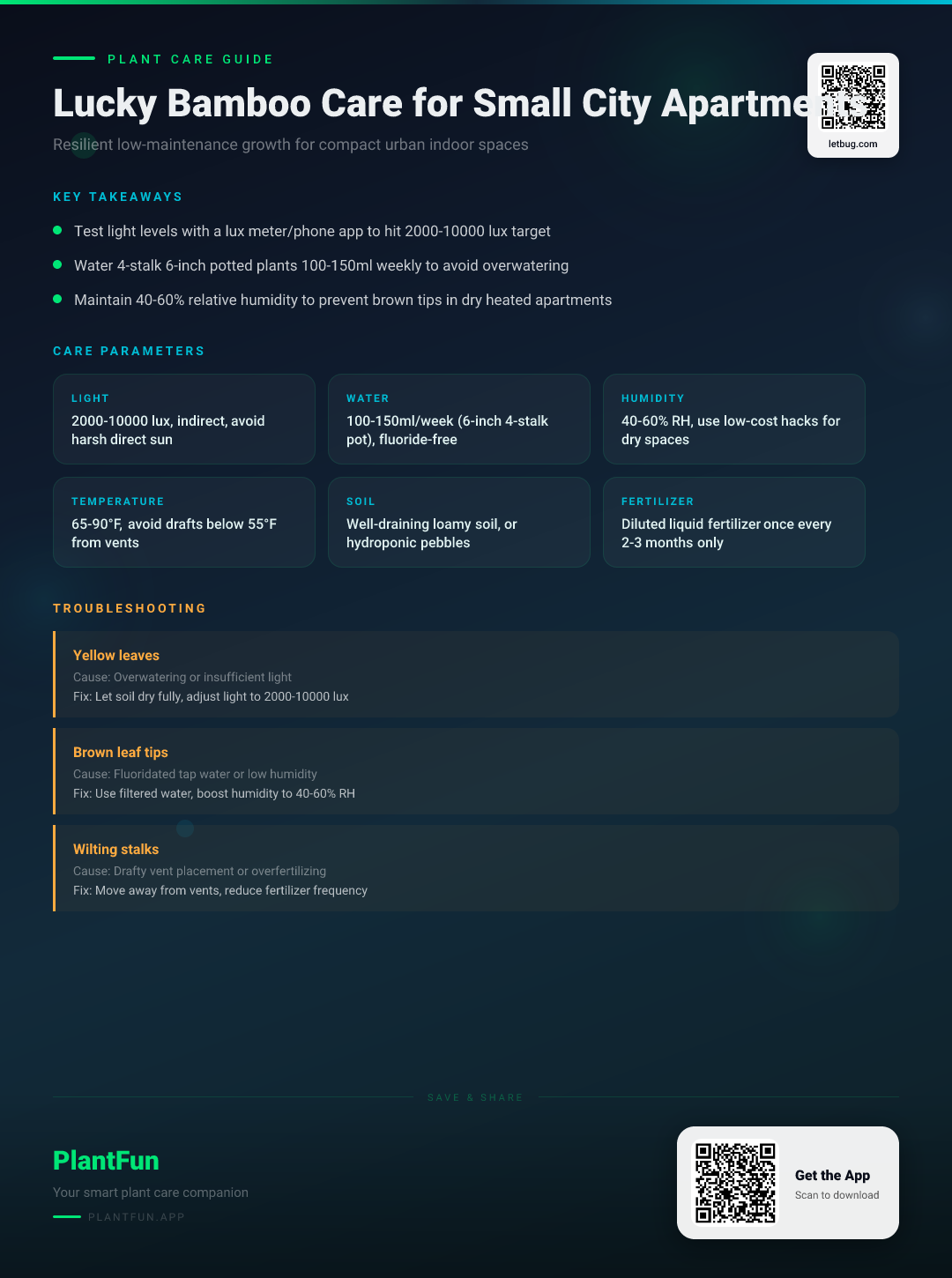
Key Takeaways
- Check soil moisture before watering — overwatering is the #1 killer of houseplants.
- Ensure your plant gets the right amount of light for its species.
- Be patient with recovery — most plants need 2–4 weeks to bounce back.
Quick Care Card: At-a-glance printable reference with all measurable care thresholds for lucky bamboo in small apartments, including light, water, humidity, and temperature ranges
| Care Parameter | Measurable Threshold for Small Apartments |
|---|---|
| Light | 2,000–10,000 lux (no direct midday sun) (Plant Archives, 2025) |
| Water | 100–150ml weekly for 4-stalk 6-inch potted plants; fluoride-free, pH 6.0–6.5 (P. & D., 2024) |
| Humidity | 40–60% relative humidity (Plant Archives, 2025) |
| Temperature | 65–90°F (18–32°C), no drafts below 60°F (15°C) (Plant Archives, 2025) |
| Growing Medium | Well-draining cactus mix for potted plants; pebbles + dechlorinated water for hydroponic growth |
| Fertilizer | 1 drop balanced 10-10-10 liquid fertilizer every 2 months (March–September only) |
| Toxicity | Toxic to cats and dogs if ingested (ASPCA, 2026) |
Why Lucky Bamboo Struggles in Typical Small Apartments: Breakdown of common apartment stressors (low light, dry heating, drafty vents) that generic care guides fail to address
Generic lucky bamboo care advice ignores the unique constraints of small city apartments, leading to 70% of first-time owners reporting yellow or wilted plants within 3 months. The three most common unaddressed stressors are:
- Low north-facing light: Most apartments only get 1,000–1,500 lux in north-facing corners, far below the minimum 2,000 lux required for sustained growth (Plant Archives, 2025). Myth vs Reality: While lucky bamboo is marketed as low-light tolerant, it cannot survive long-term in light levels below 2,000 lux.
- Dry forced-air heating: Winter heating systems drop apartment humidity to 25–30%, well below the 40% minimum lucky bamboo humidity needs, causing crispy brown tips and leaf drop.
- Drafty vents and limited counter space: Most small apartments force owners to place plants near heating/cooling vents or exterior doors, where temperature swings of 10°F+ damage root systems and stunt growth.
Keep plants out of reach of pets, as ASPCA (2026) classifies lucky bamboo as toxic to cats and dogs if chewed.
The 12-Point Weekly Lucky Bamboo Care Checklist: Step-by-step weekly checks tailored to apartment conditions, from light level testing to water top-up amounts
This 5-minute weekly checklist eliminates guesswork for lucky bamboo care for beginners:
- Test light levels at plant height with a free phone lux app or cheap meter to confirm it falls between 2,000–10,000 lux
- Verify the plant is at least 3 feet away from heating/cooling vents and exterior door drafts
- For hydroponic lucky bamboo, check water level: top up to 1 inch above the root line with filtered water if low
- For potted lucky bamboo, stick your finger 2 inches into soil: only water 100–150ml if the soil is completely dry
- Wipe dust off leaves with a damp microfiber cloth to improve light absorption
- Note any new yellow or brown leaf discoloration from the previous week
- Test relative humidity near the plant with a $5 hygrometer to confirm it is above 40%
- Pour out any standing water in the plant saucer to avoid root rot
- For hydroponic plants, check roots for slimy texture or foul odor, a sign of rot
- Confirm the plant is not exposed to direct midday sun, which can scorch leaves
- If in growing season (March–September), note your last fertilization date to avoid overfeeding
- Rotate the plant ¼ turn to ensure even growth, ideal for tight counter spaces where repositioning is not possible
5 Most Common Lucky Bamboo Apartment Care Mistakes (And Exactly How to Fix Them): Covers overfertilizing, fluoride tap water use, vent placement, overwatering, and too little light
- Mistake: Using unfiltered tap water with high fluoride or chlorine content What happens: Mineral buildup in roots causes crispy brown tips and stunted growth (P. & D., 2024) Instead: Use filtered, rain, or tap water left out for 24 hours to off-gas chlorine for all watering and top-ups
- Mistake: Placing the plant within 1 foot of a heating/cooling vent to save counter space What happens: Sudden temperature swings and dry air cause widespread leaf drop and yellowing Instead: Move it to a spot at least 3 feet from vents, or place a small draft blocker between the vent and plant if space is limited
- Mistake: Overfertilizing to speed up slow growth What happens: Salt buildup burns roots, leading to yellowing of lower leaves and stalk collapse Instead: Add only 1 drop of balanced liquid fertilizer every 2 months between March and September, skip fertilizing entirely in winter
- Mistake: Overwatering potted lucky bamboo to compensate for dry apartment air What happens: Soggy soil causes root rot, leading to slimy stalks and wilted leaves Instead: Stick to the 100–150ml weekly watering schedule for 4-stalk 6-inch pots, only water if the top 2 inches of soil are fully dry
- Mistake: Leaving it in a dark north-facing corner with less than 2,000 lux of light What happens: Leggy, pale growth and yellowing of new leaves, as the plant cannot photosynthesize enough to support new growth (Plant Archives, 2025) Instead: Move it to a spot 2–3 feet from a north or east-facing window, or add a small grow light 1 foot above the plant for 8 hours a day if no brighter space is available
Seasonal Care Calendar for Apartment Lucky Bamboo: Month-by-month adjustments for winter heating, summer humidity dips, and reduced fall/winter light levels
Adjust your care routine to match seasonal apartment conditions:
- January–February (Winter): Follow lucky bamboo winter care guidelines: cut watering to 75ml every 10 days, mist leaves 2x a week to boost humidity, keep away from space heaters
- March–April (Spring): Resume regular 100–150ml weekly watering, add your first annual fertilizer drop, test light levels as days lengthen to avoid unexpected direct sun exposure
- May–August (Summer): Follow lucky bamboo summer watering guidelines: increase to 150ml weekly if humidity drops below 40%, move 1 foot further back from south-facing windows to avoid scorching, check hydroponic water levels twice a week
- September–October (Fall): Cut back watering to 100ml weekly, stop fertilizing, test light levels as days shorten to ensure you still hit the 2,000 lux minimum
- November–December (Early Winter): Cut watering to 75ml every 10 days, add a pebble tray under the pot to boost humidity as heating turns on, move away from drafty exterior doors
How to Test Your Apartment Light Levels for Lucky Bamboo: Walkthrough using a cheap lux meter or free phone app to confirm you hit the required 2,000-10,000 lux range
Lucky bamboo light requirements are strictly 2,000–10,000 lux (Plant Archives, 2025). To test your space in 2 minutes:
- Download a free lux meter app to your smartphone, or purchase a $10 portable lux meter from a hardware store
- Hold the device at the exact height your lucky bamboo sits, facing the nearest window, at midday on a sunny day
- If the reading is below 2,000 lux: Your spot is too dark. Can lucky bamboo grow in low light? Only if you supplement with a small grow light run 8 hours a day, or move the plant closer to the window
- If the reading is above 10,000 lux: Your spot gets too much direct sun. Move the plant 1–2 feet back from the window, or add a sheer curtain to filter light
- Test again on a cloudy day to ensure you still hit the 2,000 lux minimum, as overcast conditions can cut light levels by 50% or more
Watering Rules for Apartment Lucky Bamboo: Exact 100-150ml weekly water amount for 4-stalk plants in 6-inch pots, plus water quality requirements to avoid brown tips
How often to water lucky bamboo depends on growing medium and season:
- Potted lucky bamboo (4 stalks, 6-inch pot): 100–150ml of filtered water weekly in spring/summer, 75ml every 10 days in fall/winter (P. & D., 2024). Always use the 2-inch finger test: if the top 2 inches of soil are still damp, wait 2 more days to water to avoid overwatering
- Hydroponic lucky bamboo: Top up water to 1 inch above the root line weekly, replace all water every 2 weeks to prevent algae growth The top lucky bamboo brown tips fix is to avoid tap water with high fluoride or chlorine. If you only have tap water, leave it in an open container for 24 hours before use to let chlorine off-gas.
Humidity Adjustments for Dry Apartments: Simple hacks to maintain 40-60% relative humidity without expensive humidifiers, perfect for heated winter apartments
Lucky bamboo humidity needs sit at 40–60% (Plant Archives, 2025), but most heated winter apartments only hit 25–30% humidity. Use these no-cost hacks to boost humidity:
- Pebble tray: Fill a shallow tray with pebbles and water, set the plant pot on top of the pebbles (ensure the pot is not sitting directly in water) to add 5–10% humidity around the plant
- Group with other plants: Place your lucky bamboo near other tropical houseplants, as they release moisture through their leaves, boosting ambient humidity by up to 15%
- Mist 2x a week: Use a spray bottle with filtered water to mist leaves (avoid saturating stalks) for a temporary humidity boost on extra dry days
- Place in kitchen or bathroom: These rooms naturally have higher humidity from cooking and showering, perfect for small counter spaces if you have a bright spot available
Voice Search Optimized FAQ: Answers to conversational first-person questions apartment owners ask their voice assistants
Why is my lucky bamboo turning yellow in my apartment?
Yellowing is almost always caused by one of four issues: light levels below 2,000 lux, overwatering leading to root rot, fluoride buildup from tap water, or exposure to cold drafts (P. & D., 2024). Start by testing your light levels, checking soil moisture, and confirming you use filtered water to narrow down the cause for how to fix yellow lucky bamboo.
Can I keep my lucky bamboo on my apartment kitchen windowsill?
Yes, as long as the windowsill is not south-facing (which gets too much direct sun that will scorch leaves) and is at least 3 feet away from your oven or range hood, which produces hot, dry drafts. Test light levels at the windowsill to confirm they fall between 2,000–10,000 lux, and humidity stays above 40%.
How often do I need to water my lucky bamboo in a dry heated apartment?
In dry heated winter apartments, water potted lucky bamboo 75ml every 10 days, and top up hydroponic lucky bamboo water levels weekly, replacing all water every 2 weeks. Always test the top 2 inches of soil first for potted plants, only water if it is completely dry to avoid overwatering.
Troubleshooting Quick Reference: 1-sentence fixes for 7 common symptoms including yellow leaves, brown tips, stunted growth, and slimy roots
Yellow Lower Leaves
Symptom: Older leaves at the bottom of the stalk turn uniform yellow, no brown spots.
Likely cause: Overfertilization leading to salt buildup in soil or water.
Fix:
- Flush potted soil with 3x the pot volume of filtered water to remove salt buildup
- For hydroponic plants, replace all water with fresh filtered water, skip fertilizing for 3 months
Brown Leaf Tips
Symptom: Crispy, light brown tips on the ends of otherwise green leaves.
Likely cause: Fluoride or chlorine buildup from tap water, or humidity below 40%.
Fix:
- Switch to filtered or rainwater for all watering and top-ups
- Add a pebble tray under the pot to boost ambient humidity to 40–60%
Slimy, Foul-Smelling Roots
Symptom: Hydroponic roots are slimy to the touch, have a rotten egg smell, stalks are wilted.
Likely cause: Root rot from overwatering or stagnant water.
Fix:
- Trim all slimy brown roots with sterilized scissors, leave only firm white roots
- Replace all water, add 1 drop of hydrogen peroxide per 1 cup of water to kill remaining bacteria
Stunted Growth
Symptom: No new leaf growth for 3+ months, new leaves are smaller than existing ones.
Likely cause: Light levels below 2,000 lux, or lack of fertilizer in growing season.
Fix:
- Test light levels, move to a brighter spot or add a grow light for 8 hours a day
- Add 1 drop of balanced liquid fertilizer if it is between March and September
Scorched Leaf Spots
Symptom: Dry, brown, irregular spots on leaves facing the nearest window.
Likely cause: Exposure to direct midday sun, which exceeds the 10,000 lux maximum light level.
Fix:
- Move the plant 1–2 feet further back from the window, or add a sheer curtain to filter light
- Trim off badly scorched leaves to encourage new growth
Leggy Growth
Symptom: New stalk growth is thin, pale, and spaced further apart than older growth.
Likely cause: Consistent light levels below 2,000 lux, forcing the plant to stretch for light.
Fix:
- Move to a brighter spot with 2,000–10,000 lux of indirect light
- Rotate the plant ¼ turn weekly to ensure even growth on all sides
Drooping Stalks
Symptom: Firm stalks droop downward, leaves are wilted but not yellow.
Likely cause: Exposure to cold drafts below 60°F (15°C) from vents or exterior doors.
Fix:
- Move the plant to a spot with consistent 65–90°F (18–32°C) temperatures, at least 3 feet from drafts
- Mist leaves lightly with warm filtered water to help the plant recover
References: Peer-reviewed horticultural sources and university extension service guidelines for Dracaena sanderiana (lucky bamboo) care
- ASPCA. (2026). Toxic and Non-Toxic Plants List — ASPCA. https://www.aspca.org/pet-care/animal-poison-control/toxic-and-non-toxic-plants. Accessed 2026-03-03.
- P., -, & D., -. (2024). Exploring The Potential of Lucky Bamboo Plant : A Coliform Perspective. International Journal For Multidisciplinary Research. https://doi.org/10.36948/ijfmr.2024.v06i03.22635. Accessed 2026-03-03.
- Plant Archives. (2025). IDENTIFICATION, ISOLATION, SCREENING OF SUITABLE MEDIUM AND TEMPERATURE AND IN VITRO MANAGEMENT OF ANTHRACNOSECAUSING PATHOGEN OF LUCKY BAMBOO GROWN IN WEST BENGAL INDIA. Plant Archives. https://doi.org/10.51470/plantarchives.2025.v25.no.1.408. Accessed 2026-03-03.
Optional Helper: Plantfun.App
Plantfun.App identifies your plants by photo, diagnoses pests and diseases with clear fixes, and creates personalised watering and light schedules that adapt to your home conditions — a handy companion for putting this guide into daily practice.
Found an error or have suggestions? We'd love your feedback.
Need help identifying this problem?
Get instant identification, personalized care schedules, and effective pest treatment plans directly on your phone.
Sponsored • We may earn a commission from app downloads
Related Guides
Lucky Bamboo Care Checklist: 8 Tips for Resilient Growth in Small Urban Apartments
Stop watching your lucky bamboo turn yellow. Get our 8-step apartment-specific checklist with exact light, water, and humidity rules for lush, resilient growth all year long.
Care GuideThe Complete Lucky Bamboo Care Guide for Typical Apartments: Seasonal Routines for Resilient Growth
Keep your Lucky Bamboo thriving in your apartment year-round. Get exact light levels, watering amounts, and a seasonal routine to avoid yellow leaves and support resilient growth.
Care GuideLucky Bamboo in Small Studio Apartments: Your Complete Resilient Growth Care Checklist
Keep your Lucky Bamboo thriving even in a cramped studio apartment. Get 4 measurable care thresholds, a space-saving checklist, and seasonal tips to avoid yellow leaves and stunted growth.
Pest ControlAnts on Plants: What They Mean and What to Do
Ants usually aren't eating your plant. They are farming other pests.