
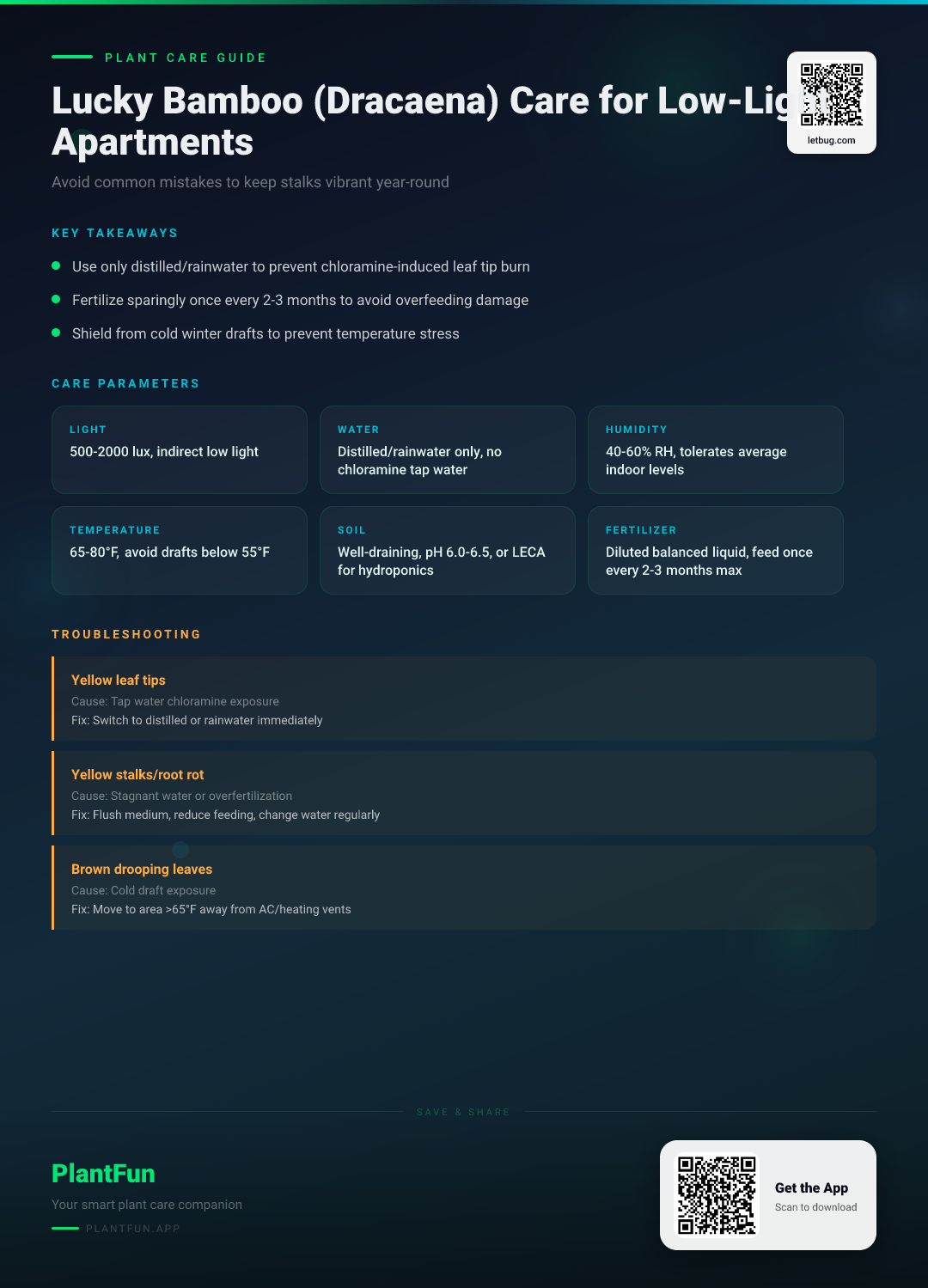
Key Takeaways
- Check soil moisture before watering — overwatering is the #1 killer of houseplants.
- Ensure your plant gets the right amount of light for its species.
- Be patient with recovery — most plants need 2–4 weeks to bounce back.
Quick Care Card: Essential Data
| Feature | Requirement |
|---|---|
| Light | 500–2,000 lux (Indirect, low to medium) |
| Water | Distilled, bottled, or rainwater (pH 6.0–6.5) |
| Humidity | 40–60% (Moderate) |
| Temperature | 65–80°F (18–27°C) |
| Substrate | Water, LECA, or well-draining potting mix |
| Fertilizer | Very dilute (1/10th strength) once every 6-8 weeks |
| Toxicity | Toxic to cats and dogs (ASPCA, 2026) |
TL;DR: The Reality of Indoor Lucky Bamboo Growth
Lucky Bamboo (Dracaena sanderiana) is often marketed as “indestructible,” but in my experience, it is highly sensitive to water quality and light levels. It thrives in ambient, indirect light and pure water. If your leaves are yellowing or stems are softening, you are likely dealing with chemical burn from tap water or anaerobic conditions in the vase. Keep it out of direct sun, use distilled water, and ensure the root system is aerated to keep it healthy long-term.
My Experience: The “Indestructible” Myth
When I first started my indoor garden, I bought a stalk of Lucky Bamboo and stuck it in a vase with tap water on my sunny windowsill. Within weeks, the stem turned mushy and the leaves scorched. I learned the hard way that Dracaena sanderiana is not a true bamboo, but a tropical plant that demands specific water purity and protection from intense light. I shifted my strategy to using only filtered water and moving the plant to a lower-light corner, which transformed my stalks from struggling stems to lush, green accents.
Why Your Apartment Isn’t Actually ‘Low Light’ (Understanding Phototropism)
Newer gardeners often confuse “low light” with “no light.” While Lucky Bamboo is shade-tolerant, it still requires 500–2,000 lux to maintain chlorophyll production (NC State Extension, 2026). If you place your plant in a windowless room, it will exhibit severe phototropism—stretching aggressively toward the nearest light source—which weakens the stalk. If you notice your plant leaning, rotate it weekly to ensure even growth.
Mistake 1: The Tap Water Trap (Why Chloramine Leads to Leaf Tip Burn)
Most tap water contains chlorine and chloramines, which accumulate in the plant’s tissues and cause brown, crispy leaf tips. This is why I exclusively use distilled water or captured rainwater. When the water chemistry is off, it can facilitate the growth of harmful pathogens that compromise the plant’s vascular system (Plant Archives, 2025).
Mistake 2: Stagnant Water and the Science of Root Aeration
Keeping bamboo in a vase of water is common, but stagnant water leads to oxygen depletion, causing roots to rot. According to recent findings, maintaining clean, oxygenated water is vital to prevent the buildup of coliforms and other bacteria (-, 2024). Change the water completely every 7–10 days and rinse the roots gently to remove any biofilm.
Mistake 3: Over-Fertilization Errors (Dosage and Frequency)
Lucky Bamboo is a slow grower. Many beginners make the mistake of adding fertilizer every time they change the water. I recommend using a high-quality, balanced liquid fertilizer at 1/10th of the recommended dosage, and only during the growing season (spring and summer).
Step-by-Step: Converting from Water to LECA or Soil for Longevity
If you want your bamboo to live for years, transitioning to a more stable medium is key:
- Clean: Remove the plant and wash the roots under cool, distilled water.
- Inspect: Trim away any mushy, slimy, or black roots using sterilized shears.
- Prepare: Use a container with drainage holes if using soil, or a net pot for LECA (Lightweight Expanded Clay Aggregate).
- Plant: For soil, use a peat-based mix with added perlite. If using LECA, fill the reservoir so that only the bottom 1 inch of the roots is submerged.
Troubleshooting: Why is my Lucky Bamboo turning yellow?
Yellowing Leaves
Symptom: Leaves turn yellow from the tips inward.
Likely cause: Chemical buildup from tap water or too much direct sunlight.
Fix:
- Switch immediately to distilled water.
- Move the plant to a spot with bright, indirect light.
Soft or Mushy Stem
Symptom: The base of the stalk feels squishy to the touch.
Likely cause: Severe root rot or bacterial infection.
Fix:
- Remove the plant and discard any rotted parts.
- If the rot has reached the stalk, the plant may not be salvageable.
Brown Leaf Tips
Symptom: Crisp, brown edges on the leaves.
Likely cause: Low humidity or salt accumulation.
Fix:
- Increase ambient humidity with a pebble tray.
- Ensure the plant is not near a heating or cooling vent.
FAQ: Can I keep my Lucky Bamboo in a windowless bathroom?
While it can survive there temporarily, it will eventually decline without a light source. If your bathroom has no windows, consider adding a small LED grow light on a 12-hour timer.
FAQ: How do I know if my Lucky Bamboo roots are rotting?
Healthy roots should be firm and pale (white or light red). If they look brown, slimy, or smell foul, they are rotting. Act quickly to trim the dead tissue and refresh the water.
Seasonal Care Calendar: Adjusting for Winter Heating and Drafts
- Spring/Summer: Growth phase. Increase light slightly and fertilize once every 6 weeks.
- Autumn/Winter: Dormancy. Keep the plant away from cold drafts or forced-air heaters, which dry out the foliage. Reduce all fertilizing.
References
- ASPCA. (2026). Toxic and Non-Toxic Plants List — ASPCA. https://www.aspca.org/pet-care/animal-poison-control/toxic-and-non-toxic-plants. Accessed 2026-03-18.
- -, P.; -, D. (2024). Exploring The Potential of Lucky Bamboo Plant : A Coliform Perspective. International Journal For Multidisciplinary Research. https://doi.org/10.36948/ijfmr.2024.v06i03.22635. Accessed 2026-03-18.
- Plant Archives. (2025). IDENTIFICATION, ISOLATION, SCREENING OF SUITABLE MEDIUM AND TEMPERATURE AND IN VITRO MANAGEMENT OF ANTHRACNOSECAUSING PATHOGEN OF LUCKY BAMBOO GROWN IN WEST BENGAL INDIA. Plant Archives. https://doi.org/10.51470/plantarchives.2025.v25.no.1.408. Accessed 2026-03-18.
- NC State Extension. (2026). Lucky Bamboo — NC State Extension Gardener Plant Toolbox. https://plants.ces.ncsu.edu/plants/bamboo-care/. Accessed 2026-03-18.
Optional Helper: Plantfun.App
Plantfun.App identifies your plants by photo, diagnoses pests and diseases with clear fixes, and creates personalised watering and light schedules that adapt to your home conditions — a handy companion for putting this guide into daily practice.
Found an error or have suggestions? We'd love your feedback.
Need help identifying this problem?
Get instant identification, personalized care schedules, and effective pest treatment plans directly on your phone.
Sponsored • We may earn a commission from app downloads
Related Guides
Lucky Bamboo in Small Urban Apartments: The Only Resilient Growth Checklist You Need
Stop watching your lucky bamboo turn yellow in your small urban apartment. Grab our science-backed checklist with exact light, water, and humidity thresholds for lush, resilient growth all year.
Care GuideThe Complete Lucky Bamboo Care Checklist for Resilient Growth in Low-Light Apartments
Stop watching your lucky bamboo turn yellow in your apartment. Get an actionable checklist with exact light, water, and humidity thresholds that keep your plant lush and resilient for years.
Care GuideLucky Bamboo in Standard City Apartments: The Only Care Checklist You’ll Ever Need
Grow thick, vibrant lucky bamboo even in tiny, low-light city apartments. Get exact light, water, humidity thresholds, a printable checklist, and fast fixes for yellow leaves or stunted growth.
Pest ControlAnts on Plants: What They Mean and What to Do
Ants usually aren't eating your plant. They are farming other pests.