
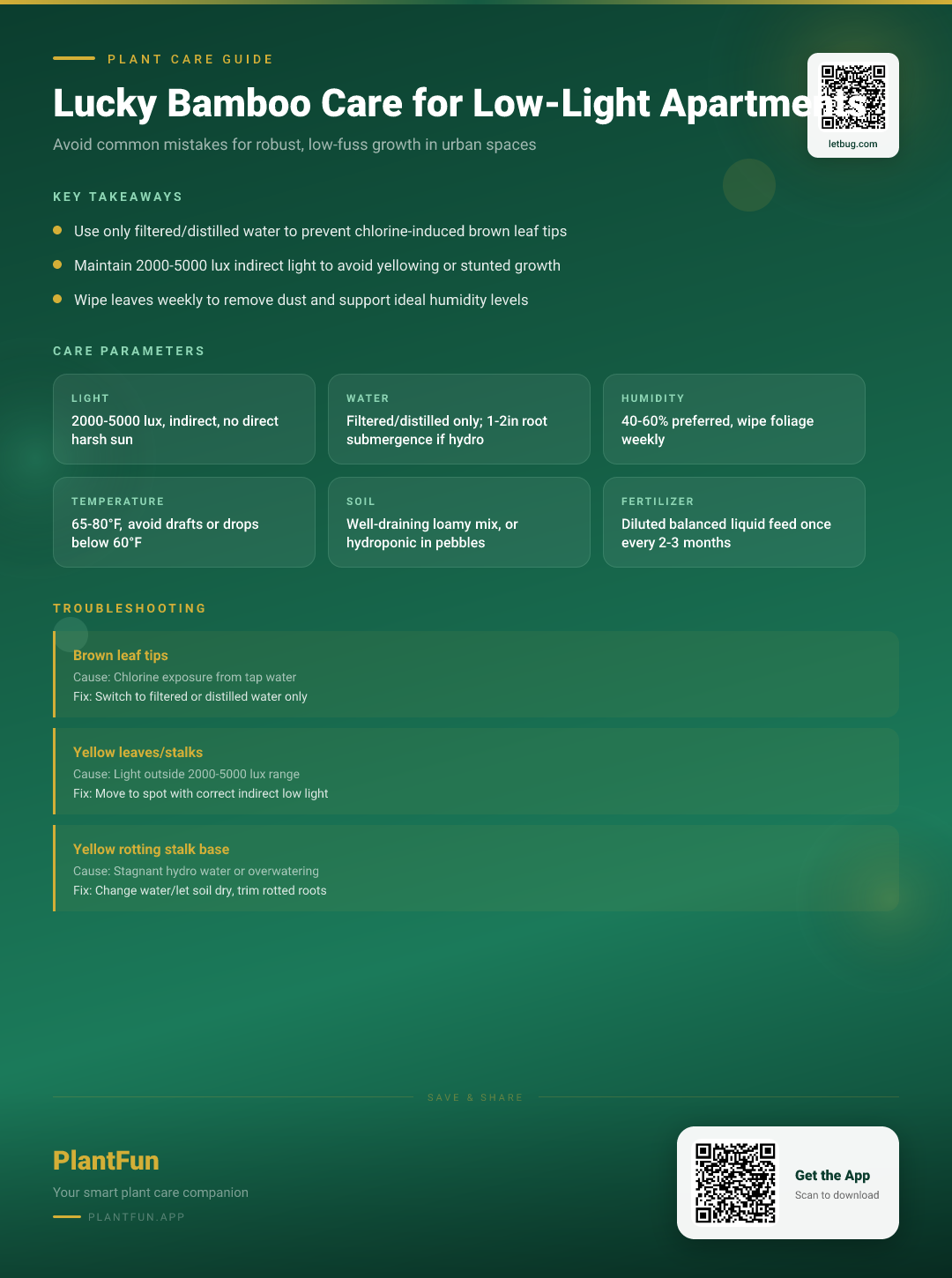
Key Takeaways
- Check soil moisture before watering — overwatering is the #1 killer of houseplants.
- Ensure your plant gets the right amount of light for its species.
- Be patient with recovery — most plants need 2–4 weeks to bounce back.
Quick Care Card: Essential Thresholds for Apartment Growth
| Feature | Requirement |
|---|---|
| Light | 2,000–5,000 Lux (Bright, indirect) |
| Water | Filtered/Distilled (Change weekly) |
| Temperature | 65°F – 80°F (18°C – 27°C) |
| Humidity | 40% – 60% |
| Medium | Water or Well-draining potting mix |
| Fertilizer | Extremely diluted (1/10th strength) once per month |
| Toxicity | Toxic to cats and dogs (ASPCA, 2026) |
TL;DR: Why Your Lucky Bamboo is Struggling in Your Apartment
If your Lucky Bamboo (Dracaena sanderiana) is yellowing, it is likely signaling a stress response to water impurities, stagnant conditions, or insufficient light. Most apartment dwellers struggle because they treat this plant as a set-and-forget piece of decor rather than a living organism requiring specific chemical and environmental balances. By switching to filtered water, ensuring consistent light levels, and maintaining airflow, you can reverse most common decline patterns within four weeks.
Defining the Habitat: The Reality of Low-Light Living
When I first started keeping Lucky Bamboo in my studio apartment, I made the mistake of placing it in a dark corner, assuming it was “low-light tolerant.” I quickly learned that “tolerant” does not mean “thriving.” In my experience, these plants utilize light to manage their internal metabolic processes, and without meeting the 2,000 lux threshold, the plant begins to cannibalize its own energy reserves, leading to yellowing stalks.
Mistake #1: Using Tap Water (And Why Chlorine Causes Brown Tips)
Many owners assume tap water is fine. However, chemicals like chlorine and chloramine—common in municipal systems—can accumulate in the plant’s tissues, causing tip necrosis (brown tips).
- The Fix: Always use filtered, distilled, or rainwater. If you must use tap, let it sit out for 24 hours to allow chlorine to dissipate. Note that mineral accumulation can lead to coliform issues if water isn’t managed correctly (-, 2024).
Mistake #2: The ‘Glass Vase’ Trap: Balancing Water vs. Soil
Growing in water looks clean, but it requires vigilance. If the water level is too high and covers the stalk, the submerged part can rot.
- The Fix: Keep water levels exactly at 1–2 inches above the roots. If you choose soil, use a porous, well-draining cactus mix to prevent the fungal pathogens that cause root rot (Plant Archives, 2025).
Mistake #3: Neglecting Light Requirements: 2,000–5,000 Lux Defined
Low-light does not mean no light. Your plant needs to be within 3–5 feet of a window. If the plant looks stretched (etiolated), it is begging for more photons.
Mistake #4: Temperature Fluctuations: Keeping it Between 65-80°F
Apartments with drafty windows or high-heat radiators create stress. If your plant is near a vent, it will experience rapid transpiration, leading to wilt. Keep it stable between 65-80°F.
Mistake #5: Humidity & Dust: Why Your Plant Needs a Weekly Wipe
Dusty leaves cannot photosynthesize efficiently. Wipe them with a damp cloth weekly to ensure the stomata—tiny pores—are clear for gas exchange.
Can I keep my Lucky Bamboo in a windowless bathroom?
No. While they handle humidity well, they still require photosynthetically active radiation. A windowless bathroom will inevitably lead to systemic yellowing.
Why is my Lucky Bamboo stalk turning yellow at the base?
Symptom: The base feels mushy or turns yellow.
Likely cause: Root rot due to waterlogged conditions or fungal pathogens (Plant Archives, 2025).
Fix:
- Remove from water.
- Trim away blackened, slimy roots with sterilized shears.
- Rinse the stalk and place in fresh, clean water.
How do I know if my Lucky Bamboo is getting enough water?
If the plant is in soil, stick your finger 2 inches down. If it feels like a wrung-out sponge, it is perfect. In water, check if the water is cloudy; cloudy water indicates bacteria and a need for a total change.
The Recovery Protocol: A 4-Week Step-by-Step Rescue Plan
- Week 1: Isolate the plant. Perform a full water change with distilled water and scrub the container with mild soap to remove biofilm.
- Week 2: Move to a brighter spot (near a north-facing window). Do not fertilize yet.
- Week 3: Inspect the roots. If they are white and firm, the plant is recovering. If they remain brown, remove the damaged parts.
- Week 4: Introduce a 1/10th strength liquid fertilizer only if new leaf growth is visible.
Seasonal Maintenance Calendar for Urban Growers
- Winter: Reduce water changes to every 10 days as evaporation slows (Lucky Bamboo winter care). Keep away from dry radiator heat.
- Spring/Summer: Increase light exposure and ensure water is changed weekly to prevent algae buildup.
References
- -, P.; -, D. (2024). Exploring The Potential of Lucky Bamboo Plant : A Coliform Perspective. https://doi.org/10.36948/ijfmr.2024.v06i03.22635. Accessed 2026-03-18.
- Plant Archives. (2025). IDENTIFICATION, ISOLATION, SCREENING OF SUITABLE MEDIUM AND TEMPERATURE AND IN VITRO MANAGEMENT OF ANTHRACNOSECAUSING PATHOGEN OF LUCKY BAMBOO GROWN IN WEST BENGAL INDIA. https://doi.org/10.51470/plantarchives.2025.v25.no.1.408. Accessed 2026-03-18.
- ASPCA. (2026). Toxic and Non-Toxic Plants List — ASPCA. https://www.aspca.org/pet-care/animal-poison-control/toxic-and-non-toxic-plants. Accessed 2026-03-18.
Optional Helper: Plantfun.App
Plantfun.App identifies your plants by photo, diagnoses pests and diseases with clear fixes, and creates personalised watering and light schedules that adapt to your home conditions — a handy companion for putting this guide into daily practice.
Found an error or have suggestions? We'd love your feedback.
Need help identifying this problem?
Get instant identification, personalized care schedules, and effective pest treatment plans directly on your phone.
Sponsored • We may earn a commission from app downloads
Related Guides
Lucky Bamboo in Apartment Living: 5 Common Mistakes and How to Fix Them
Stop your Lucky Bamboo from yellowing. Learn the exact water-to-light ratios and maintenance hacks to keep your stalks vibrant in any typical apartment.
Care GuideLucky Bamboo in Low-Light Apartments: 5 Mistakes That Kill Your Resilient Dracaena
Stop killing your Lucky Bamboo with tap water. Master 5 essential care steps for low-light apartments and keep your stalks vibrant with our expert checklist.
Care GuideThe Complete Lucky Bamboo Care Checklist for Resilient Growth in Typical Urban Apartments
Stop guessing your lucky bamboo care routine. Get exact light, water, and humidity thresholds, plus a 12-point checklist to keep your plant lush, healthy, and resilient in any small urban apartment.
Pest ControlAnts on Plants: What They Mean and What to Do
Ants usually aren't eating your plant. They are farming other pests.