
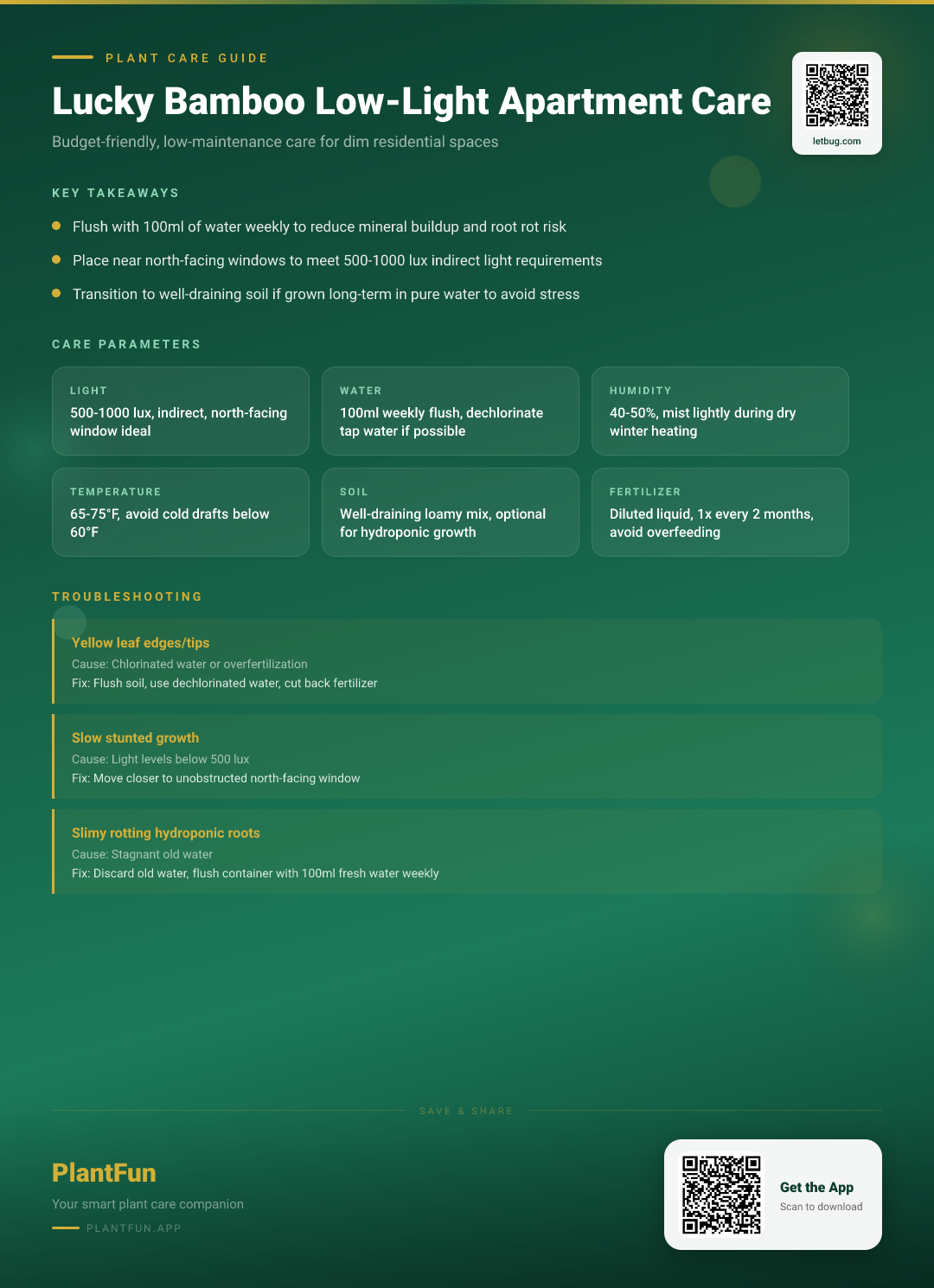
Key Takeaways
- Check soil moisture before watering — overwatering is the #1 killer of houseplants.
- Ensure your plant gets the right amount of light for its species.
- Be patient with recovery — most plants need 2–4 weeks to bounce back.
Quick Care Card: Essential Metrics
| Feature | Requirement |
|---|---|
| Light | 500–1,000 lux (bright, indirect) |
| Water | Weekly 100ml flush (drainage essential) |
| Humidity | 40–50% |
| Temperature | 65–75°F (18–24°C) |
| Soil | Well-draining, peat-based potting mix |
| Fertilizer | Minimal; half-strength balanced liquid quarterly |
| Toxicity | Toxic to cats and dogs (ASPCA, 2026) |
TL;DR: The Bottom Line for Apartment Dwellers
Lucky Bamboo (Dracaena sanderiana) is not a true aquatic plant. While it can survive in water for a time, long-term health requires a transition to soil. If you live in an apartment with limited light, stick to 500–1,000 lux, avoid direct sun to prevent scorch, and provide a 100ml water flush weekly. This ensures stable nutrient absorption and prevents the root rot common in stagnant vase setups (NC State Extension, 2026).
My Experience: The “Aquatic Myth” Lesson
When I first started my indoor plant collection in a tiny studio, I thought Lucky Bamboo was the ultimate low-maintenance prop. I kept mine in a decorative glass jar of water for six months. It looked fine until the leaves began to yellow and the water turned murky. I realized I was starving the plant of oxygen and essential soil-bound nutrients. Transitioning it to a small pot with a premium potting mix saved it. Since then, my stems have doubled in size.
Why Your Lucky Bamboo Struggles in Pure Water
While commonly sold in vases, Lucky Bamboo is actually a terrestrial plant. In stagnant water, oxygen levels drop, which can foster pathogens that lead to stem decay. According to recent research, the management of the growth medium is critical to preventing infection by pathogens like those causing anthracnose (Plant Archives, 2025). Soil provides a biological buffer that water lacks, stabilizing the pH and providing the minerals necessary for long-term vitality.
The Resilience Strategy: Moving from Water to Soil
If your plant has been in water, moving it to soil builds resilience.
- Prepare: Choose a small pot with drainage holes (essential for preventing root rot).
- Select Medium: Use a peat-based potting mix amended with perlite for aeration.
- Transition: Place the roots in the soil, gently firming it around the base. Do not pack it too tightly.
- Acclimate: Water lightly and keep the plant in moderate light for two weeks to prevent transplant shock.
Step-by-Step: The Perfect Low-Light Watering Schedule
Apartments are notorious for inconsistent humidity, which affects how fast your plant drinks.
- Test: Every Sunday, insert your finger 2 inches into the soil. If it feels dry, proceed.
- Flush: Use 100ml of water. Ensure it is room temperature to avoid shocking the root system.
- Drain: Let the excess water run out of the bottom. Never let the pot sit in a saucer of standing water, as this creates a breeding ground for coliform bacteria (-, 2024).
Lighting Hacks: How to Maximize North-Facing Window Exposure
In low-light apartments, every photon counts.
- Proximity: Move your plant within 2 feet of a North-facing window.
- Reflection: Use a white wall or a light-colored shelf near the plant to bounce more light back onto the leaves.
- Cleaning: Dust the leaves monthly with a damp cloth; dust acts as a light filter that starves your plant.
Seasonal Shifts: Adjusting Care for Dry Winter Apartment Air
Winter radiator heat drops humidity significantly below the ideal 40–50% range. To help your plant survive:
- Group your plants: Clustering plants increases local humidity through transpiration.
- Avoid drafts: Keep the plant away from direct airflow from vents, which causes brown tips.
Myth-Busting: Do You Really Need Distilled Water?
Contrary to popular belief, you don’t always need expensive distilled water. Most Lucky Bamboo varieties are hardy enough to tolerate treated municipal water, provided you let it sit out for 24 hours to dissipate chlorine.
Voice Search FAQ
How do I know if my Lucky Bamboo is dying?
Check for soft, mushy stems or a foul odor emanating from the base. These are definitive signs of root rot and stem necrosis.
Can I use tap water for my lucky bamboo in an apartment?
Yes, but let the water sit in an open container for 24 hours first to allow chlorine to evaporate. This prevents the chemical burn often mistaken for nutrient deficiencies.
Why are the leaves on my lucky bamboo turning yellow?
Yellowing is usually a symptom of over-fertilization, excessive direct sunlight, or chemical sensitivity (NC State Extension, 2026). Check your light source and flush the soil with fresh water to remove salt buildup.
Common Mistakes That Kill Growth
- Mistake: Over-fertilizing. What happens: Chemical salts burn the root tips, turning leaves yellow. Instead: Use a diluted liquid fertilizer at 1/4 strength only twice per year.
- Mistake: Light Shock. What happens: Sudden movement to high sun causes leaf scorch. Instead: Transition the plant to brighter areas over the course of 10 days.
Budget-Friendly Maintenance Checklist
- Rotate the pot 90 degrees weekly for even growth.
- Clean leaves monthly to maximize photosynthetic efficiency.
- Check soil moisture every Sunday morning.
- Keep away from heating vents to preserve ambient humidity levels.
References
- -, P.; -, D. (2024). Exploring The Potential of Lucky Bamboo Plant : A Coliform Perspective. International Journal For Multidisciplinary Research. https://doi.org/10.36948/ijfmr.2024.v06i03.22635. Accessed 2026-03-17.
- Plant Archives. (2025). IDENTIFICATION, ISOLATION, SCREENING OF SUITABLE MEDIUM AND TEMPERATURE AND IN VITRO MANAGEMENT OF ANTHRACNOSECAUSING PATHOGEN OF LUCKY BAMBOO GROWN IN WEST BENGAL INDIA. Plant Archives. https://doi.org/10.51470/plantarchives.2025.v25.no.1.408. Accessed 2026-03-17.
- ASPCA. (2026). Toxic and Non-Toxic Plants List — ASPCA. https://www.aspca.org/pet-care/animal-poison-control/toxic-and-non-toxic-plants. Accessed 2026-03-17.
- NC State Extension. (2026). Lucky Bamboo — NC State Extension Gardener Plant Toolbox. https://plants.ces.ncsu.edu/plants/bamboo-care/. Accessed 2026-03-17.
Optional Helper: Plantfun.App
Plantfun.App identifies your plants by photo, diagnoses pests and diseases with clear fixes, and creates personalised watering and light schedules that adapt to your home conditions — a handy companion for putting this guide into daily practice.
Found an error or have suggestions? We'd love your feedback.
Need help identifying this problem?
Get instant identification, personalized care schedules, and effective pest treatment plans directly on your phone.
Sponsored • We may earn a commission from app downloads
Related Guides
Lucky Bamboo Care Checklist for Small Apartments: Budget Tips for Resilient Growth
Skip fancy plant supplies for your lucky bamboo. Grab a free 8-step budget checklist, exact light, water, and humidity parameters to keep growth resilient in small apartments.
Care GuideLucky Bamboo in Low-Light Apartments: The 7-Step Budget Care Checklist for Resilient Growth
Skip overpriced plant products and grow lush lucky bamboo in your apartment. Get 7 budget-friendly care steps, exact light/water thresholds, and a free printable checklist for no-fuss growth.
Care GuideLucky Bamboo Care Checklist: 8 Tips for Resilient Growth in Small Urban Apartments
Stop watching your lucky bamboo turn yellow. Get our 8-step apartment-specific checklist with exact light, water, and humidity rules for lush, resilient growth all year long.
Pest ControlAnts on Plants: What They Mean and What to Do
Ants usually aren't eating your plant. They are farming other pests.