
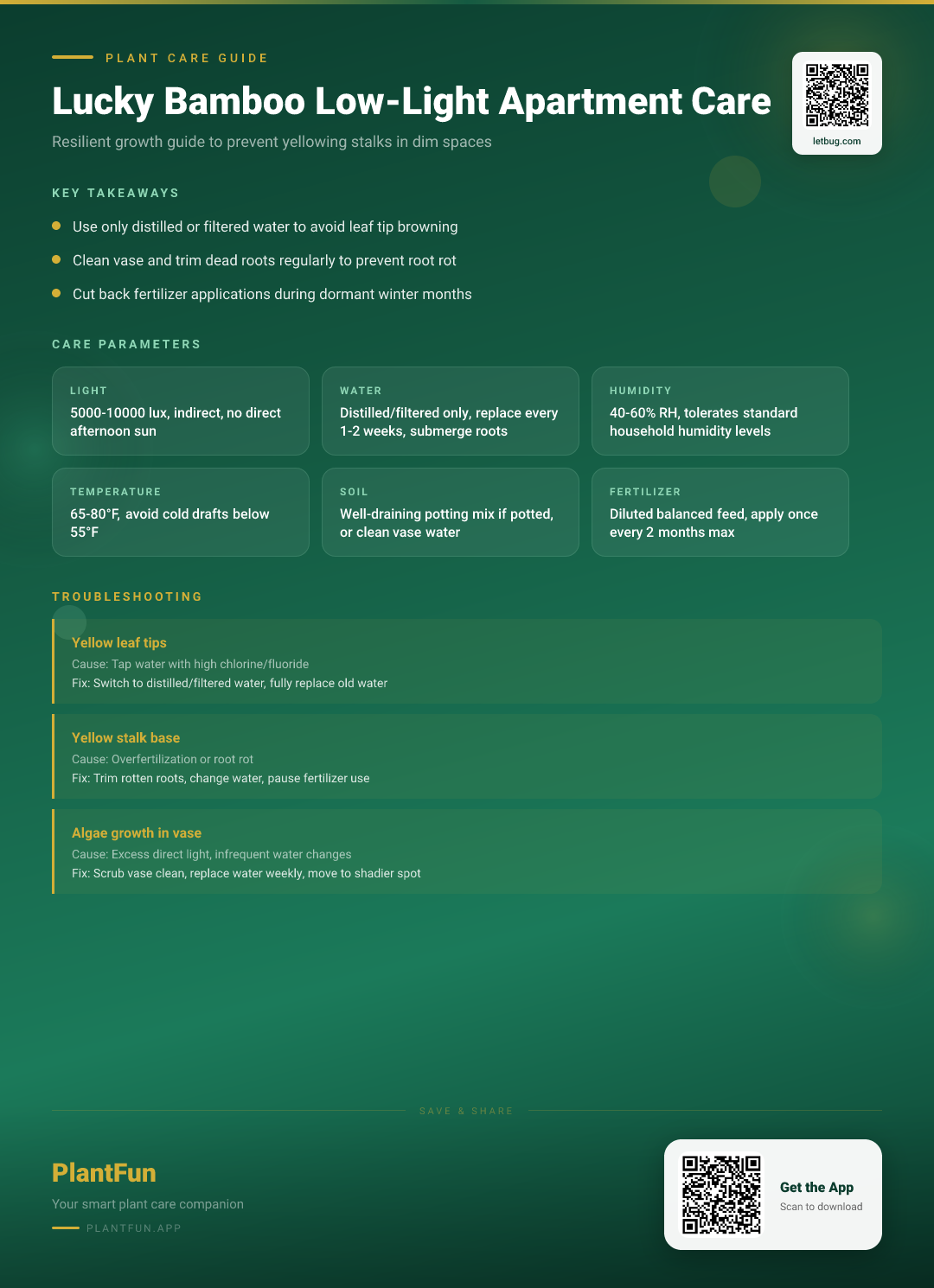
Key Takeaways
- Check soil moisture before watering — overwatering is the #1 killer of houseplants.
- Ensure your plant gets the right amount of light for its species.
- Be patient with recovery — most plants need 2–4 weeks to bounce back.
Quick Care Card
| Feature | Requirement |
|---|---|
| Light | 5,000–10,000 lux (bright, indirect) |
| Water | Distilled or filtered water (change every 7-10 days) |
| Humidity | 40–60% |
| Temperature | 65–80°F (18–27°C) |
| Soil | Well-draining, peat-based mix if choosing soil |
| Fertilizer | Weak liquid, 1-2 times per year |
| Toxicity | Toxic to cats and dogs (ASPCA, 2026) |
TL;DR
Lucky Bamboo (Dracaena sanderiana) is not a true bamboo; it is a member of the Asparagaceae family (NC State Extension, 2026). It fails in windowless apartments because it requires moderate, indirect light to photosynthesize effectively. Neglecting these light needs and using tap water containing chlorine or fluoride are the primary reasons for premature yellowing and decline. If your plant is in a dark corner, it is slowly starving—move it to a brighter spot immediately.
The Low-Light Reality
When I first started collecting plants, I made the mistake of placing my Lucky Bamboo on a bookshelf in a hallway with zero natural light. Within a month, the vibrant green stalks faded, and the leaves began to droop.
Many apartment dwellers mistakenly believe these plants thrive on neglect. While they are resilient, they are not magical. Dracaena sanderiana requires at least 5,000 to 10,000 lux to maintain healthy cell structure (NC State Extension, 2026). In a dark room, the plant cannot produce enough energy to maintain its root system, often leading to susceptibility to pathogens like Anthracnose (Plant Archives, 2025). If you don’t have a bright window, consider using a full-spectrum LED grow light for 8–10 hours a day to mimic the necessary intensity.
Water Quality Matters
If your Lucky Bamboo has brown, crispy leaf tips, you are likely using tap water. Most municipal water supplies contain fluoride and chlorine, which act as toxins to sensitive Dracaena species. Over time, these chemicals accumulate in the plant’s tissues.
I always recommend using distilled water or reverse-osmosis filtered water. If you must use tap water, let it sit out for 24 hours to allow some chlorine to dissipate, though this does nothing for fluoride. For those looking to master their environment, keeping the water clean is paramount to preventing bacterial growth (-, P. & -, D., 2024).
Step-by-Step Care Guide
Keeping your plant in a vase requires a strict maintenance rhythm to prevent stagnation.
- Inspect Roots: Every two weeks, lift the stalks out of the vase. Healthy roots should be firm and reddish or cream-colored. If they are mushy or slimy, you have root rot (NC State Extension, 2026).
- Clean the Vase: Use mild, fragrance-free soap to scrub the container, removing any algae buildup. Algae competes for nutrients and light.
- Refresh the Water: Fill the vase so the roots are submerged, but ensure the green stalk itself is not sitting deep in water, which can trigger rot.
- Trimming: If you find dead roots, use a sterilized pair of shears to snip them off cleanly to prevent the spread of decay.
Seasonal Care Calendar
- Spring/Summer (Active Growth): The plant will consume more water. Monitor levels every 5 days and provide a very dilute (1/10th strength) liquid fertilizer once during the season.
- Autumn/Winter (Dormancy): Growth slows. Reduce fertilizer to zero. During winter, be extra careful with drafts; keep the plant away from radiators or cold air vents to maintain the ideal 65–80°F range (NC State Extension, 2026).
Common Mistakes to Avoid
- Mistake: Using high-strength fertilizer. What happens: Salt burn on the roots. Instead: Use a specialized liquid fertilizer for water-grown plants at 10% of the recommended dose.
- Mistake: Direct afternoon sun. What happens: Sunscald (bleached, white patches). Instead: Provide bright, indirect light via a sheer curtain.
FAQ
- Why is my Lucky Bamboo turning yellow at the base? This usually indicates either water-quality issues (fluoride toxicity) or, more seriously, internal rot caused by a stagnant environment.
- How do I know if my Lucky Bamboo has root rot? If the roots appear black, smell like decay, or easily pull away from the stalk, it is root rot.
- Can I grow Lucky Bamboo in soil instead of just water? Yes, you can transition it to a well-draining potting mix, but ensure you keep it consistently moist, as it will struggle if it dries out completely.
Troubleshooting
Algae Growth
Symptom: Green, cloudy water or slime on the glass.
Likely cause: Excess light hitting the water directly or nutrient-rich water.
Fix:
- Change the water immediately.
- Use an opaque vase to block light from the water line.
Stunted Growth
Symptom: New leaves are tiny or non-existent.
Likely cause: Lack of nutrients or insufficient light.
Fix:
- Move to a spot with better indirect light.
- Add a single drop of liquid fertilizer during the spring growth phase.
Yellow Stalk
Symptom: The main stalk is turning yellow from the bottom up.
Likely cause: Often indicative of irreversible bacterial rot or chemical burn.
Fix:
- Check roots for decay; if the stem is soft, it cannot be saved.
- If the stem is firm, flush the plant with distilled water and relocate to a more stable temperature zone.
References
- -, P.; -, D. (2024). Exploring The Potential of Lucky Bamboo Plant : A Coliform Perspective. International Journal For Multidisciplinary Research. https://doi.org/10.36948/ijfmr.2024.v06i03.22635. Accessed 2026-03-10.
- Plant Archives. (2025). IDENTIFICATION, ISOLATION, SCREENING OF SUITABLE MEDIUM AND TEMPERATURE AND IN VITRO MANAGEMENT OF ANTHRACNOSECAUSING PATHOGEN OF LUCKY BAMBOO GROWN IN WEST BENGAL INDIA. Plant Archives. https://doi.org/10.51470/plantarchives.2025.v25.no.1.408. Accessed 2026-03-10.
- ASPCA. (2026). Toxic and Non-Toxic Plants List — ASPCA. https://www.aspca.org/pet-care/animal-poison-control/toxic-and-non-toxic-plants. Accessed 2026-03-10.
- NC State Extension. (2026). Lucky Bamboo — NC State Extension Gardener Plant Toolbox. https://plants.ces.ncsu.edu/plants/bamboo-care/. Accessed 2026-03-10.
Optional Helper: Plantfun.App
Plantfun.App identifies your plants by photo, diagnoses pests and diseases with clear fixes, and creates personalised watering and light schedules that adapt to your home conditions — a handy companion for putting this guide into daily practice.
Found an error or have suggestions? We'd love your feedback.
Need help identifying this problem?
Get instant identification, personalized care schedules, and effective pest treatment plans directly on your phone.
Sponsored • We may earn a commission from app downloads
Related Guides
Lucky Bamboo in Small Urban Apartments: Seasonal Care Checklist for Resilient Year-Round Growth
Keep your lucky bamboo thriving even in cramped, light-limited urban apartments. Get a 4-season care checklist, exact light and water thresholds, and fixes for common yellow leaf issues.
Care GuideLucky Bamboo in Small Urban Apartments: The Only Resilient Growth Checklist You Need
Stop watching your lucky bamboo turn yellow in your small urban apartment. Grab our science-backed checklist with exact light, water, and humidity thresholds for lush, resilient growth all year.
Care GuideThe Complete Lucky Bamboo Care Checklist for Resilient Growth in Typical Urban Apartments
Stop guessing your lucky bamboo care routine. Get exact light, water, and humidity thresholds, plus a 12-point checklist to keep your plant lush, healthy, and resilient in any small urban apartment.
Pest ControlAnts on Plants: What They Mean and What to Do
Ants usually aren't eating your plant. They are farming other pests.