
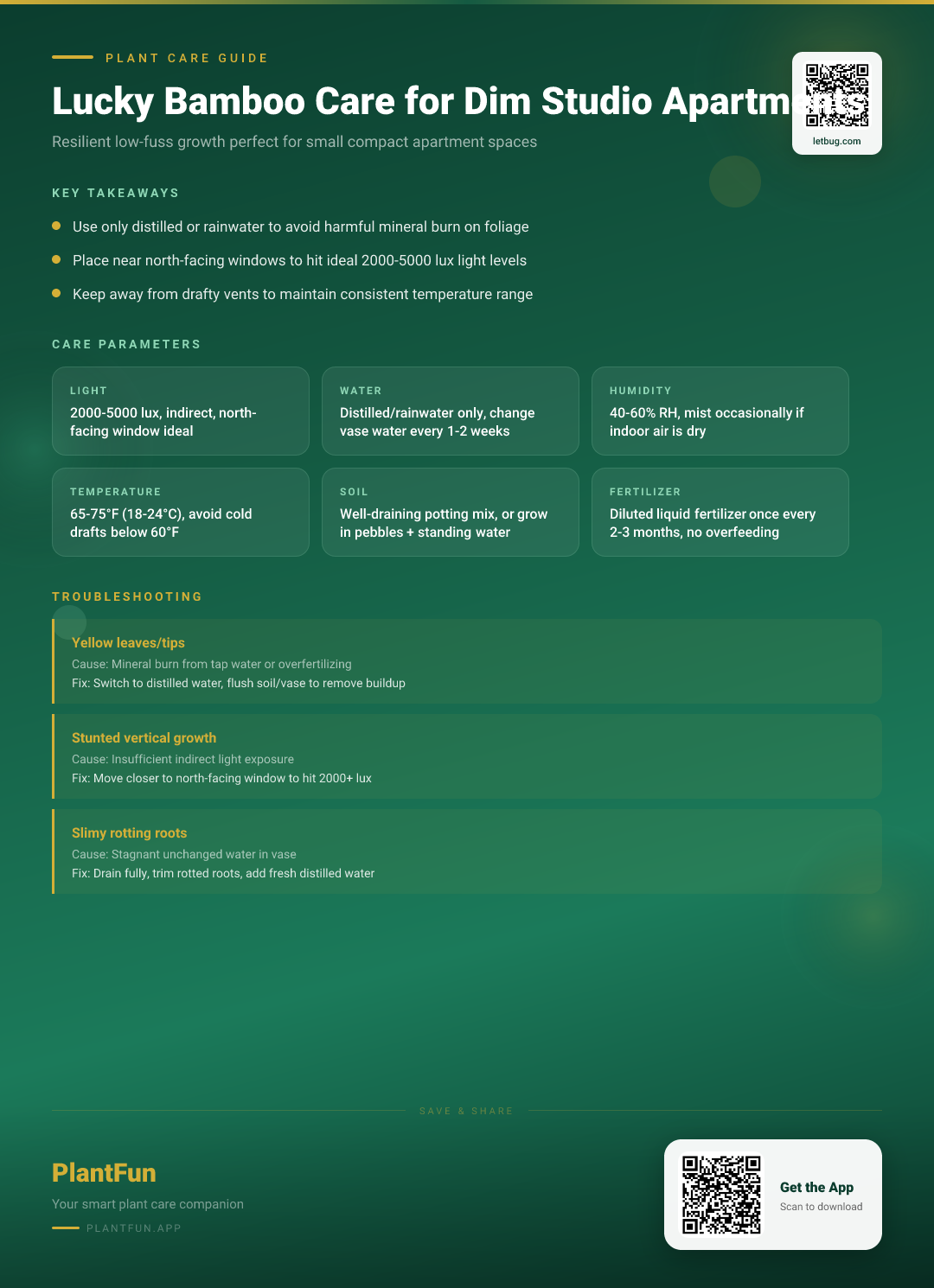
Key Takeaways
- Check soil moisture before watering — overwatering is the #1 killer of houseplants.
- Ensure your plant gets the right amount of light for its species.
- Be patient with recovery — most plants need 2–4 weeks to bounce back.
TL;DR: Quick Care Success
Lucky Bamboo (Dracaena sanderiana) thrives in studios if you prioritize water purity over convenience. Use distilled or filtered water only—tap water minerals cause yellowing. Keep light between 2,000–5,000 lux and change water bi-weekly. Avoid direct, harsh sun and never let the roots dry out.
Quick Care Card: Essential Data for Apartment Growth
| Feature | Requirement |
|---|---|
| Light | Bright, indirect (2,000–5,000 lux) |
| Water | Distilled, rain, or reverse osmosis water |
| Temperature | 65-75°F (18-24°C) |
| Humidity | Moderate (40-60%) |
| Soil | Optional: Well-draining, peat-based mix |
| Fertilizer | Minimal; balanced liquid (1/10th strength) |
| Toxicity | Toxic to cats and dogs (ASPCA, 2026) |
My Experience: The Studio Struggle
When I first moved into my cramped studio, I tucked a Lucky Bamboo vase on my desk, assuming it was indestructible. Within a month, the leaves yellowed and the stalks turned mushy. I realized the combination of stagnant air and tap water chemicals was killing my plant. After switching to distilled water and moving it three feet closer to my north-facing window, it finally stopped declining. Learning to respect the specific water and light needs of Dracaena sanderiana saved my desk companion.
Why Your Studio Apartment is a Unique Habitat for Dracaena sanderiana
Studio apartments often feature low airflow and limited light, which can create a breeding ground for pathogens. According to research on the management of pathogens like Anthracnose in Dracaena sanderiana, these plants are susceptible to fungal issues when moisture levels are not carefully managed (Plant Archives, 2025). In a small space, you aren’t just caring for a plant; you are managing a micro-ecosystem.
Decoding Light: Achieving 2,000–5,000 Lux in North-Facing Windows
Lucky Bamboo is often mislabeled as a ‘low-light’ plant. While it tolerates low light, it doesn’t thrive there. To maintain structural integrity, aim for 2,000 to 5,000 lux. If you don’t have a light meter, a simple test is to place your hand between the window and the plant; a soft, diffused shadow indicates ideal intensity.
Water Science: Why Distilled or Rainwater is Non-Negotiable
Tap water contains chlorine, chloramine, and fluoride. These chemicals build up in the plant’s vascular system, leading to tip burn and yellowing leaves. As noted in recent explorations of Dracaena sanderiana cultivation, water quality is a primary factor in preventing coliform growth and chemical toxicity (P. & D., 2024).
Step-by-Step: Managing Water Levels for Vertical Stability
- Use a clear vase to monitor root health weekly.
- Ensure the water level covers at least 2 inches of the roots.
- Keep the stalks upright using decorative pebbles, which also provide mechanical stability.
- Change the water entirely every 14 days to replenish oxygen.
Temperature & Airflow: Maintaining 65-75°F (18-24°C) Without Drafts
Plants in studios often sit near radiators or AC units. Dracaena sanderiana prefers a stable 65-75°F (18-24°C) (NC State Extension, 2026). Avoid placing your vase directly in the path of a vent, as rapid temperature fluctuations cause leaf stress.
Why is my Lucky Bamboo turning yellow in my apartment?
Symptom: Leaves or stalks are turning bright yellow or translucent.
Likely cause: Mineral toxicity from tap water or over-fertilization.
Fix:
- Immediately flush the vase with room-temperature distilled water.
- Remove the plant and rinse the roots gently.
- Trim away any decaying, mushy root sections using sterile scissors.
How often do I need to change the water in my bamboo vase?
Symptom: Water looks cloudy or smells slightly swampy.
Likely cause: Bacteria buildup due to stagnant conditions.
Fix:
- Change water every 10–14 days for optimal results.
- Use a mild soap to wash the vase and pebbles during the change.
- Refill with fresh, room-temperature distilled water.
Can I grow Lucky Bamboo in soil if my apartment is dry?
Symptom: The plant seems to wilt despite being in water.
Likely cause: The dry, low-humidity air of a studio is stressing the foliage.
Fix:
- Transition to a well-draining, peat-based soil mix.
- Keep the soil consistently moist but never waterlogged.
- Use a pebble tray with water underneath to boost localized humidity.
Seasonal Care: Adjusting for Winter Heating and Summer Humidity
During winter, your indoor heating will drop humidity levels significantly. Mist your bamboo leaves daily. In summer, increase water changes to weekly to prevent the warmer temperatures from accelerating bacterial growth in the vase.
Common Mistakes: Avoiding Overcrowding and Mineral Burn
- Mistake: Using a small, crowded container. What happens: Restricted root growth leads to structural weakness. Instead: Choose a vase that allows at least 2 inches of space around the root ball.
- Mistake: Over-fertilizing. What happens: Salt buildup kills the plant quickly. Instead: Only fertilize once every two months with a water-soluble plant food diluted to 1/10th strength.
References
- P., -., & D., -. (2024). Exploring The Potential of Lucky Bamboo Plant : A Coliform Perspective. International Journal For Multidisciplinary Research. https://doi.org/10.36948/ijfmr.2024.v06i03.22635. Accessed 2026-03-19.
- Plant Archives. (2025). IDENTIFICATION, ISOLATION, SCREENING OF SUITABLE MEDIUM AND TEMPERATURE AND IN VITRO MANAGEMENT OF ANTHRACNOSECAUSING PATHOGEN OF LUCKY BAMBOO GROWN IN WEST BENGAL INDIA. Plant Archives. https://doi.org/10.51470/plantarchives.2025.v25.no.1.408. Accessed 2026-03-19.
- ASPCA. (2026). Toxic and Non-Toxic Plants List — ASPCA. https://www.aspca.org/pet-care/animal-poison-control/toxic-and-non-toxic-plants. Accessed 2026-03-19.
- NC State Extension. (2026). Lucky Bamboo — NC State Extension Gardener Plant Toolbox. https://plants.ces.ncsu.edu/plants/bamboo-care/. Accessed 2026-03-19.
Optional Helper: Plantfun.App
Plantfun.App identifies your plants by photo, diagnoses pests and diseases with clear fixes, and creates personalised watering and light schedules that adapt to your home conditions — a handy companion for putting this guide into daily practice.
Found an error or have suggestions? We'd love your feedback.
Need help identifying this problem?
Get instant identification, personalized care schedules, and effective pest treatment plans directly on your phone.
Sponsored • We may earn a commission from app downloads
Related Guides
Lucky Bamboo Care Checklist: 8 Tips for Resilient Growth in Small Urban Apartments
Stop watching your lucky bamboo turn yellow. Get our 8-step apartment-specific checklist with exact light, water, and humidity rules for lush, resilient growth all year long.
Care GuideLucky Bamboo in Small City Apartments: The Only Resilient Growth Care Checklist You Need
Stop letting your lucky bamboo yellow or wilt in your small city apartment. Get our 12-point checklist, exact light, water, and humidity thresholds for consistent, resilient growth all year.
Care GuideThe Complete Lucky Bamboo Care Guide for Typical Apartments: Seasonal Routines for Resilient Growth
Keep your Lucky Bamboo thriving in your apartment year-round. Get exact light levels, watering amounts, and a seasonal routine to avoid yellow leaves and support resilient growth.
Pest ControlAnts on Plants: What They Mean and What to Do
Ants usually aren't eating your plant. They are farming other pests.