
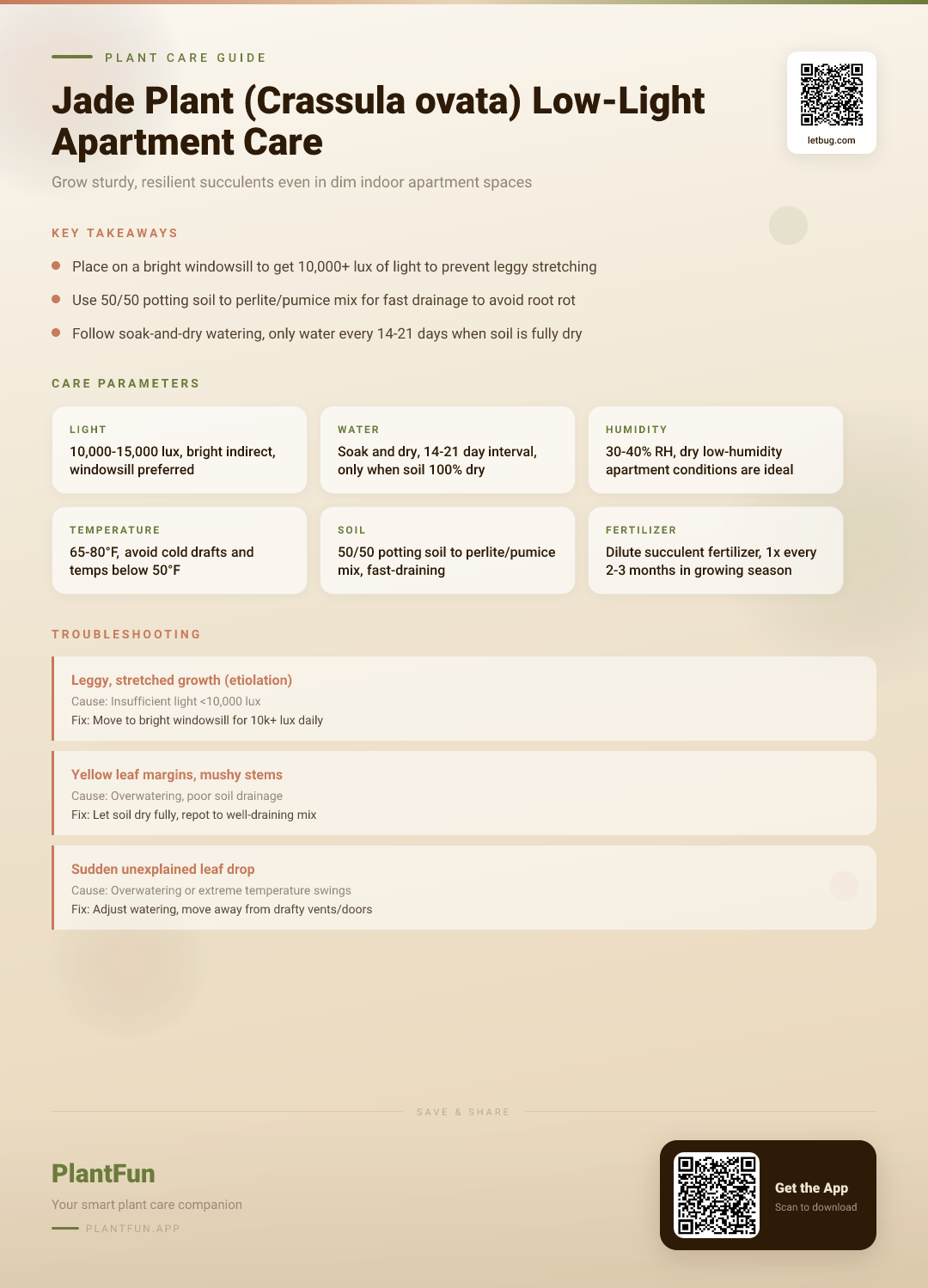
Key Takeaways
- Check soil moisture before watering — overwatering is the #1 killer of houseplants.
- Ensure your plant gets the right amount of light for its species.
- Be patient with recovery — most plants need 2–4 weeks to bounce back.
Quick Care Card
| Feature | Requirement |
|---|---|
| Light | 10,000–15,000 lux (Direct or bright indirect) |
| Watering | Soak and dry; wait for 100% soil desiccation |
| Humidity | 30–40% (Thrives in lower humidity) |
| Temperature | 65–75°F (18–24°C) |
| Soil Mix | 50% potting soil, 50% perlite or pumice |
| Fertilizer | Balanced succulent fertilizer, monthly in summer |
| Toxicity | Toxic to cats and dogs (ASPCA, 2026) |
TL;DR
Jade Plants (Crassula ovata) are desert-native succulents that require high-intensity light to maintain a compact structure. In apartments, they often suffer from “etiolation”—stretching toward light sources. To help yours survive, prioritize a south-facing window, use a gritty, well-draining soil mix, and strictly avoid overwatering. When I first brought my own Jade into a dimly lit studio, it became spindly within weeks; the secret is treating them like desert inhabitants, not tropical houseplants.
Why Jade Plants Struggle in Apartments
When I first started my indoor plant journey, I made the mistake of placing my Jade in a “bright” corner, only to find the stems leaning aggressively and losing their signature woody thickness. Crassula ovata is adapted to high-solar-irradiance environments (NC State Extension, 2026). When indoor light levels fall below 10,000 lux, the plant shifts its energy from root and stem development to aggressive leaf-area expansion, resulting in the dreaded “leggy” appearance. Without sufficient light to drive photosynthesis, the plant cannot process water efficiently, leading to common issues like root rot.
Understanding Light
Light intensity is the single most critical factor for Crassula ovata. Many indoor gardeners mistake “bright room” lighting for sufficient photosynthetic active radiation. In reality, a corner even three feet away from a window can have 70% less light than the windowsill itself. I recommend using a light meter app or a dedicated sensor to aim for 10,000–15,000 lux. If you cannot reach these levels, move your plant to the direct path of a south-facing window. As noted in recent research, specific artificial LED intensities can compensate for these deficiencies in indoor vertical gardens (Gautam et al., 2021).
Step-by-Step Watering
I never water my Jade on a calendar schedule. Instead, I use the “soak and dry” method.
- Test the soil: Stick your finger two inches into the potting mix. If you feel any moisture, do not water.
- Check for dryness: If the mix is 100% dry, move your pot to the sink.
- Thorough soak: Water until liquid runs freely through the drainage holes.
- Drainage: Ensure the pot sits for 15 minutes to allow excess water to escape before returning it to the saucer.
In typical indoor apartment conditions, this usually happens every 14–21 days.
Soil Selection for Drainage
Standard potting soil retains too much moisture for desert succulents. I always mix my own substrate: 50% high-quality potting soil combined with 50% perlite or pumice. This porosity is essential; it mimics the fast-draining, rocky soils where Crassula ovata evolved and prevents the stagnant conditions that trigger root rot (NC State Extension, 2026).
Temperature & Humidity
While many tropical plants crave humidity, Jade plants prefer drier air. Apartments with humidity levels below 30% are actually ideal, as high humidity can exacerbate fungal issues in succulents (Sheeran & Rasmussen, 2023). Keep your plant in a range of 65–80°F. Avoid placing them directly in front of heating vents or AC drafts, which can cause temperature shocks.
Myth-Busting
- Myth: “Jade plants can live in the corner of my living room.”
- Reality: This is a recipe for slow decline. Without a direct light source, the internodal spacing (the gap between leaves) will stretch, weakening the plant’s structural integrity.
FAQ
- Can I move my Jade plant to my dark office cubicle if it has a desk lamp? Yes, provided you use a full-spectrum LED grow light positioned within 6–10 inches of the plant canopy to ensure sufficient intensity (Gautam et al., 2021).
- Why is my Jade plant dropping leaves even when I water it regularly? Leaf drop is often a sign of overwatering or poor soil drainage, leading to oxygen deprivation at the roots. Check for mushy stems immediately.
- Is it safe to keep my Jade near my pets? No. The ASPCA classifies Crassula ovata as toxic to cats and dogs (ASPCA, 2026).
Seasonal Care Calendar
- Spring/Summer (Growth): Increase watering frequency slightly, fertilize once per month, and maximize light exposure.
- Fall/Winter (Dormancy): Reduce watering to once every 4–6 weeks. The plant will naturally grow slower; do not force growth with fertilizer.
Common Mistakes
- Mistake: Using a pot without a drainage hole. What happens: Water pools at the bottom, rotting the roots. Instead: Always drill a hole or use a nursery pot inside a decorative cover pot.
- Mistake: Watering on a “every Sunday” schedule. What happens: You will inevitably overwater during cloudy weeks when the plant uses less energy. Instead: Only water when the soil is 100% dry to the touch.
Troubleshooting Guide
Etiolation (Stretching)
Symptom: The stems become thin, pale, and the distance between leaves increases significantly.
Likely cause: Insufficient light intensity.
Fix:
- Move the plant to a window with direct sunlight.
- Use a grow light to supplement for 8–10 hours per day.
Yellowing Leaves
Symptom: Leaves turn yellow and mushy, often dropping off at the slightest touch.
Likely cause: Overwatering or poor soil aeration.
Fix:
- Stop watering immediately.
- Repot into fresh, dry, gritty succulent soil.
Wrinkled Leaves
Symptom: Leaves appear shriveled or “raisin-like.”
Likely cause: Underwatering (dehydration).
Fix:
- Provide a thorough soak until water drains from the bottom.
- Ensure the pot is not “root-bound,” which prevents water absorption.
References
- ASPCA. (2026). Toxic and Non-Toxic Plants List — ASPCA. https://www.aspca.org/pet-care/animal-poison-control/toxic-and-non-toxic-plants. Accessed 2026-03-14.
- Gautam, B., Dubey, R., & Kaur, N. (2021). GROWTH RESPONSE OF INDOOR ORNAMENTAL PLANT SPECIES TO VARIOUS ARTIFICIAL LIGHT INTENSITIES (LED) IN AN INDOOR VERTICAL GARDEN. Plant Archives. https://doi.org/10.51470/plantarchives.2021.v21.no1.096. Accessed 2026-03-14.
- NC State Extension. (2026). Jade Plant — NC State Extension Gardener Plant Toolbox. https://plants.ces.ncsu.edu/plants/jade-plant/. Accessed 2026-03-14.
- Sheeran, L., & Rasmussen, A. (2023). Aerial roots elevate indoor plant health: Physiological and morphological responses of three high‐humidity adapted Araceae species to indoor humidity levels. Plant, Cell & Environment. https://doi.org/10.1111/pce.14568. Accessed 2026-03-14.
Optional Helper: Plantfun.App
Plantfun.App identifies your plants by photo, diagnoses pests and diseases with clear fixes, and creates personalised watering and light schedules that adapt to your home conditions — a handy companion for putting this guide into daily practice.
Found an error or have suggestions? We'd love your feedback.
Need help identifying this problem?
Get instant identification, personalized care schedules, and effective pest treatment plans directly on your phone.
Sponsored • We may earn a commission from app downloads
Related Guides
The Complete Jade Plant Care Checklist for Thriving Growth in Small Urban Apartments
Grow a lush, resilient jade plant in your small urban apartment with this zero-cost checklist, including exact light levels, watering amounts, and seasonal care tips you can implement today.
Care GuideThe Jade Plant Budget Care Guide for Apartment Living: Thrive Without Expensive Supplies
Boost your Jade Plant's growth with a 0-dollar care plan. Learn the exact light, water, and soil ratios needed to keep your Crassula ovata thriving in apartments.
Care GuideJade Plant Care for Low-Light Apartments: A Resilient Growth Strategy for Urban Growers
Transform your leggy Jade into a compact, vibrant centerpiece. Follow our precise light and water thresholds to master indoor succulent care in small spaces.
Pest ControlAnts on Plants: What They Mean and What to Do
Ants usually aren't eating your plant. They are farming other pests.