
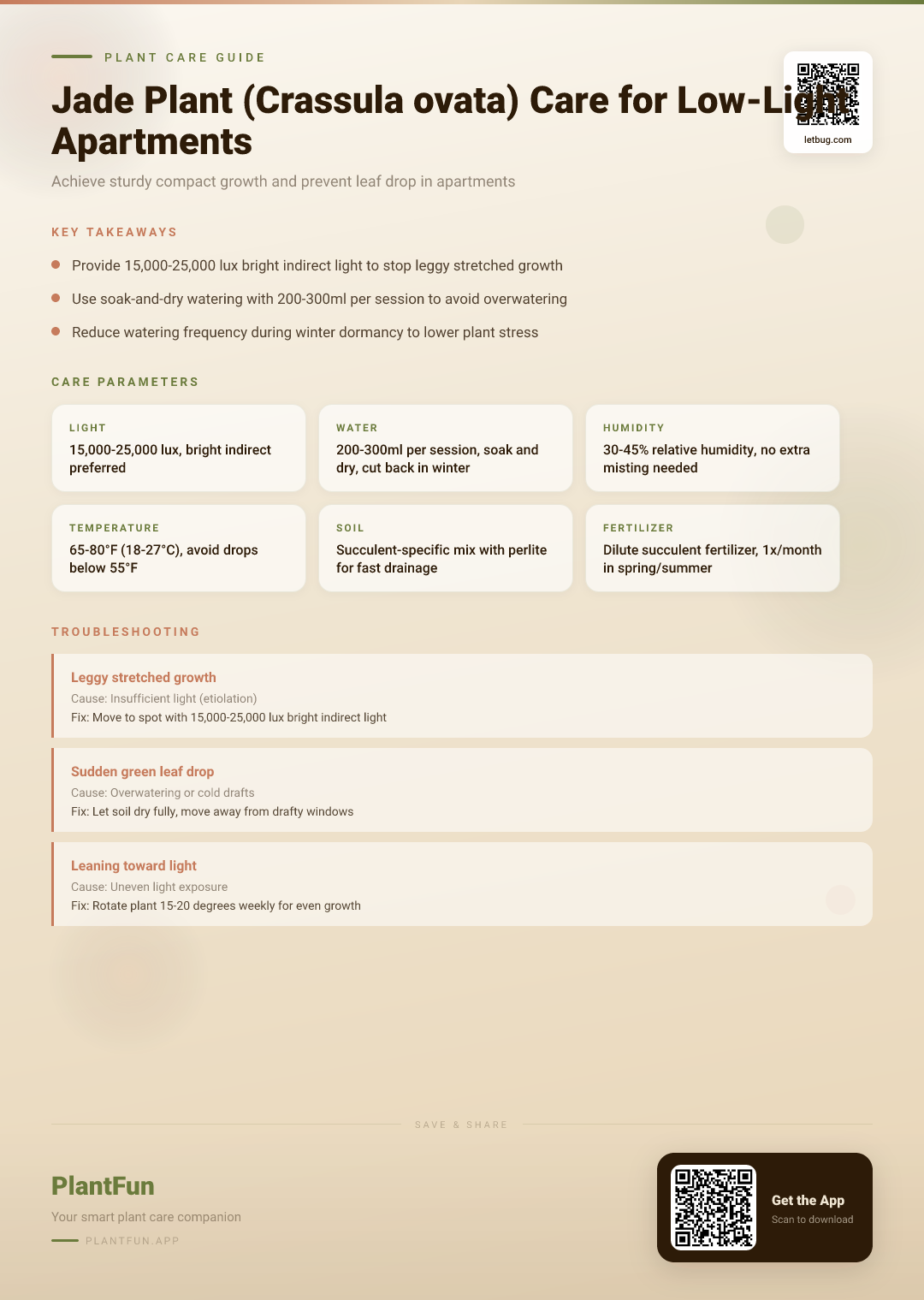
Key Takeaways
- Check soil moisture before watering — overwatering is the #1 killer of houseplants.
- Ensure your plant gets the right amount of light for its species.
- Be patient with recovery — most plants need 2–4 weeks to bounce back.
TL;DR: The Quick Fix for Your Jade Plant
If your Jade (Crassula ovata) is stretching, it is begging for more light. Move it to your brightest window (south-facing is ideal) or invest in a full-spectrum LED grow light. Water only when the top 2 inches of soil are bone dry, typically every 2-3 weeks, and never let it sit in water. A compact, sturdy Jade is a thirsty, well-lit Jade.
Quick Care Card: Essential Thresholds for Your Jade (Crassula ovata)
| Category | Requirement |
|---|---|
| Light | 15,000–25,000 Lux (Bright, indirect to direct) |
| Watering | Soak and dry (200-300ml depending on pot size) |
| Humidity | 30–45% (Average household levels) |
| Temperature | 65–80°F (18–27°C) |
| Soil | Well-draining succulent/cactus mix with added perlite |
| Fertilizer | Balanced 10-10-10, diluted, during growing season |
| Toxicity | Toxic to cats and dogs (ASPCA, 2026) |
My Experience: The “Stretching” Struggle
When I first started keeping succulents in my tiny studio apartment, I made the common mistake of placing my Jade on a bookshelf away from the window. Within weeks, the stem grew thin, the internodes (the space between leaves) stretched out, and the leaves looked tiny and pale. I was essentially starving it of light. I learned the hard way that Jades aren’t just houseplants; they are high-energy desert survivors that require specific, intense light cycles to maintain their signature, tree-like, compact structure.
Why Your Jade Plant Looks ‘Stretched’ (The Science of Etiolation)
Etiolation is the botanical term for when a plant grows abnormally long and pale because it is searching for light. In low-light environments, Crassula ovata prioritizes vertical growth over leaf development to ‘reach’ for a potential light source. This weakens the internal structure, often leading to a leaning or top-heavy plant (NC State Extension, 2026).
Light Requirements: Providing 15,000-25,000 Lux in Typical Apartments
To keep your Jade compact, you need to provide significant light intensity. I use a light meter app to ensure my Jade hits the 15,000–25,000 lux threshold. If you lack natural light, supplementing with LED growth panels has been shown to assist in maintaining healthy growth habits for indoor ornamental species (Halawa & Aisuwarya, 2023).
Watering Mastery: Using the ‘Soak and Dry’ Method for 200-300ml Hydration
Stop watering on a calendar schedule. Instead, use the “finger test”: push your index finger 2 inches into the soil. If it feels moist, do not water. When it is dry, irrigate thoroughly with 200-300ml of water, ensuring excess drains out of the bottom holes. This prevents root rot, a common fatal error in indoor succulent care for indoor apartments.
Temperature & Humidity: Keeping it 65-80°F (18-27°C) with 30-45% Humidity
Jades thrive in the same temperatures humans find comfortable. However, watch for cold drafts near windows in winter. Maintaining steady temperatures between 65–80°F (18–27°C) prevents the plant from entering premature dormancy or suffering cold shock (NC State Extension, 2026).
Soil Science: Why Succulent-Specific Mixes with Perlite are Non-Negotiable
The best soil for jade plant health is one that allows for rapid drainage. I always mix a standard succulent soil with a 30% addition of coarse perlite or pumice. This ensures air circulation around the roots, reducing the risk of fungal pathogens (Ravindran & Thomas, 2025).
Seasonal Shifts: Adjusting Your Watering Schedule for Winter Dormancy
In winter, the plant’s metabolism slows down significantly. Reduce your jade plant watering schedule to once every 4-6 weeks. Overwatering during this dormant phase is the fastest way to kill a healthy Jade.
Frequently Asked Questions
Can I keep my Jade plant in a north-facing apartment window?
Technically, yes, but it will likely become leggy. A north-facing window rarely provides the 15,000+ lux required. You will likely need to supplement with a grow light to maintain a resilient jade plant.
Why is my jade plant losing leaves?
Leaf drop is often a sign of overwatering or sudden temperature changes. If the leaves are yellow and squishy, check the soil drainage immediately (ASPCA, 2026).
How do I fix a Jade plant that is leaning toward the window?
Rotate the pot 90 degrees every week to encourage even growth. If the stem is already bent, consider pruning the top to encourage branching and a thicker trunk (NC State Extension, 2026).
Common Mistakes: Avoiding the ‘Slow Death’ of Overwatering
- Mistake: Watering on a strict weekly schedule.
- What happens: Roots suffocate and rot.
- Instead: Only water when the top 2 inches of soil are dry.
- Mistake: Using a pot without drainage holes.
- What happens: Water pools at the bottom, leading to root death.
- Instead: Always choose containers with at least one large drainage hole.
- Mistake: Ignoring how to prune a jade plant.
- What happens: The plant becomes too tall and top-heavy.
- Instead: Prune stems just above a leaf node to force side-branching.
References
- Halawa, H.; Aisuwarya, R. (2023). Smart Plant Pot Robot with IoT Integration for Indoor Ornamental Plants Care. JITCE (Journal of Information Technology and Computer Engineering). https://doi.org/10.25077/jitce.7.2.97-106.2023. Accessed 2026-03-19.
- Ravindran, A.; Thomas, P. (2025). Flora Care: A Smart AI-Based System for Plant Disease Diagnosis and Plant Growth Identification. International Journal of Science and Research (IJSR). https://doi.org/10.21275/mr25425182032. Accessed 2026-03-19.
- ASPCA. (2026). Toxic and Non-Toxic Plants List — ASPCA. https://www.aspca.org/pet-care/animal-poison-control/toxic-and-non-toxic-plants. Accessed 2026-03-19.
- NC State Extension. (2026). Jade Plant Care — NC State Extension Gardener Plant Toolbox. https://plants.ces.ncsu.edu/plants/jade-plant/. Accessed 2026-03-19.
Optional Helper: Plantfun.App
Plantfun.App identifies your plants by photo, diagnoses pests and diseases with clear fixes, and creates personalised watering and light schedules that adapt to your home conditions — a handy companion for putting this guide into daily practice.
Found an error or have suggestions? We'd love your feedback.
Need help identifying this problem?
Get instant identification, personalized care schedules, and effective pest treatment plans directly on your phone.
Sponsored • We may earn a commission from app downloads
Related Guides
The Jade Plant Budget Care Guide: Resilient Growth in Typical Low-Budget Apartments
Transform your Jade Plant into a thriving apartment centerpiece. Master cost-free care with exact watering schedules and light hacks for long-term resiliency.
Care GuideThe Complete Jade Plant Care Checklist for Resilient Growth in Low-Light Studio Apartments
Grow a lush, thriving jade plant even in your dim studio apartment. Grab our free budget-friendly care checklist with exact light, water, and soil tips to avoid common growth issues.
Care GuideThe Complete Jade Plant Care Checklist for Budget-Friendly Resilient Growth in Typical Apartments
Grow a lush, thick jade plant in your typical apartment without spending extra on specialty supplies. Get our free 7-step checklist, exact watering schedules, and light thresholds for zero-fuss resilient growth.
Pest ControlAnts on Plants: What They Mean and What to Do
Ants usually aren't eating your plant. They are farming other pests.