
Key Takeaways
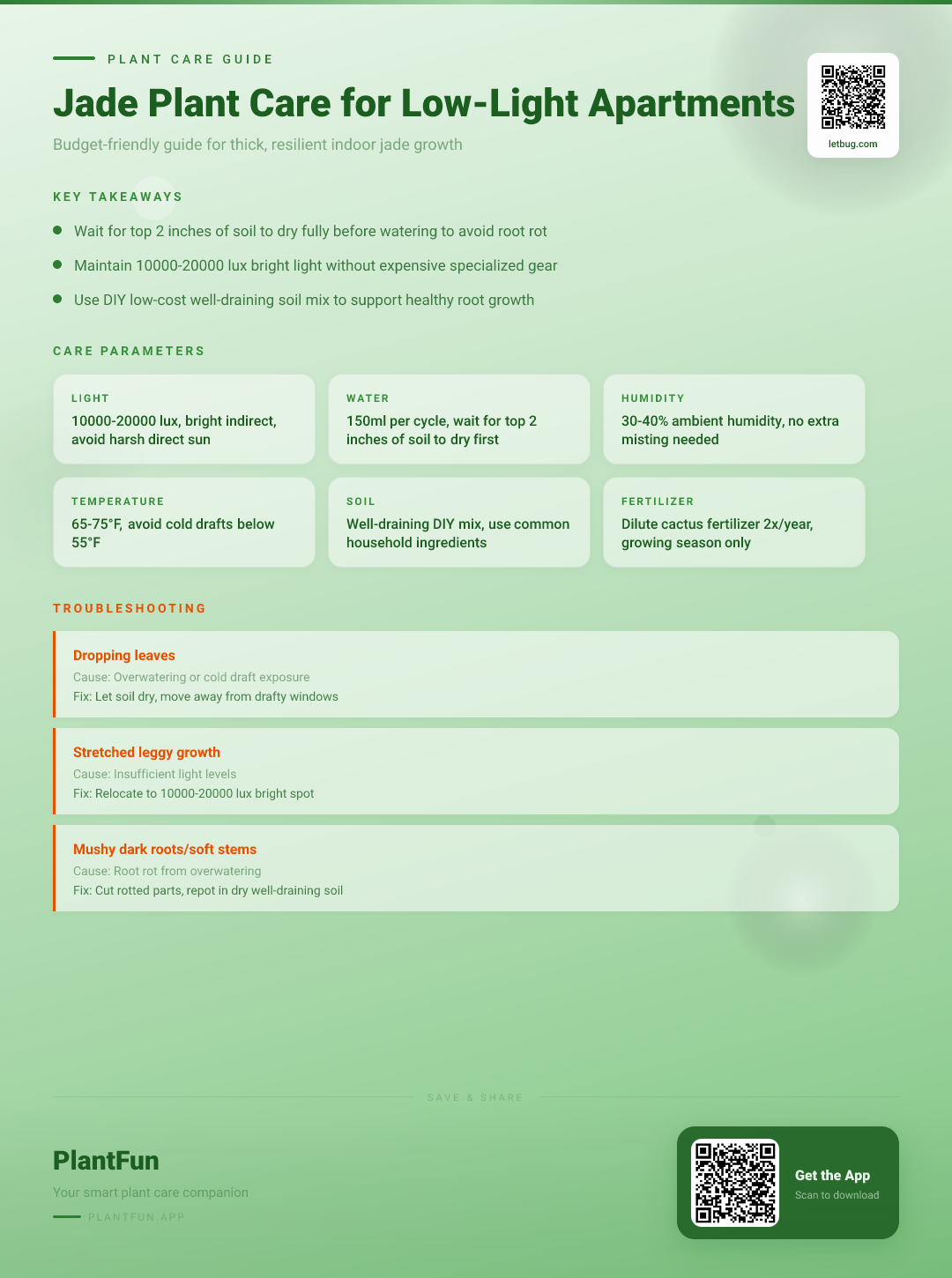
- Check soil moisture before watering — overwatering is the #1 killer of houseplants.
- Ensure your plant gets the right amount of light for its species.
- Be patient with recovery — most plants need 2–4 weeks to bounce back.
Quick Care Card: Essential Thresholds
| Feature | Requirement |
|---|---|
| Light | 15,000–20,000 lux |
| Temperature | 65–75°F (18–24°C) |
| Humidity | 30–40% |
| Water | ~150ml per cycle (when soil is dry) |
| Soil | Fast-draining, gritty mix |
| Fertilizer | Balanced 10-10-10 (diluted) |
| Toxicity | Toxic to cats and dogs (ASPCA, 2026) |
TL;DR: The Apartment Reality for Jade Plants
Yes, you can grow a thriving Crassula ovata in an apartment. Contrary to popular belief, they don’t need intense desert heat. They thrive when you provide bright, indirect light, allow the soil to dry completely between waterings, and keep them in a stable environment (NC State Extension, 2026). Avoid over-potting and focus on drainage to succeed.
My Experience: The “Over-Loving” Mistake
When I first got my Jade plant, I placed it in a dark corner and watered it every time the top looked dry. I thought I was being attentive, but I was actually suffocating the root system. My Jade started dropping leaves and developed soft, squishy stems. It wasn’t until I learned to treat it like a desert native—allowing the soil to reach bone-dry status—that I saw those signature woody trunks and plump, resilient leaves.
Why Jade Plants Struggle in Standard Apartments
Most apartments suffer from lower light levels and poor air circulation compared to a greenhouse. When we keep a Jade plant in a low-light area, the plant struggles to photosynthesize efficiently, leading to weak, elongated growth (etiolation). Furthermore, improper drainage in standard potting soil holds moisture too long, which invites root-rotting pathogens (Ravindran & Thomas, 2025).
Understanding Your Light: Optimizing 10,000–20,000 Lux Without Expensive Gear
Many assume Jades need direct sun, but in an apartment, a south or west-facing window is your best asset. If you lack a high-light window, place your Jade on a ledge directly against the glass. You don’t need fancy sensors; if your plant isn’t casting a distinct shadow, the light is insufficient (Halawa & Aisuwarya, 2023). Rotate the pot every two weeks to ensure even growth.
The Budget Watering Strategy: Why Less is Always More
How often to water your Jade plant? The answer isn’t a calendar date; it’s the “2-inch rule.” Stick your finger 2 inches into the soil. If it feels even slightly damp, do not water. When you do, use approximately 150ml of water to ensure the soil is moistened without water-logging the roots. This prevents the physiological stress that causes leaf drop.
Soil Science on a Budget: DIY Well-Draining Mixes
Don’t buy expensive “succulent mixes” if you are on a budget. You can make an excellent substrate by mixing 60% standard indoor potting soil with 40% coarse perlite or horticultural grit. This increases porosity, allowing excess water to escape and preventing the root rot commonly seen in stagnant soil environments.
Seasonal Care Calendar: Adapting to Apartment Temperature Shifts
- Spring/Summer: Growth phase. Water when dry and keep in the brightest light possible.
- Fall/Winter: Dormancy phase. Reduce water significantly—perhaps once a month. The lower light of winter means the plant uses less water (NC State Extension, 2026).
Common Mistakes to Avoid
- Mistake: Using a pot that is too large. What happens: Excessive soil holds too much moisture. Instead: Use a pot only 1–2 inches wider than the root ball.
- Mistake: Keeping it near a drafty window in winter. What happens: Sudden cold shocks cause leaf drop. Instead: Move the plant 2 feet away from the glass during freezing nights.
Voice Search FAQ
- Why is my Jade plant dropping leaves in my living room? This is usually a sign of overwatering or insufficient light. Check the soil moisture first.
- How often should I actually water my Jade plant? Only when the soil is dry through the top 2 inches. In low light, this might be once every 3–4 weeks.
- Can I put my Jade plant in the bedroom? Yes, but ensure it gets bright, indirect light; otherwise, it will become leggy.
Troubleshooting Guide
Etiolation (Leggy Growth)
Symptom: Stems are stretching, leaves are spaced far apart, and the plant leans toward the light.
Likely cause: The plant is starved for light (NC State Extension, 2026).
Fix:
- Move the plant to a brighter window.
- Prune the leggy stems to encourage branching.
Root Rot
Symptom: Lower leaves turn yellow or mushy, and the stem base looks dark/soft.
Likely cause: Water is trapped in the root zone for too long (Ravindran & Thomas, 2025).
Fix:
- Remove the plant from the pot and trim off black, mushy roots.
- Repot in a fresh, dry, gritty mix.
References
- Halawa, H.; Aisuwarya, R. (2023). Smart Plant Pot Robot with IoT Integration for Indoor Ornamental Plants Care. JITCE (Journal of Information Technology and Computer Engineering). https://doi.org/10.25077/jitce.7.2.97-106.2023. Accessed 2026-03-18.
- Ravindran, A.; Thomas, P. (2025). Flora Care: A Smart AI-Based System for Plant Disease Diagnosis and Plant Growth Identification. International Journal of Science and Research (IJSR). https://doi.org/10.21275/mr25425182032. Accessed 2026-03-18.
- ASPCA. (2026). Toxic and Non-Toxic Plants List. https://www.aspca.org/pet-care/animal-poison-control/toxic-and-non-toxic-plants. Accessed 2026-03-18.
- NC State Extension. (2026). Jade Plant Care. https://plants.ces.ncsu.edu/plants/jade-plant/. Accessed 2026-03-18.
Optional Helper: Plantfun.App
Plantfun.App identifies your plants by photo, diagnoses pests and diseases with clear fixes, and creates personalised watering and light schedules that adapt to your home conditions — a handy companion for putting this guide into daily practice.
Found an error or have suggestions? We'd love your feedback.
Need help identifying this problem?
Get instant identification, personalized care schedules, and effective pest treatment plans directly on your phone.
Sponsored • We may earn a commission from app downloads
Related Guides
The Complete Jade Plant Care Checklist for Thriving Growth in Small Urban Apartments
Grow a lush, resilient jade plant in your small urban apartment with this zero-cost checklist, including exact light levels, watering amounts, and seasonal care tips you can implement today.
Care GuideJade Plant Care for Low-Light Apartments: A Resilient Growth Strategy for Urban Growers
Transform your leggy Jade into a compact, vibrant centerpiece. Follow our precise light and water thresholds to master indoor succulent care in small spaces.
Care GuideThe Complete Jade Plant Care Checklist for Resilient Growth in Low-Light Studio Apartments
Grow a lush, thriving jade plant even in your dim studio apartment. Grab our free budget-friendly care checklist with exact light, water, and soil tips to avoid common growth issues.
Pest ControlAnts on Plants: What They Mean and What to Do
Ants usually aren't eating your plant. They are farming other pests.