
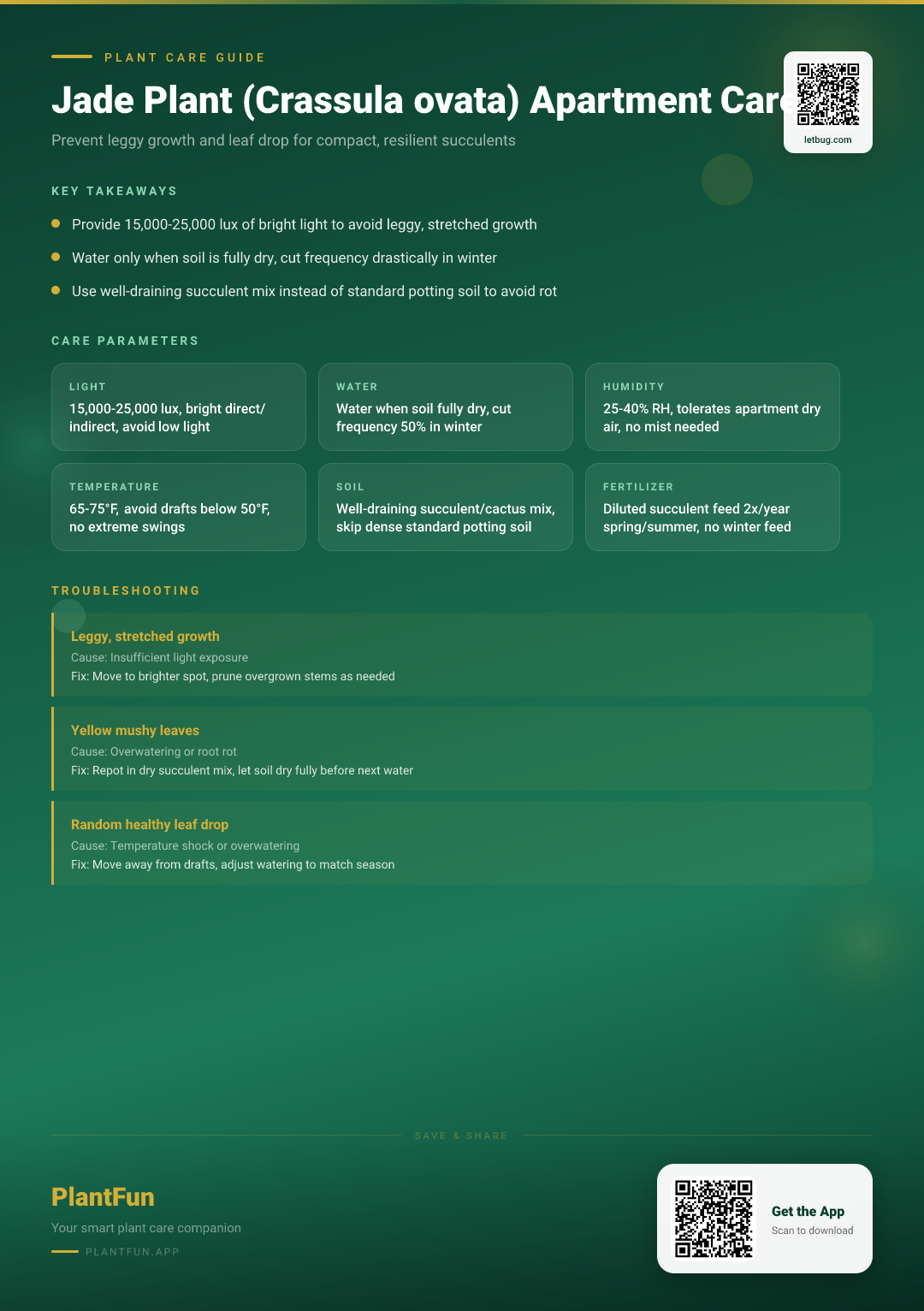
Key Takeaways
- Check soil moisture before watering — overwatering is the #1 killer of houseplants.
- Ensure your plant gets the right amount of light for its species.
- Be patient with recovery — most plants need 2–4 weeks to bounce back.
Quick Care Card: Essential Thresholds
| Feature | Requirement |
|---|---|
| Light | 15,000–25,000 lux |
| Water | Allow soil to dry 100% between waterings |
| Humidity | 25–40% (Low to moderate) |
| Temperature | 65–75°F (18–24°C) |
| Soil | Well-draining, grit-heavy mix |
| Fertilizer | Balanced 10-10-10 (diluted) in spring |
| Toxicity | Toxic to cats and dogs (ASPCA, 2026) |
TL;DR: The 3 Golden Rules for Apartment Jade Success
To keep your Crassula ovata thriving, follow these three rules: (1) Place it in the brightest window you have; Jades need high intensity to stay compact. (2) Never water on a schedule—only water when the leaves feel slightly soft or the soil is bone dry. (3) Use a pot with a drainage hole to prevent root rot. When I first started collecting succulents, I treated my Jade like a tropical fern. I made the mistake of watering it every week, which quickly led to leaf drop and mushy stems.
Why Your Apartment Jade Looks ‘Leggy’: The Light-Deficiency Connection
“Legginess” or etiolation is the plant’s desperate search for a better light source. In an apartment, your plant may be receiving only a fraction of the 15,000–25,000 lux it requires (NC State Extension, 2026). When light is insufficient, the internodes (the stem space between leaves) stretch out, resulting in a weak, drooping structure. If your Jade is leaning heavily toward the window, it is signaling that its light environment is inadequate. Rotate the pot every time you water to ensure even exposure, or supplement with a dedicated grow light if your natural light levels are consistently low.
The Watering Paradox: Why Less is Always More in Low-Flow Air
Apartments often have stagnant air, which means soil takes much longer to dry than it would in a greenhouse or outdoor environment. Overwatering is the most common cause of root suffocation. As noted in recent research on smart monitoring, root health is highly dependent on precise moisture identification (Halawa & Aisuwarya, 2023). Always perform the “finger test”: insert your finger two inches deep into the soil. If you feel any dampness, wait. The plant is a succulent; it is designed to store water in its leaves, not its roots.
Seasonal Maintenance: Adjusting Care from High-Sun Summer to Dim Winter
Your Jade needs a “dormancy” period. In the winter, growth naturally slows due to lower light levels (NC State Extension, 2026). Reduce your watering frequency by at least 50% compared to summer. If you keep the plant in a room that drops below 60°F, be even more cautious, as cold, wet soil is a death sentence for succulents.
Common Mistakes: Identifying Overwatering vs. Underwatering Symptoms
Overwatered Jade Plant
Symptom: Lower leaves turn yellow and become mushy or transparent.
Likely cause: Excess moisture trapped in the root zone.
Fix:
- Remove the plant from the pot and inspect the roots for dark, slimy textures.
- Repot into a dry, porous succulent mix and wait at least 10 days to water again.
Underwatered Jade Plant
Symptom: Leaves appear wrinkled or shriveled.
Likely cause: The plant is utilizing its internal water storage to survive.
Fix:
- Submerge the bottom of the pot in water for 15 minutes to hydrate the root ball.
- Move the plant to a spot with slightly less direct heat to slow evaporation.
How to Fix a Leaning or Top-Heavy Jade (The Pruning Guide)
If your Jade has become too top-heavy, don’t fear the shears. Pruning actually encourages the plant to develop a thicker, woodier trunk. Use clean, sterile scissors and cut just above a leaf node. This will signal the plant to branch out into two new stems from the cut point, creating a bushier, more structurally sound plant. Learn more about managing your indoor plant health to ensure your pruning cuts heal properly.
Why is my Jade plant dropping healthy-looking leaves?
This is usually caused by sudden environmental changes, such as moving the plant from a dark corner to direct sun, or sudden cold drafts. Ensure the temperature remains consistent between 65–75°F (NC State Extension, 2026).
How often should I water my indoor Jade plant in the winter?
In winter, you may only need to water once every 4–6 weeks. Always check the soil dryness first; if the leaves aren’t puckering, the plant doesn’t need water.
Can I save a Jade plant that has been sitting in water-logged soil?
Yes, but you must act fast. Gently remove the plant, trim away any black, mushy roots, and let the remaining healthy root ball air-dry for 24 hours before repotting in fresh, coarse soil.
The Soil Science: Why Standard Potting Mix is Killing Your Jade
Standard potting soil retains too much water. A Jade requires a medium with high aeration. I always mix 50% standard indoor potting soil with 50% inorganic components like perlite, pumice, or coarse sand. This mimics the plant’s native rocky habitat and prevents the compaction that leads to root rot (Ravindran & Thomas, 2025).
References
- Halawa, H., & Aisuwarya, R. (2023). Smart Plant Pot Robot with IoT Integration for Indoor Ornamental Plants Care. JITCE (Journal of Information Technology and Computer Engineering). https://doi.org/10.25077/jitce.7.2.97-106.2023. Accessed 2026-03-17.
- Ravindran, A., & Thomas, P. (2025). Flora Care: A Smart AI-Based System for Plant Disease Diagnosis and Plant Growth Identification. International Journal of Science and Research (IJSR). https://doi.org/10.21275/mr25425182032. Accessed 2026-03-17.
- ASPCA. (2026). Toxic and Non-Toxic Plants List — ASPCA. https://www.aspca.org/pet-care/animal-poison-control/toxic-and-non-toxic-plants. Accessed 2026-03-17.
- NC State Extension. (2026). Jade Plant Care — NC State Extension Gardener Plant Toolbox. https://plants.ces.ncsu.edu/plants/jade-plant/. Accessed 2026-03-17.
Optional Helper: Plantfun.App
Plantfun.App identifies your plants by photo, diagnoses pests and diseases with clear fixes, and creates personalised watering and light schedules that adapt to your home conditions — a handy companion for putting this guide into daily practice.
Found an error or have suggestions? We'd love your feedback.
Need help identifying this problem?
Get instant identification, personalized care schedules, and effective pest treatment plans directly on your phone.
Sponsored • We may earn a commission from app downloads
Related Guides
The Complete Jade Plant Care Checklist for Thriving Growth in Small Urban Apartments
Grow a lush, resilient jade plant in your small urban apartment with this zero-cost checklist, including exact light levels, watering amounts, and seasonal care tips you can implement today.
Care GuideThe Complete Jade Plant Care Checklist for Budget-Friendly Resilient Growth in Typical Apartments
Grow a lush, thick jade plant in your typical apartment without spending extra on specialty supplies. Get our free 7-step checklist, exact watering schedules, and light thresholds for zero-fuss resilient growth.
Care GuideThe Complete Jade Plant Care Checklist for Resilient Growth in Small Urban Apartments
Grow a lush, unkillable jade plant even in a tiny urban apartment. Get exact light levels, watering amounts, space-saving hacks, and a seasonal checklist for resilient, compact growth.
Pest ControlAnts on Plants: What They Mean and What to Do
Ants usually aren't eating your plant. They are farming other pests.