
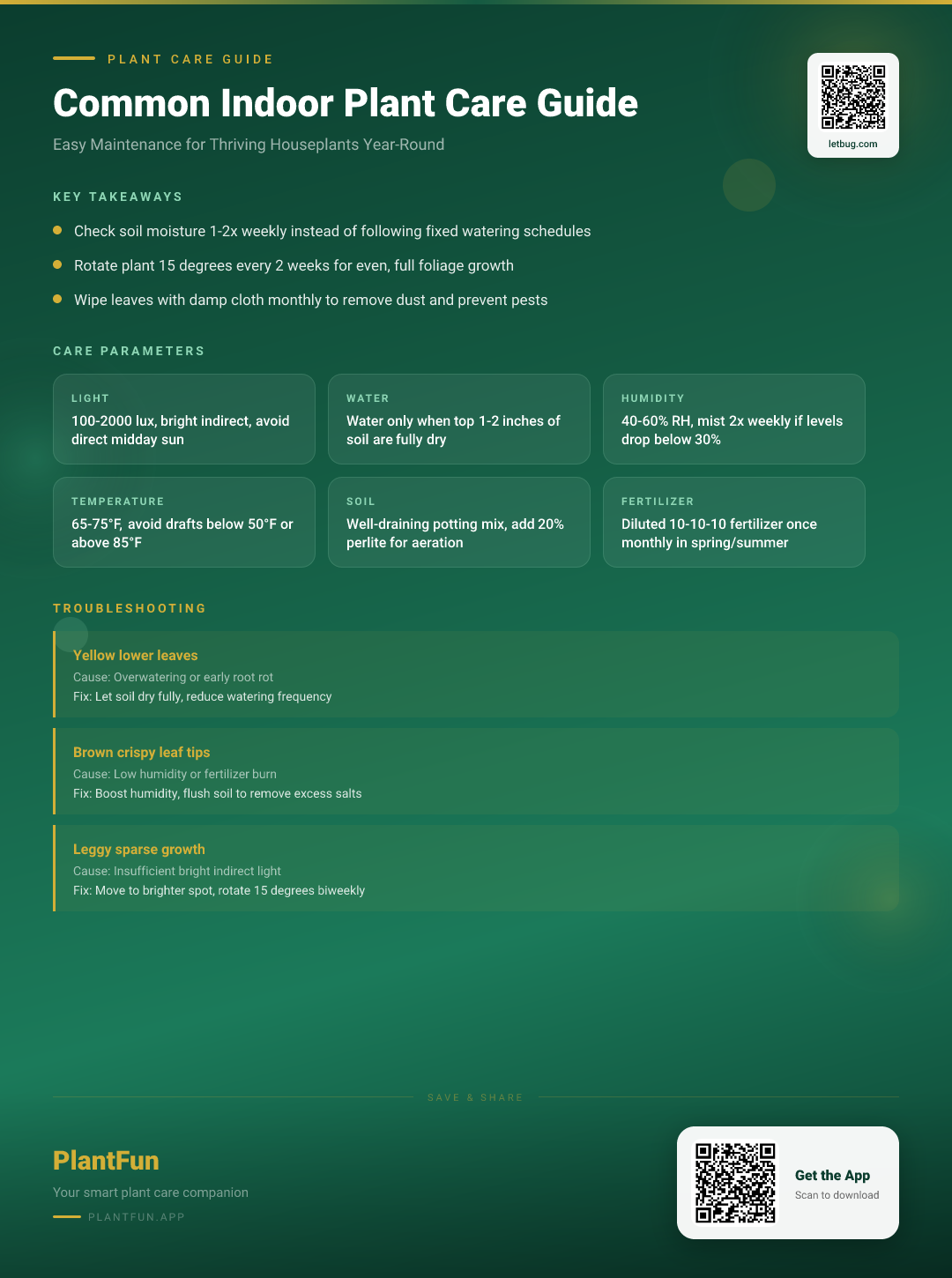
Key Takeaways
- Check soil moisture before watering — overwatering is the #1 killer of houseplants.
- Ensure your plant gets the right amount of light for its species.
- Be patient with recovery — most plants need 2–4 weeks to bounce back.
Quick diagnosis checklist
Spend 60 seconds checking your plants for these common symptoms to identify issues fast:
- ✅ Yellow lower leaves: Overwatering or nutrient deficiency
- ✅ Crispy brown leaf edges: Low humidity, underwatering, or fertilizer salt buildup
- ✅ Drooping leaves: Underwatering, overwatering, or sudden temperature shock
- ✅ No new growth in spring/summer: Insufficient light or root-bound conditions
- ✅ Sticky residue on leaf surfaces: Pest infestation (mealybugs, aphids, or scale)
- ✅ Pale, bleached leaf spots: Too much unfiltered direct sunlight
Root causes and risk factors
Most indoor plant health issues stem from mismatched environmental conditions to your plant’s native habitat, per peer-reviewed horticultural research:
- Incorrect light levels: A 2021 study of common indoor ornamental plants found that species have distinct light requirements, ranging from 1000 lux for low-light tolerant varieties to 5000 lux for sun-loving tropicals (Gautam et al, 2021). Too little light stunts growth, while too much causes leaf burn.
- Inappropriate humidity: High-humidity adapted Araceae species (monstera, pothos, philodendron) rely on aerial roots to absorb moisture from the air, and perform poorly when ambient humidity drops below 40% (Sheeran & Rasmussen, 2023).
- Overwatering or underwatering: Most indoor plant deaths are linked to irregular watering practices, as most species prefer consistently moist (not soggy) soil.
- Toxicity risks: Many popular indoor plants contain compounds that are harmful to pets and children if ingested, so proper placement is critical for household safety (ASPCA, 2026).
Step-by-step action plan
Follow these measurable, actionable steps to set up a sustainable plant care routine for all your indoor plants:
- Match plants to their light needs: Use a light meter app or the hand test: hold your palm 1 foot from the plant’s location at midday. A clear shadow means bright indirect light (3000-5000 lux, ideal for monstera, fiddle leaf fig), a faint shadow means low light (1000-2000 lux, ideal for snake plants, ZZ plants) (Gautam et al, 2021). Move plants to match their requirements.
- Water only when needed: Stick your index finger 2 inches deep into the soil. If completely dry, water until 10% of the pot’s total volume drains out the bottom (e.g., 150ml of water for a 1.5L pot). If damp, wait 2-3 days and retest.
- Adjust humidity for sensitive species: If your home humidity is below 40%, group plants together to raise ambient humidity by 10-15%, or place a pebble tray filled with water under the pot (do not submerge the pot base) (Sheeran & Rasmussen, 2023).
- Verify pet safety: Cross-reference all your plants with the ASPCA toxic and non-toxic plants list, and place toxic varieties at least 5 feet off the ground out of reach of dogs, cats, and young children (ASPCA, 2026).
- Fertilize only during active growth: Apply diluted balanced 10-10-10 NPK liquid fertilizer at ½ the recommended strength once every 4 weeks from March to September, and skip fertilization entirely in winter.
Common mistakes to avoid
- Mistake: Watering plants on a fixed weekly schedule regardless of soil moisture What happens: Overwatering causes root rot, yellowing leaves, and fungal growth, and is the leading cause of indoor plant death Instead: Use the 2-inch finger test to check soil moisture every 3-4 days, and only water when the top 2 inches are completely dry
- Mistake: Placing all indoor plants directly in south-facing windows for maximum light What happens: Unfiltered direct sunlight burns shade-adapted tropical plants, causing permanent brown bleached spots on leaves Instead: Position sun-loving plants (succulents, bird of paradise) within 1 foot of south-facing windows, and shade-loving plants (pothos, ferns) 3-5 feet away or behind a sheer curtain (Gautam et al, 2021)
- Mistake: Trimming off aerial roots on monstera and philodendron plants What happens: Aerial roots support moisture and nutrient uptake for Araceae species, so removing them reduces growth rate and overall plant health (Sheeran & Rasmussen, 2023) Instead: Tuck aerial roots into the top layer of soil, or train them to climb a moss pole for extra support
- Mistake: Assuming all popular houseplants are safe for pets What happens: Many common indoor plants (pothos, lilies, sago palm) are toxic to cats and dogs, causing vomiting, diarrhea, or even kidney damage if ingested Instead: Verify every plant’s toxicity status via the ASPCA database before bringing it home, and keep toxic varieties in pet-free areas (ASPCA, 2026)
Action Checklist
Use this recurring checklist to stay on top of plant care without extra work:
Weekly
✅ Test soil moisture for all potted plants ✅ Wipe dust off leaf surfaces to improve light absorption ✅ Check leaf undersides for signs of pest activity
Monthly
✅ Rotate plants ¼ turn to ensure even, balanced growth ✅ Flush soil with 3x the pot volume of water to remove fertilizer salt buildup ✅ Test home humidity levels with a low-cost hygrometer
Quarterly
✅ Gently tip plants out of their pots to check for root-bound conditions (roots circling the edge of the root ball) ✅ Repot if root-bound, using a pot 1-2 inches larger than the current one with drainage holes ✅ Refresh the top 1 inch of soil with fresh potting mix for plants you don’t repot that season
FAQ and Summary
FAQ
- Can I put my pothos in a windowless bathroom? Pothos can survive in low light as low as 1000 lux, but they will not produce new growth without a light source. If your bathroom has no natural light, add a 10W LED grow light set to run 8 hours per day to support healthy growth (Gautam et al, 2021).
- How often should I mist my indoor plants? Misting only provides temporary humidity relief that lasts 15-30 minutes. For consistent, long-term humidity for sensitive species, use a pebble tray or small cool-mist humidifier to maintain 40-60% ambient humidity (Sheeran & Rasmussen, 2023).
- Can I use tap water for my indoor plants? Most indoor plants tolerate standard tap water, but heavily chlorinated or hard water can cause brown leaf edges from salt buildup. Let tap water sit out overnight to dissipate chlorine, or use collected rainwater for sensitive species like calathea and maidenhair ferns.
- Are snake plants toxic to cats? Yes, snake plants (sansevieria) are classified as toxic to cats and dogs by the ASPCA, as they contain saponins that cause vomiting, diarrhea, and lethargy if ingested (ASPCA, 2026). Keep them on high shelves or in rooms your pets do not have access to.
Optional Helper: Plantfun.App
Plantfun.App identifies your plants by photo, diagnoses pests and diseases with clear fixes, and creates personalised watering and light schedules that adapt to your home conditions — a handy companion for putting this guide into daily practice.
Summary
This indoor plant guide provides all the practical plant care guidance you need to keep your indoor plants thriving year-round. Start with the 60-second quick diagnosis to spot issues early, address root causes like mismatched light or low humidity, and follow the step-by-step action plan to build a low-effort sustainable care routine. Avoid the most common plant care mistakes, use the recurring action checklist to stay on track, and always verify plant toxicity if you have pets or small children in your home.
References
- Gautam, B.; Dubey, R.; Kaur, N. (2021). GROWTH RESPONSE OF INDOOR ORNAMENTAL PLANT SPECIES TO VARIOUS ARTIFICIAL LIGHT INTENSITIES (LED) IN AN INDOOR VERTICAL GARDEN. PLANT ARCHIVES. https://doi.org/10.51470/plantarchives.2021.v21.no1.096. Accessed 2026-03-09.
- Sheeran, L.; Rasmussen, A. (2023). Aerial roots elevate indoor plant health: Physiological and morphological responses of three high‐humidity adapted Araceae species to indoor humidity levels. Plant, Cell & Environment. https://doi.org/10.1111/pce.14568. Accessed 2026-03-09.
- ASPCA. (2026). Toxic and Non-Toxic Plants List — ASPCA. American Society for the Prevention of Cruelty to Animals. https://www.aspca.org/pet-care/animal-poison-control/toxic-and-non-toxic-plants. Accessed 2026-03-09.
Found an error or have suggestions? We'd love your feedback.
Need help identifying this problem?
Get instant identification, personalized care schedules, and effective pest treatment plans directly on your phone.
Sponsored • We may earn a commission from app downloads
Related Guides
Golden Pothos Care for Apartment Living: A Resilient Guide for Dim, Small Spaces
Transform your small apartment into a lush oasis with our expert Golden Pothos care guide. Get precise light, watering, and growth thresholds for resilient vines.
Care GuideMoney Tree Care for Busy Apartments: The Complete Guide to Resilient Indoor Growth
Transform your apartment into a lush sanctuary. Master Money Tree care with expert light, water, and humidity thresholds designed to keep your plant thriving.
Care GuidePilea Peperomioides in Low-Light Apartments: The Complete Care Guide for Resilient Growth
Transform your Pilea's growth in low-light apartments. Use these exact lux, watering, and soil protocols to stop leaf drop and encourage a bushy, vibrant plant.
Pest ControlAnts on Plants: What They Mean and What to Do
Ants usually aren't eating your plant. They are farming other pests.