
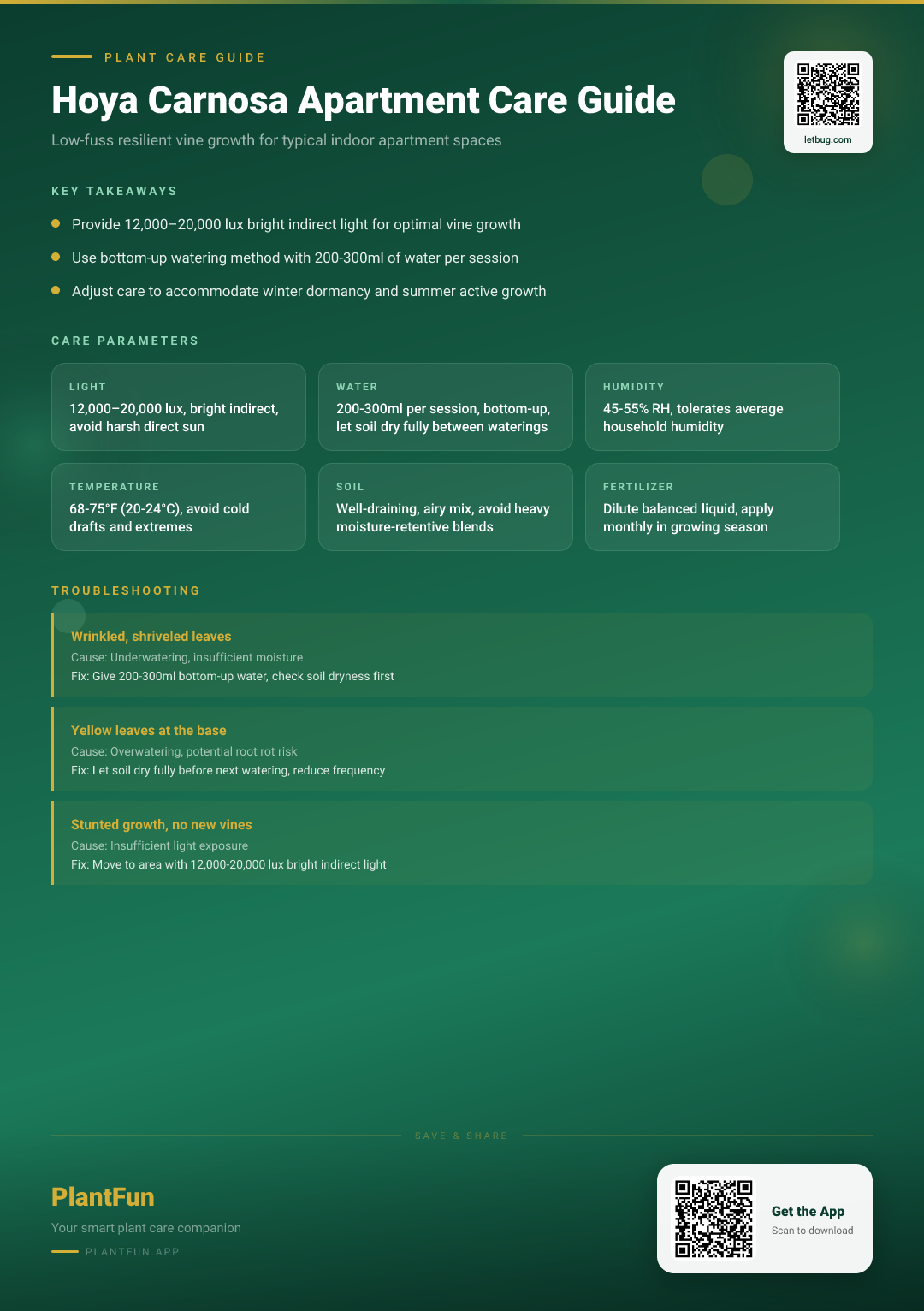
Key Takeaways
- Check soil moisture before watering — overwatering is the #1 killer of houseplants.
- Ensure your plant gets the right amount of light for its species.
- Be patient with recovery — most plants need 2–4 weeks to bounce back.
Quick Care Card: Essential Thresholds for Hoya Success
| Feature | Requirement |
|---|---|
| Light | 12,000–20,000 lux (Bright, indirect) |
| Watering | 200–300ml when top 2 inches are dry |
| Humidity | 45–55% Relative Humidity (RH) |
| Temperature | 68–75°F (20–24°C) |
| Soil | Chunky, well-draining aroid mix |
| Fertilizer | Balanced liquid feed, monthly in summer |
| Toxicity | Non-toxic to cats and dogs (ASPCA, 2026) |
TL;DR: Why Hoya Carnosa Is the Perfect Apartment Companion
Hoya carnosa is a drought-tolerant, succulent-like vine that thrives in moderate indoor conditions. Because it is a CAM (Crassulacean Acid Metabolism) plant, it is uniquely adapted to conserve water (Singh et al., 1984), making it incredibly resilient for apartment dwellers who may occasionally miss a watering cycle. It requires bright, indirect light and minimal fuss, making it ideal for the modern home.
Understanding the Habitat: How Hoyas Adapt to Interior Conditions
When I first got my Hoya carnosa, I treated it like a thirsty tropical fern. I made the mistake of keeping the soil consistently damp, which led to a near-death experience for the roots. In their native epiphytic habitats, these plants grow on trees, receiving dappled sunlight and frequent airflow. Understanding this helps us replicate their environment in an apartment using basic indoor plant care tips.
Light Requirements: Targeting 12,000–20,000 lux for Optimal Growth
Hoyas need light, but not the harsh, scorching rays of a south-facing window at high noon. I use a simple light meter app to target 12,000–20,000 lux. If you lack a meter, aim for a spot where the plant can “see” the sky but not the sun. If your leaves are dark green and spaced far apart, the plant is searching for more light; this is a clear sign your Hoya light requirements are not being met.
Watering Mastery: Using the ‘Bottom-Up’ Approach for 200–300ml Hydration
Instead of overhead watering—which can trap moisture in the leaf axils—I use the bottom-up method.
- Fill a basin with 200–300ml of water.
- Place the nursery pot inside for 15–20 minutes.
- Allow excess water to drain fully. This ensures the root ball is hydrated without risking stem rot. Always wait until the top 2 inches of soil are dry to the touch before repeating.
Humidity and Temperature: Managing 45-55% RH and 68-75°F (20-24°C) Ranges
Most apartments fall within the 45-55% RH range, which is sufficient for Hoya carnosa. They are quite tolerant of the 68–75°F (20–24°C) range common in residential living. Avoid placing them directly in front of A/C vents or radiators, as sudden temperature fluctuations can shock the plant and stall growth (NC State Extension, 2026).
Soil Science: Creating a Budget-Friendly Well-Draining Mix
To achieve the perfect Hoya potting mix recipe, I combine equal parts:
- High-quality orchid bark (for aeration)
- Perlite (for drainage)
- Coco coir or peat moss (for moisture retention) This mix prevents the roots from sitting in stagnant water, which is essential for resilient Hoya care.
Seasonal Care Calendar: Adjusting for Winter Dormancy vs Summer Vigor
- Spring/Summer: This is peak growth time. Increase watering frequency and apply a balanced fertilizer once per month to encourage those iconic, star-shaped blooms (Kuang et al., 2023).
- Autumn/Winter: As light levels drop, growth slows. Reduce watering significantly—I often wait an extra week during these months—and cease all fertilization.
Common Mistakes to Avoid: Why Leaf Wrinkling Happens
- Mistake: Constant misting. What happens: Fungal issues on the leaves. Instead: Use a humidifier or group plants to elevate local humidity.
- Mistake: Using a pot without holes. What happens: Root rot and Hoya leaves wrinkling. Instead: Use a terracotta or plastic pot with drainage holes.
Yellowing Leaves
Symptom: Lower leaves turning yellow and mushy.
Likely cause: Overwatering leading to root suffocation.
Fix:
- Gently unpot the plant to inspect roots.
- Trim any blackened, mushy roots with sterilized shears.
- Re-pot into fresh, dry, well-draining media.
Voice Search FAQ: How do I know if my Hoya needs more light?
If your plant is stretching, with long spaces between leaves (internodes), it is “leggy.” This indicates the plant is searching for light. Move it closer to a window, but introduce it to the new position gradually over a week to prevent leaf burn.
Voice Search FAQ: Why are my Hoya leaves yellowing at the base?
Why is my Hoya yellowing at the base? This is usually the first sign of overwatering. Ensure your pot has drainage and allow the soil to dry out significantly more between watering sessions.
Voice Search FAQ: Can I grow a Hoya in a room without a window?
While Hoyas are resilient, they are not low-light plants. Growing a Hoya in a room without a window is only possible if you supplement with a high-quality, full-spectrum LED grow light set to an 8–10 hour cycle to meet their energy needs.
References and Scientific Sources for Hoya Cultivation
- Singh, B.; Greenberg, E.; Preiss, J. (1984). ADPglucose Pyrophosphorylase from the CAM Plants Hoya carnosa and Xerosicyos danguyi. Plant Physiology. https://doi.org/10.1104/pp.74.3.711. Accessed 2026-03-18.
- Kuang, Y.; Jia, R.; Balslev, H. (2023). Ontogeny of the pollinium in Hoya carnosa provides new insights into microsporogenesis. Plant Reproduction. https://doi.org/10.1007/s00497-023-00460-z. Accessed 2026-03-18.
- ASPCA. (2026). Toxic and Non-Toxic Plants List — ASPCA. https://www.aspca.org/pet-care/animal-poison-control/toxic-and-non-toxic-plants. Accessed 2026-03-18.
- NC State Extension. (2026). Hoya Carnosa — NC State Extension Gardener Plant Toolbox. https://plants.ces.ncsu.edu/plants/hoya-carnosa/. Accessed 2026-03-18.
Optional Helper: Plantfun.App
Plantfun.App identifies your plants by photo, diagnoses pests and diseases with clear fixes, and creates personalised watering and light schedules that adapt to your home conditions — a handy companion for putting this guide into daily practice.
Found an error or have suggestions? We'd love your feedback.
Need help identifying this problem?
Get instant identification, personalized care schedules, and effective pest treatment plans directly on your phone.
Sponsored • We may earn a commission from app downloads
Related Guides
Hoya Carnosa in a Low-Humidity Apartment: The Complete Care Guide for Resilient Growth
Revive your Hoya Carnosa with expert light and water metrics. Learn how to maintain lush, wax-like foliage in dry apartment air with this 5-step care manual.
Care GuideHoya Carnosa in a Drafty Apartment: The Seasonal Care Checklist for Resilient Growth
Stabilize your Hoya Carnosa in changing apartment climates with this expert guide. Master the exact light, water, and seasonal shifts needed for consistent growth.
Care GuideHoya Carnosa in Drafty North-Facing Entryways: The Only Care Guide You’ll Ever Need
Stop losing leaves on your entryway Hoya carnosa. Get exact lux levels, humidity targets, and a 4-season care routine to keep your wax plant blooming even in cold, drafty, low-light entry spaces.
Pest ControlAnts on Plants: What They Mean and What to Do
Ants usually aren't eating your plant. They are farming other pests.