
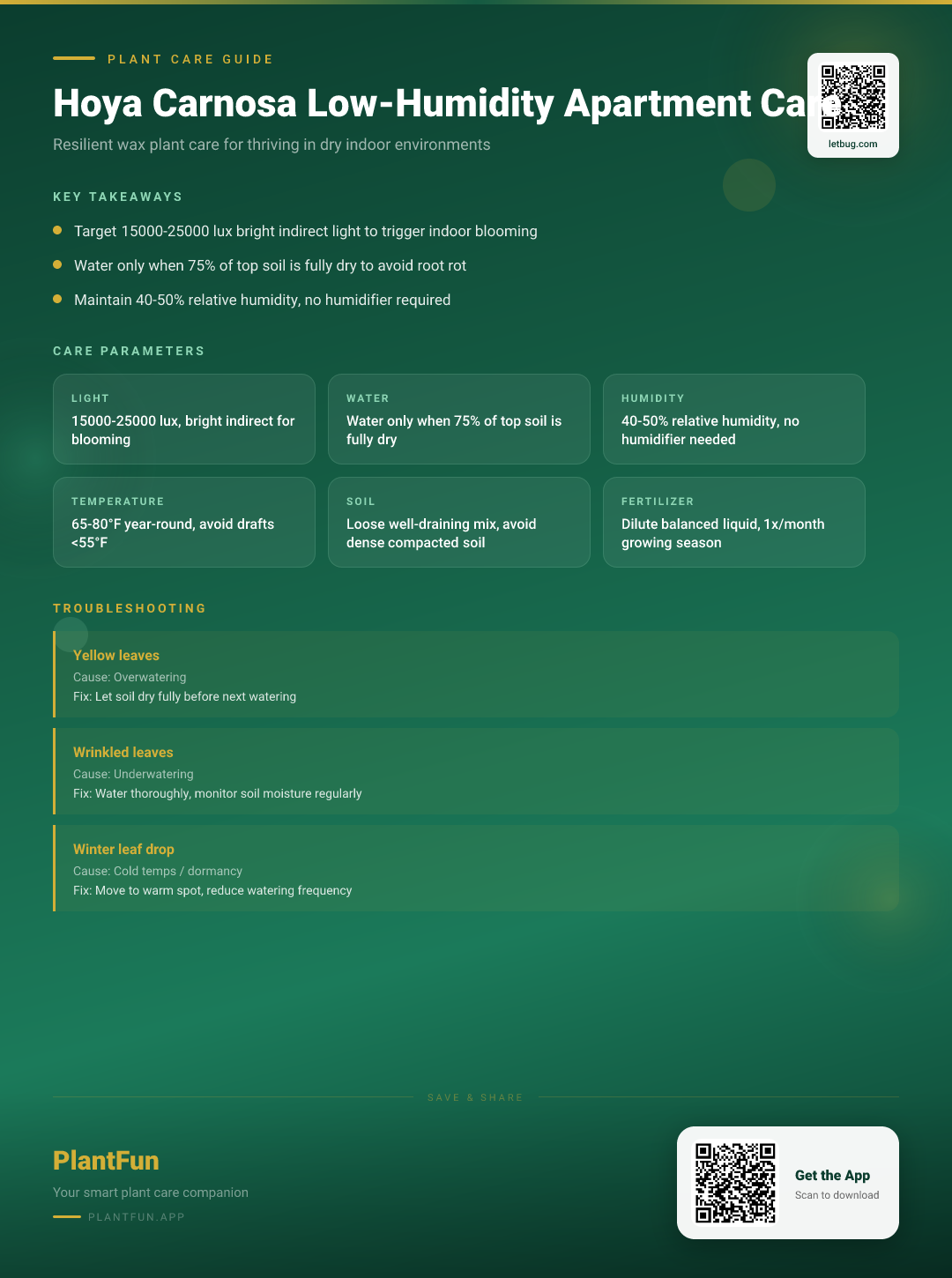
Key Takeaways
- Check soil moisture before watering — overwatering is the #1 killer of houseplants.
- Ensure your plant gets the right amount of light for its species.
- Be patient with recovery — most plants need 2–4 weeks to bounce back.
Quick Care Card: Essential Metrics for Success
| Feature | Requirement |
|---|---|
| Light | 15,000–25,000 lux (bright, indirect) |
| Watering | When soil is 75% dry |
| Humidity | 40–50% (Ambient apartment levels are fine) |
| Temperature | 65–80°F (18–27°C) |
| Soil | Chunky, well-draining aroid mix |
| Fertilizer | Balanced liquid feed during active growth |
| Toxicity | Non-toxic to pets (ASPCA, 2026) |
TL;DR: Why Hoya Carnosa Is the Ultimate Apartment Survivor
Hoya Carnosa is a robust epiphyte that thrives on neglect rather than constant pampering. Unlike tropical ferns, it stores water in its thick, waxy leaves, making it perfect for apartments with inconsistent care schedules. If you provide bright, indirect light and allow the soil to dry out significantly between waterings, you can expect long-lasting blooms and vining growth even in standard indoor humidity.
The Biology of the Wax Plant: Why Your Apartment Is Its Perfect Natural Habitat
When I first got my Hoya Carnosa, I treated it like a thirsty tropical. I made the mistake of keeping it in dense, wet soil, which led to premature root rot. I eventually learned that this plant is a CAM (Crassulacean Acid Metabolism) plant. As noted in research on the metabolic pathways of this species, the plant is biologically optimized for periods of drought (Singh, Greenberg, and Preiss, 1984). Its ability to manage its internal water stores through specialized leaf tissues makes it remarkably resilient to the dry, climate-controlled air of modern apartments.
Step 1: Mastering Light (Targeting 15,000–25,000 lux for indoor blooming)
For a Hoya to bloom, it requires more than just “bright” light; it needs sustained, bright, indirect exposure. I use a light meter to target 15,000–25,000 lux. If you don’t have a meter, place the plant directly in an east-facing window where it can catch the gentle morning sun. If your Hoya is stretching—meaning it has long, leafless stems—it is starving for light.
Step 2: Precision Watering (How to measure when the soil is 75% dry)
Stop relying on a rigid calendar. Instead, use the “finger test.” Insert your finger at least two inches into the potting medium. If the soil feels cool or damp, hold off. Your Hoya should reach a state of 75% dryness, where the mix feels mostly loose and dry to the touch, before you saturate the pot. Ensure you use well-draining soil mixes to prevent water logging.
Step 3: Humidity Management (Achieving 40-50% relative humidity without a humidifier)
Hoya Carnosa is not a humidity-hog. My experience shows that 40–50% humidity—the typical range for most homes—is perfectly adequate. Avoid the temptation to buy a humidifier. Instead, focus on proper ventilation, which prevents fungal issues that often plague high-humidity environments.
Step 4: Temperature Control (Keeping your Hoya between 65-80°F for year-round growth)
Consistency is king. I keep my Hoyas away from heating vents and AC drafts. A stable range of 65–80°F (18–27°C) mimics their natural environment, preventing the stress-induced dormancy that can occur during sharp temperature fluctuations (NC State Extension, 2026).
Seasonal Care Calendar: Adjusting your routine from spring growth to winter dormancy
- Spring/Summer: Increase watering frequency as temperatures rise. Apply a balanced fertilizer every 4–6 weeks.
- Autumn: Gradually decrease watering as the days shorten and growth slows.
- Winter: Allow the plant to stay drier for longer. Stop all fertilizing to avoid salt buildup in the soil.
Myth-Busting: Should I mist my Hoya leaves for humidity?
No. Misting provides negligible humidity for only a few minutes and often leaves behind mineral deposits or promotes bacterial growth on the wax-like leaf surface. It does not replicate the sustained atmospheric moisture the plant requires to thrive.
FAQ
Why is my Hoya dropping leaves in the middle of winter?
This is usually a reaction to overwatering during the plant’s natural dormancy phase. Even if the plant looks dry, it is consuming less energy in winter. Scale back your Hoya watering schedule immediately.
Can I put my Hoya in low light?
While the plant may survive in low light for a short time, it will not bloom, and it will become susceptible to pests. For the long-term health of the plant, always prioritize a bright, window-adjacent spot.
How do I know if my Hoya needs more light?
Look for internodal spacing: if the distance between leaf sets is greater than 2 inches, the plant is “reaching” and needs a brighter location.
Common Mistakes to Avoid
- Mistake: Using standard peat-heavy indoor potting soil. What happens: The soil holds too much water, suffocating the roots. Instead: Use a mix of orchid bark, perlite, and coco coir to maximize aeration.
- Mistake: Over-potting the plant. What happens: Excess soil stays wet for too long, leading to root rot. Instead: Always choose a pot only 1-2 inches wider than the root ball.
Troubleshooting: Reading the signals of wrinkled vs. yellow leaves
Wrinkled, thin leaves
Symptom: Leaves lose their turgidity and feel soft or papery.
Likely cause: Chronic underwatering or root damage that prevents hydration.
Fix:
- Check the soil moisture levels immediately.
- If the soil is bone-dry, give the plant a thorough soak.
Yellowing leaves
Symptom: Lower leaves turning yellow and eventually dropping off.
Likely cause: Overwatering leading to root suffocation.
Fix:
- Remove the plant from the pot and inspect the roots.
- Trim away mushy, black roots and repot in fresh, dry, porous medium.
References
- Singh, B., Greenberg, E., and Preiss, J. (1984). ADPglucose Pyrophosphorylase from the CAM Plants Hoya carnosa and Xerosicyos danguyi. Plant Physiology. https://doi.org/10.1104/pp.74.3.711. Accessed 2026-03-17.
- Kuang, Y., Jia, R., and Balslev, H. (2023). Ontogeny of the pollinium in Hoya carnosa provides new insights into microsporogenesis. Plant Reproduction. https://doi.org/10.1007/s00497-023-00460-z. Accessed 2026-03-17.
- ASPCA. (2026). Toxic and Non-Toxic Plants List — ASPCA. https://www.aspca.org/pet-care/animal-poison-control/toxic-and-non-toxic-plants. Accessed 2026-03-17.
- NC State Extension. (2026). Hoya Carnosa — NC State Extension Gardener Plant Toolbox. https://plants.ces.ncsu.edu/plants/carnosa-care/. Accessed 2026-03-17.
Optional Helper: Plantfun.App
Plantfun.App identifies your plants by photo, diagnoses pests and diseases with clear fixes, and creates personalised watering and light schedules that adapt to your home conditions — a handy companion for putting this guide into daily practice.
Found an error or have suggestions? We'd love your feedback.
Need help identifying this problem?
Get instant identification, personalized care schedules, and effective pest treatment plans directly on your phone.
Sponsored • We may earn a commission from app downloads
Related Guides
The Complete Hoya Carnosa Care Guide for Small Apartments: No Fuss, Resilient Growth
Grow lush, blooming Hoya carnosa in your small apartment without fancy gear. Get exact light, water, and humidity thresholds plus a free seasonal care checklist for resilient, low-fuss growth.
Care GuideHoya Carnosa in a Drafty Apartment: The Seasonal Care Checklist for Resilient Growth
Stabilize your Hoya Carnosa in changing apartment climates with this expert guide. Master the exact light, water, and seasonal shifts needed for consistent growth.
Care GuideHoya Carnosa in a Dim Studio Apartment: The Resilient Guide to Blooming All Year
Master Hoya carnosa care in your apartment with this 4-season guide. Learn precise light levels and moisture thresholds to ensure consistent, fragrant blooms.
Pest ControlAnts on Plants: What They Mean and What to Do
Ants usually aren't eating your plant. They are farming other pests.