
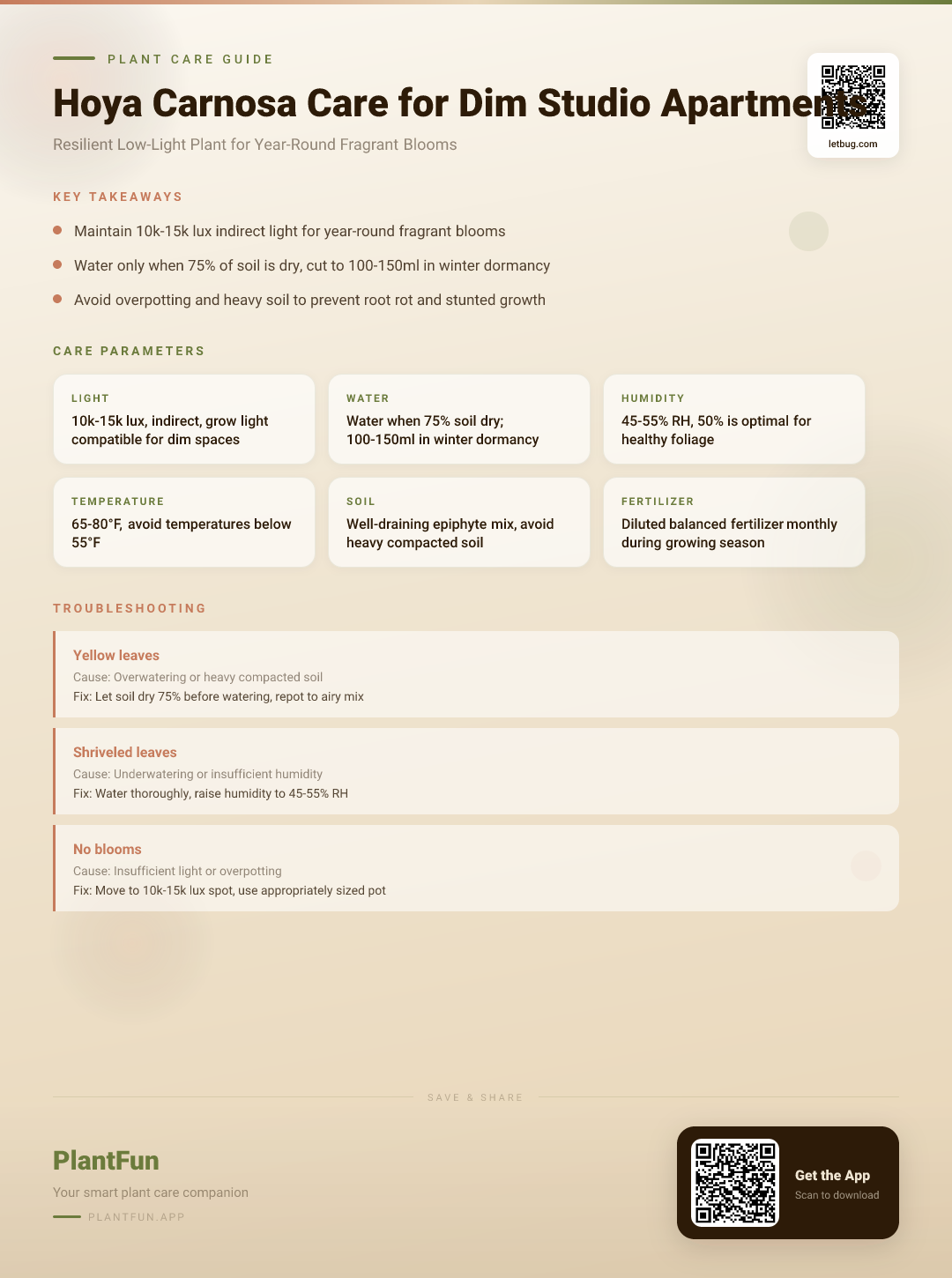
Key Takeaways
- Check soil moisture before watering — overwatering is the #1 killer of houseplants.
- Ensure your plant gets the right amount of light for its species.
- Be patient with recovery — most plants need 2–4 weeks to bounce back.
TL;DR: Hoya carnosa is an ideal apartment plant because of its succulent nature. It thrives in 10,000–15,000 lux, requires water only when 75% of the soil is dry, and can bloom indoors with consistent light. Keep it away from pets (ASPCA, 2026).
My Experience
When I first got my Hoya carnosa for my north-facing studio, I made the mistake of treating it like a tropical fern. I kept the soil constantly damp and placed it in the darkest corner. Predictably, the leaves began to yellow and drop. It wasn’t until I adjusted my approach—treating it more like a cactus that enjoys a periodic drink—that it finally produced its iconic porcelain-like blooms. This guide is built on those hard-learned lessons and the biology of this resilient species.
Quick Care Card: Essential Data
| Feature | Requirement |
|---|---|
| Light | 10,000–15,000 lux |
| Water | When 75% of the soil is dry |
| Humidity | 45–55% relative humidity |
| Temperature | 65–80°F (18–27°C) |
| Soil | Chunky, well-draining orchid mix |
| Fertilizer | Balanced liquid feed during growing season |
| Toxicity | Toxic to cats and dogs (ASPCA, 2026) |
Why Your Hoya Carnosa Is Built for Apartment Life
Hoya carnosa is an epiphyte, meaning it naturally grows on trees rather than in soil. This evolutionary history makes it remarkably drought-tolerant, as its leaves are modified for water storage (NC State Extension, 2026). Its ability to manage gas exchange efficiently makes it a perfect companion for urban microclimates where airflow might be limited.
The 15,000 Lux Threshold
Many enthusiasts believe Hoya carnosa is a low-light plant, but that is a myth. While it survives in low light, it will not thrive or bloom without reaching the 15,000 lux threshold. In a dim studio, place your Hoya within 12 inches of your brightest window. If your windows are north-facing, a supplementary full-spectrum grow light set for 12 hours a day is essential to bridge the gap.
Seasonal Watering Routine
Your watering frequency should follow the plant’s metabolism. During the high-light spring and summer months, the plant consumes more energy. During winter dormancy, reduce your watering to 100–150ml per session to avoid drowning the root system. Overwatering is the primary cause of decline in indoor environments (NC State Extension, 2026).
The Humidity Myth
While tropical plants are often labeled as “humidity lovers,” Hoya carnosa is satisfied with 50% relative humidity. You do not need a greenhouse or daily misting. In fact, excessive misting can lead to fungal issues if your apartment lacks sufficient air circulation.
Step-by-Step: The ‘Check-Dry’ Method
- Use your index finger to check the soil depth. Insert it 2 inches into the medium.
- If the substrate feels moist, wait three more days.
- When the pot feels noticeably lightweight and the soil is dry at the 75% mark, add 100–150ml of water.
- Ensure any excess water drains completely; never let the pot sit in standing water.
Understanding the Science
Hoya carnosa utilizes a specialized metabolic pathway known as Crassulacean Acid Metabolism (CAM) (Singh et al., 1984). This allows the plant to close its stomata during the day to prevent water loss and open them at night for carbon dioxide uptake (Singh et al., 1984). Understanding this unique physiology is key to managing its growth cycles and reproductive health (Kuang et al., 2023).
Troubleshooting Guide
Leaf Shriveling
Symptom: Leaves lose their turgidity and appear wrinkled or thin.
Likely cause: Chronic dehydration or damaged root systems that cannot absorb water.
Fix:
- Check the soil moisture; if bone dry, perform a bottom soak for 20 minutes.
- If soil is moist but leaves are wrinkled, inspect for root rot.
Yellowing Leaves
Symptom: Lower leaves turn yellow and drop off.
Likely cause: Overwatering leading to root asphyxiation.
Fix:
- Halt all watering immediately.
- Repot into a fresh, airy orchid-based substrate.
FAQ
Why is my Hoya carnosa not growing new leaves in the winter? This is normal. The plant enters a period of metabolic dormancy (NC State Extension, 2026). Growth will resume when light levels increase in spring.
Can I keep my Hoya in a windowless bathroom if I have a grow light? Yes, provided the light is strong enough to maintain a consistent 15,000 lux and is kept on a timer for at least 12 hours.
How do I know when my Hoya is ready to bloom? Once your plant reaches maturity—usually 2+ years old—it will produce peduncles (small, woody spurs). Do not remove these, as they are where the fragrant flowers develop (Kuang et al., 2023).
Common Mistakes to Avoid
-
Mistake: Overpotting.
What happens: Excess soil stays wet too long, leading to rot.
Instead: Keep the plant in a snug pot; Hoyas prefer being slightly root-bound. -
Mistake: Heavy potting soil.
What happens: Compaction prevents the root respiration required for healthy growth.
Instead: Use a mix of bark, perlite, and a small amount of coco coir.
References
- Singh, B., Greenberg, E., & Preiss, J. (1984). ADPglucose Pyrophosphorylase from the CAM Plants Hoya carnosa and Xerosicyos danguyi. Plant Physiology. https://doi.org/10.1104/pp.74.3.711. Accessed 2026-03-15.
- Kuang, Y., Jia, R., & Balslev, H. (2023). Ontogeny of the pollinium in Hoya carnosa provides new insights into microsporogenesis. Plant Reproduction. https://doi.org/10.1007/s00497-023-00460-z. Accessed 2026-03-15.
- ASPCA. (2026). Toxic and Non-Toxic Plants List — ASPCA. https://www.aspca.org/pet-care/animal-poison-control/toxic-and-non-toxic-plants. Accessed 2026-03-15.
- NC State Extension. (2026). Hoya Carnosa — NC State Extension Gardener Plant Toolbox. https://plants.ces.ncsu.edu/plants/hoya-carnosa/. Accessed 2026-03-15.
Optional Helper: Plantfun.App
Plantfun.App identifies your plants by photo, diagnoses pests and diseases with clear fixes, and creates personalised watering and light schedules that adapt to your home conditions — a handy companion for putting this guide into daily practice.
Found an error or have suggestions? We'd love your feedback.
Need help identifying this problem?
Get instant identification, personalized care schedules, and effective pest treatment plans directly on your phone.
Sponsored • We may earn a commission from app downloads
Related Guides
Hoya Carnosa in East-Facing Apartments: The Complete Seasonal Care Checklist for Resilient Growth
Grow a lush, blooming Hoya carnosa in your east-facing apartment with our seasonal care checklist, exact light lux levels, watering schedules, and mistake-free resilient growth tips.
Care GuideHoya Carnosa in East-Facing Studio Apartments: The Only Care Guide You’ll Ever Need
Keep your Hoya carnosa thriving in your east-facing studio with exact light levels, watering measurements, and low-effort renter-friendly hacks to get fragrant pink blooms even if you forget to water sometimes, no permanent home modifications required.
Care GuideThe Complete Hoya Carnosa Care Checklist for Resilient Growth in Small East-Facing Apartments
Grow lush, blooming Hoya carnosa in your small east-facing apartment with this science-backed checklist. Get exact light levels, water amounts, and fast fixes for common symptoms today.
Pest ControlAnts on Plants: What They Mean and What to Do
Ants usually aren't eating your plant. They are farming other pests.