
Key Takeaways
- Check soil moisture before watering — overwatering is the #1 killer of houseplants.
- Ensure your plant gets the right amount of light for its species.
- Be patient with recovery — most plants need 2–4 weeks to bounce back.
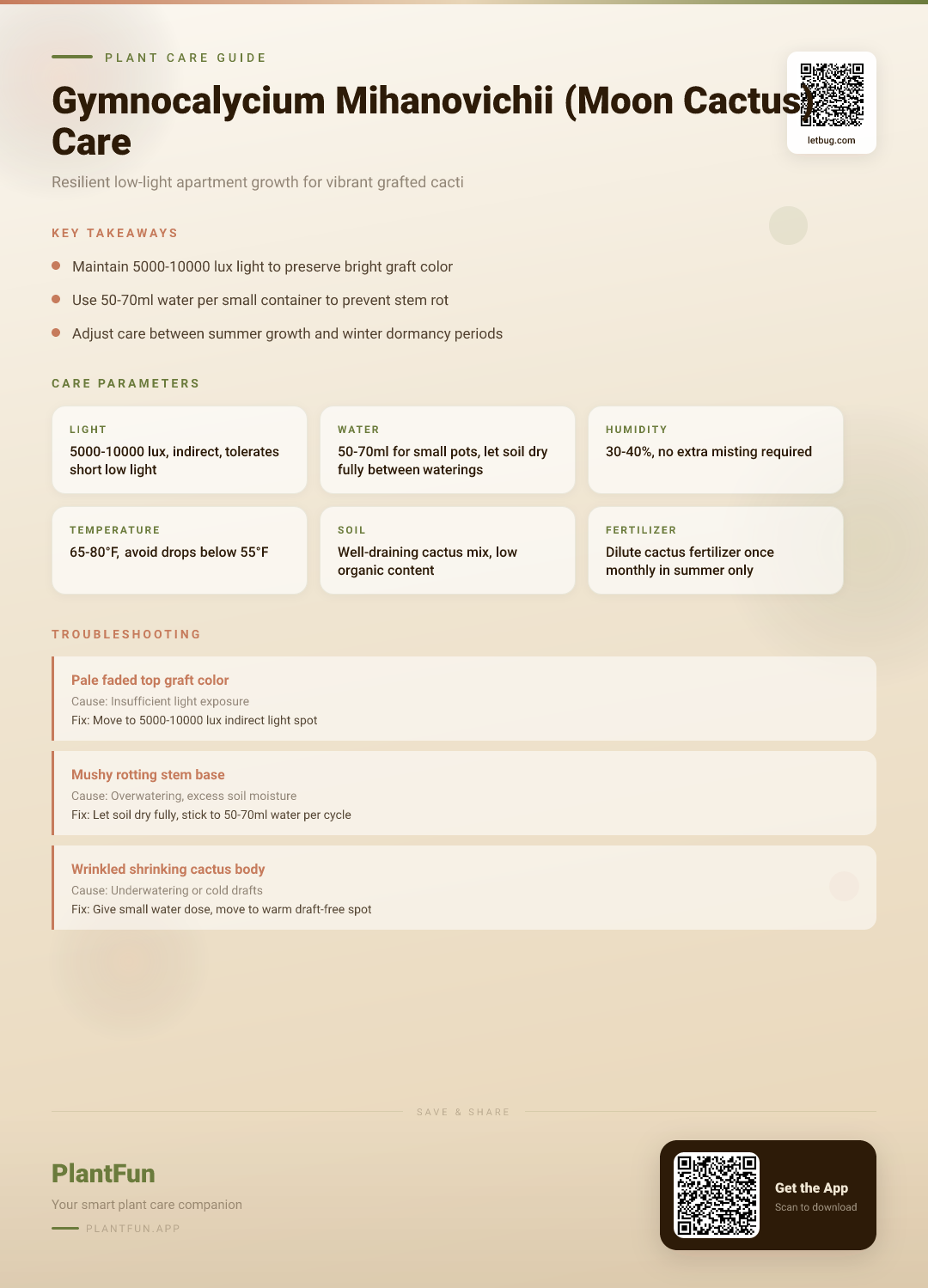
TL;DR: The Moon Cactus (Gymnocalycium mihanovichii) is a grafted hybrid that thrives in bright, indirect light—not scorching sun. To succeed in an apartment, maintain 5,000-10,000 lux, use a strict 50-70ml watering threshold, and prioritize excellent drainage to prevent rot. Because it lacks chlorophyll, the colorful top is entirely dependent on the green rootstock for survival.
Quick Care Card: Essential Data for Gymnocalycium mihanovichii
| Feature | Requirement |
|---|---|
| Light | 5,000–10,000 Lux (Bright Indirect) |
| Water | 50–70ml when soil is 100% dry |
| Humidity | 30%–40% |
| Temperature | 65°F–80°F |
| Soil | Fast-draining succulent mix |
| Fertilizer | Balanced cactus liquid (monthly in summer) |
| Toxicity | Non-toxic (ASPCA, 2026) |
My Experience: Learning the Hard Way
When I first brought home my own Gymnocalycium mihanovichii, I made the common rookie mistake of placing it in a south-facing window with direct, unfiltered afternoon heat. Within a week, the vibrant red hue faded, and the base began to shrivel. I realized then that while these are cacti, their “Moon” top is a mutation that is actually quite sensitive to intense radiation. My shift to a brighter, indirect spot in my living room transformed the plant’s health entirely.
Why the Moon Cactus Thrives in Apartment Settings
Many assume cacti require harsh desert sun. However, Gymnocalycium mihanovichii originates from forest floors where it receives filtered light. In apartments, this makes them ideal candidates for windowsills that provide bright, ambient light without direct UV scorching (NC State Extension, 2026). Their small footprint also makes them perfect for shelf-top displays.
Understanding the Graft: Why Your Cactus Has Two Colors
The Moon Cactus is actually two plants in one. The colorful top (the scion) is a mutant that cannot produce its own chlorophyll, while the bottom green stem (the stock, usually Hylocereus) provides the nutrients (Flower Research Journal, 2022). Their biological bond is fragile; if the graft union begins to brown or soften, it is a sign the connection is failing.
Light Requirements: Managing 5,000-10,000 Lux in Typical Apartments
If your apartment gets moderate light, you are in the ideal zone. Aim for 5,000 to 10,000 lux. If you don’t have a light meter, imagine a spot where you can comfortably read a book without eye strain, but where the sun’s rays aren’t hitting the plant directly for more than an hour. If the color fades to a washed-out pink or white, the plant is likely not receiving enough light to maintain its pigment.
Watering Strategy: Using the 50-70ml Threshold for Small Containers
Overwatering is the leading killer of these plants. I strictly use a measuring cup to deliver 50-70ml of water only when the soil is completely bone-dry. You can test this by inserting a wooden skewer into the soil; if it comes out with any dampness or dark color, wait another week. Always discard excess water in the saucer to prevent root rot (Pfeiffer, 1989).
Temperature & Humidity: Keeping it Between 65-80°F and 30-40% Humidity
These plants prefer stable indoor temperatures. If your apartment dips below 60°F, growth will stall. Humidity should remain low—our homes typically hover around 30-40%, which is perfect. Avoid placing them near drafty AC vents or hot radiators.
Seasonal Care Calendar: Shifting Needs from Summer Growth to Winter Dormancy
- Spring/Summer: Water every 2-3 weeks (50-70ml). Fertilize once per month.
- Autumn: Begin tapering water; move to once every 4-5 weeks.
- Winter: Dormancy period. Keep the plant cool and almost completely dry to encourage a healthy spring restart.
Common Mistakes: Why Overwatering Kills Your Cactus Faster Than Dark Corners
- Mistake: Watering on a calendar schedule.
- What happens: Permanent root suffocation.
- Instead: Water based on soil dryness check.
- Mistake: Using a pot without drainage holes.
- What happens: Water pools at the base, leading to rot (Pfeiffer, 1989).
- Instead: Ensure your pot has at least one central drainage hole.
FAQ
Why is my Moon Cactus turning pale or losing its bright top color?
This is typically a response to low light. The plant is struggling to synthesize energy. Move it to a brighter, filtered-light location, but avoid immediate full sun, which can burn the tissue.
How do I know if my cactus is suffering from root rot?
Look for a soft, squishy base or a yellowing, translucent stem. If you press the base and it feels mushy rather than firm, the plant is likely in the late stages of decay (Pfeiffer, 1989).
Can I keep my Gymnocalycium in a dim office cubicle?
While they are resilient, a “dim” cubicle is likely below 2,000 lux. Your cactus will eventually etiolate (stretch and thin out). Use a small desk-mounted LED grow light to supplement if natural light is insufficient.
Step-by-Step Recovery Plan for a Shrinking or Wrinkled Cactus
- Check the base firmness. If firm but wrinkled, the plant is thirsty. Provide 60ml of water.
- If the base is soft, remove the plant from the pot and inspect roots. Trim away any black or mushy roots with sterilized scissors.
- Repot into a high-quality, dry succulent-specific potting mix.
- Wait 7 days before providing any water to allow the roots to callous over.
References & Botanical Research Notes
- ASPCA. (2026). Toxic and Non-Toxic Plants List — ASPCA. https://www.aspca.org/pet-care/animal-poison-control/toxic-and-non-toxic-plants. Accessed 2026-03-18.
- Flower Research Journal. (2022). A New Red Colored Gymnocalycium mihanovichii ‘Red Ace’ for Grafted Cactus. Flower Research Journal. https://doi.org/10.11623/frj.2022.30.s.48. Accessed 2026-03-18.
- NC State Extension. (2026). Gymnocalycium mihanovichii — NC State Extension Gardener Plant Toolbox. https://plants.ces.ncsu.edu/plants/cactus-care/. Accessed 2026-03-18.
- Pfeiffer, C. (1989). First Report of Dichotomophthora indica as a Pathogen of Myrtillocactus geometrizans and Gymnocalycium mihanovichii var. friedrichii in Arizona. Plant Disease. https://doi.org/10.1094/pd-73-0081e. Accessed 2026-03-18.
Optional Helper: Plantfun.App
Plantfun.App identifies your plants by photo, diagnoses pests and diseases with clear fixes, and creates personalised watering and light schedules that adapt to your home conditions — a handy companion for putting this guide into daily practice.
Found an error or have suggestions? We'd love your feedback.
Need help identifying this problem?
Get instant identification, personalized care schedules, and effective pest treatment plans directly on your phone.
Sponsored • We may earn a commission from app downloads
Related Guides
Gymnocalycium Mihanovichii Care in Your Dim Apartment: A Seasonal Guide for Resilient Growth
Revive your Moon Cactus with this seasonal care plan. Discover exact light, water, and soil requirements to help your Gymnocalycium thrive in apartment living.
Care GuideGymnocalycium Mihanovichii Care for Apartments: The 5-Step Blueprint for Radiant, Compact Cactus Growth
Master Gymnocalycium mihanovichii care in your apartment. Follow our precise 5-step watering and lighting protocol to keep your grafted cactus vibrant and healthy.
Care GuideMoon Cactus Care Checklist for East-Facing Apartment Windowsills: Resilient Growth Tips That Actually Work
Stop guessing at moon cactus care. Get exact light levels, watering amounts, seasonal rules, and a printable weekly checklist to keep your plant thriving on your east-facing apartment windowsill.
Pest ControlAnts on Plants: What They Mean and What to Do
Ants usually aren't eating your plant. They are farming other pests.