
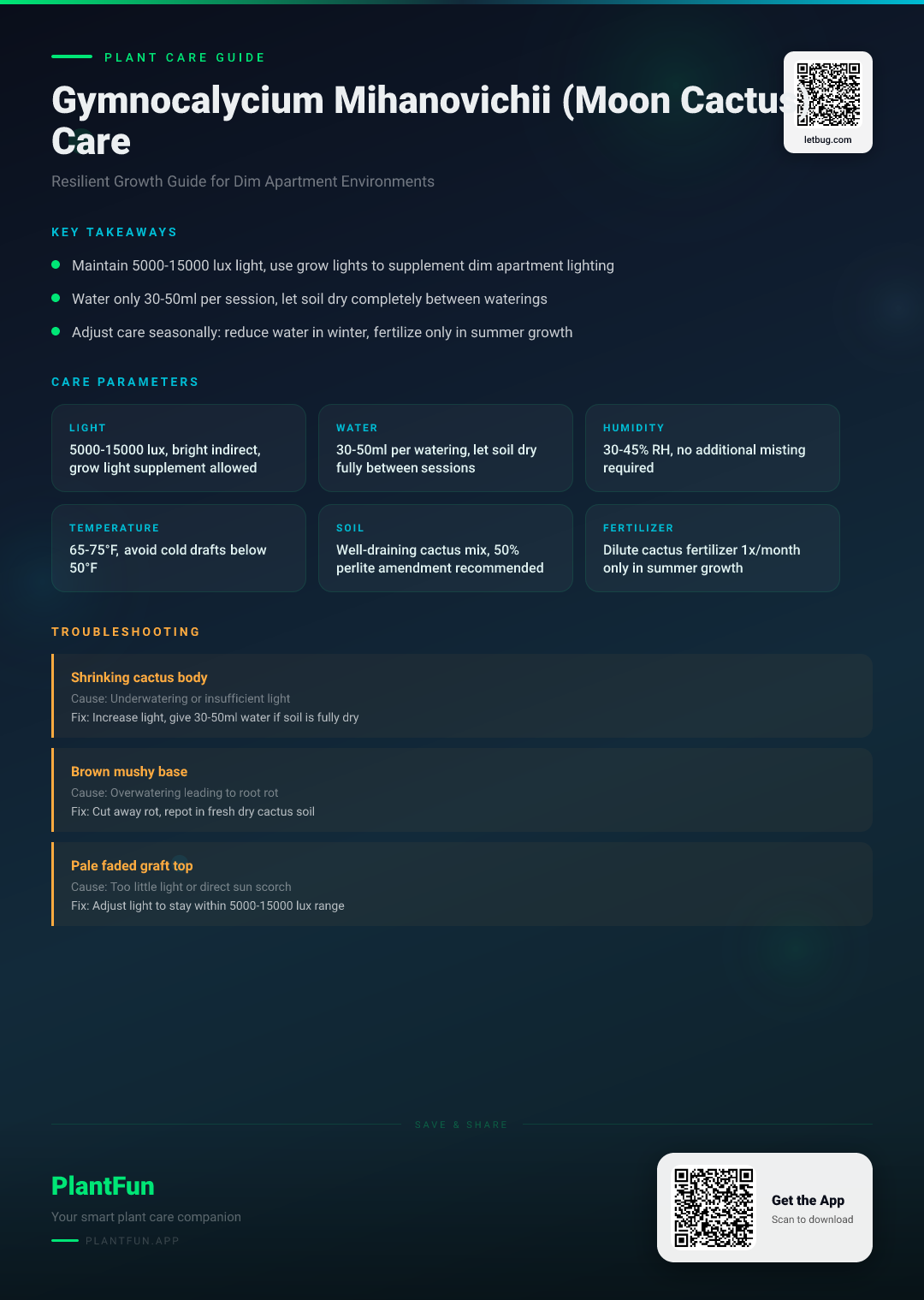
Key Takeaways
- Check soil moisture before watering — overwatering is the #1 killer of houseplants.
- Ensure your plant gets the right amount of light for its species.
- Be patient with recovery — most plants need 2–4 weeks to bounce back.
Quick Care Card: Essential Data
| Feature | Requirement |
|---|---|
| Light | 5,000–15,000 Lux |
| Water | 30–50ml (when dry) |
| Temperature | 65–75°F (18–24°C) |
| Humidity | 30–45% |
| Soil | Fast-draining cactus mix |
| Fertilizer | Balanced low-nitrogen (diluted) |
| Toxicity | Non-toxic (ASPCA, 2026) |
TL;DR: The Moon Cactus Survival Essentials for Low-Light Homes
To keep your Gymnocalycium mihanovichii alive in a dim apartment, prioritize light over all else. Even though they are cacti, they suffer in deep shade. Supplement with grow lights, water only when the substrate is 100% dry, and avoid temperature fluctuations. When I first started, I lost my first Moon Cactus to overwatering; I learned the hard way that a “dim” apartment requires a much slower metabolic pace from your plant. If it stays in the dark, it will eventually rot or shrink from lack of photosynthesis.
Understanding Your Gymnocalycium: Why Apartment Light Isn’t Enough
Many indoor gardeners assume that because a plant is a cactus, it can survive in a dark corner. This is a myth. Gymnocalycium mihanovichii lack chlorophyll in their colorful tops, relying entirely on the Hylocereus (dragon fruit cactus) rootstock to provide energy (Flower Research Journal, 2022). In a dim apartment, the rootstock cannot gather enough light to support both itself and the top, leading to a slow decline.
Format A: Step-by-Step Care Guide for Urban Dwellers
- Assess Your Lux: Use a light meter or a phone app to ensure your spot provides at least 5,000 lux. If it’s below 3,000, the plant is starving.
- Drainage First: Ensure your pot has drainage holes. If you have a decorative cachepot, ensure you remove the inner plastic liner to water it (NC State Extension, 2026).
- Watering Technique: Use a measured 30–50ml of water, poured directly onto the soil, avoiding the junction between the two cacti.
- Placement: Move the plant to the nearest window, ideally one with southern or western exposure.
Measurable Thresholds: Watering Schedules and Soil Saturation
In a low-light environment, do not follow a “weekly” calendar. Instead, use the “weight and probe” method. I lift my pots; if they feel suspiciously light, the water is gone. You can also stick your finger two inches into the soil. If you feel any coolness or moisture, do not water. Watering too frequently in low light invites Dichotomophthora indica and other opportunistic pathogens (Pfeiffer, 1989).
The Seasonal Rotation: How to Adjust Care from Winter Dormancy to Summer Growth
- Summer: The plant will actively grow. Increase watering slightly if light levels are adequate.
- Winter: Reduce water by 50%. The cooler, darker months in an apartment trigger a rest phase. If you keep the heat at 70°F, keep a close eye on soil dryness, as the cactus won’t consume water as quickly.
Common Mistakes: Why Your Cactus Is Shrinking or Turning Brown
- Mistake: Watering on a strict schedule regardless of light. What happens: Root rot and fungal decay. Instead: Only water when the soil is fully desiccated.
- Mistake: Placing the cactus in a decorative, non-draining container. What happens: Salt buildup and suffocation of roots. Instead: Use well-draining terra cotta to allow the soil to breathe.
FAQ: Why is my Moon Cactus turning pale in my living room?
This is a classic sign of etiolation or light deficiency. When a cactus turns pale, it is losing its pigment density because it lacks the energy to maintain its cellular structure (Flower Research Journal, 2022).
FAQ: How do I know if I’m watering my cactus too much?
If the base of your Hylocereus (the bottom part) feels squishy or turns translucent/yellow, you are likely overwatering. Learn more about identifying moisture stress to catch this early.
FAQ: Can I use artificial grow lights to supplement my apartment light?
Yes, and in a dim apartment, it is highly recommended. Full-spectrum LED grow lights placed 6-12 inches above the plant for 8-10 hours a day can make the difference between survival and growth.
Advanced Care: When to Repot and Soil Amendment Recipes
Repot every 2 years using a blend of 50% inorganic grit (pumice or perlite) and 50% potting soil. The goal is to maximize porosity. If you are struggling with finding the right substrate, prioritize large-particle components to prevent compaction.
Troubleshooting Guide: Identifying Pest Signals vs. Natural Aging
[Root Rot]
Symptom: The base of the cactus is turning brown and mushy.
Likely cause: Excessive moisture trapped in the root zone.
Fix:
- Remove the plant from the soil immediately.
- Trim away blackened or mushy roots.
- Repot into fresh, dry, porous soil and wait one week before watering.
[Sunburn]
Symptom: Bleached white or brown patches appearing on the surface.
Likely cause: Sudden move from a very dark room to direct, intense sun.
Fix:
- Move the plant to an area with bright, indirect light.
- Allow the plant to acclimate over two weeks by gradually increasing light exposure.
The Science of Grafting: Maintaining the Symbiotic Union
Remember that the Moon Cactus is a graft. The red/yellow top is a mutant Gymnocalycium that cannot photosynthesize. The green bottom is a hardy Hylocereus. If you notice the two parts starting to pull apart or the union drying out, the plant is struggling to transport nutrients (Flower Research Journal, 2022). Keep the temperature consistent to avoid stressing the vascular tissues at the graft site.
References
- ASPCA. (2026). Toxic and Non-Toxic Plants List — ASPCA. https://www.aspca.org/pet-care/animal-poison-control/toxic-and-non-toxic-plants. Accessed 2026-03-17.
- Flower Research Journal. (2022). A New Red Colored Gymnocalycium mihanovichii ‘Red Ace’ for Grafted Cactus. Flower Research Journal. https://doi.org/10.11623/frj.2022.30.s.48. Accessed 2026-03-17.
- NC State Extension. (2026). Gymnocalycium Mihanovichii — NC State Extension Gardener Plant Toolbox. https://plants.ces.ncsu.edu/plants/cactus-care/. Accessed 2026-03-17.
- Pfeiffer, C. (1989). First Report of Dichotomophthora indica as a Pathogen of Myrtillocactus geometrizans and Gymnocalycium mihanovichii var. friedrichii in Arizona. Plant Disease. https://doi.org/10.1094/pd-73-0081e. Accessed 2026-03-17.
Optional Helper: Plantfun.App
Plantfun.App identifies your plants by photo, diagnoses pests and diseases with clear fixes, and creates personalised watering and light schedules that adapt to your home conditions — a handy companion for putting this guide into daily practice.
Found an error or have suggestions? We'd love your feedback.
Need help identifying this problem?
Get instant identification, personalized care schedules, and effective pest treatment plans directly on your phone.
Sponsored • We may earn a commission from app downloads
Related Guides
Gymnocalycium Mihanovichii Care for Apartments: The 5-Step Blueprint for Radiant, Compact Cactus Growth
Master Gymnocalycium mihanovichii care in your apartment. Follow our precise 5-step watering and lighting protocol to keep your grafted cactus vibrant and healthy.
Care GuideThe Complete Moon Cactus Care Guide for East-Facing Studio Apartments: Budget-Friendly Tips for Resilient Growth
Cut expensive cactus care products out of your budget. Get exact light, water, and soil thresholds plus a seasonal checklist to keep your moon cactus thriving in a small east-facing studio apartment.
Care GuideMoon Cactus Care Checklist for East-Facing Apartment Windowsills: Resilient Growth Tips That Actually Work
Stop guessing at moon cactus care. Get exact light levels, watering amounts, seasonal rules, and a printable weekly checklist to keep your plant thriving on your east-facing apartment windowsill.
Pest ControlAnts on Plants: What They Mean and What to Do
Ants usually aren't eating your plant. They are farming other pests.