
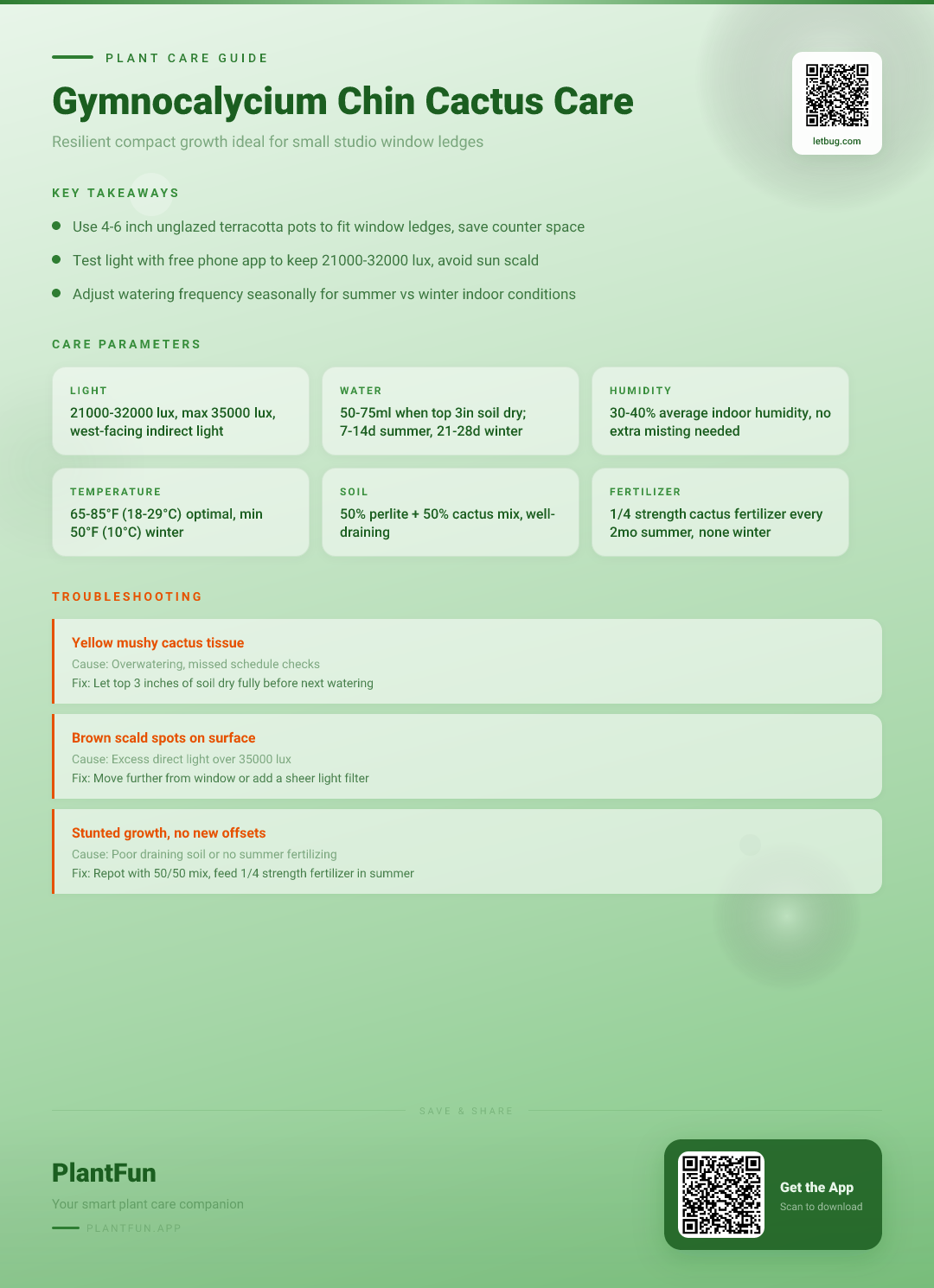
Key Takeaways
- Check soil moisture before watering — overwatering is the #1 killer of houseplants.
- Ensure your plant gets the right amount of light for its species.
- Be patient with recovery — most plants need 2–4 weeks to bounce back.
Quick Care Card
| Parameter | Measurable Guideline |
|---|---|
| Light | 21,000–32,000 lux (west-facing window, 35,000 lux max to avoid scald) |
| Water | 50–75ml only when top 3 inches of soil are completely dry |
| Humidity | 30–40% (standard studio humidity, no misting required) |
| Temperature | 65–85°F (18–29°C), hard minimum 50°F (10°C) in winter |
| Soil | 50% perlite / 50% commercial cactus soil mix |
| Fertilizer | 1/4 strength cactus fertilizer every 2 months, summer only |
| Toxicity | Non-toxic to cats, dogs, and humans (ASPCA, 2026) |
Why Gymnocalycium Is Ideal for Small Studio Apartments
Most 400–600 sq ft urban studios have features that are often seen as downsides for houseplants: limited counter space, dry 30–40% humidity, drafty window sills, and bright west-facing light. But these are exactly the conditions gymnocalycium chin cacti evolved to thrive in (Cactus and Succulent Journal, 2019). These compact cacti max out at 6 inches wide, fitting perfectly on standard 4–6 inch window ledges without taking up valuable counter or shelf space. They tolerate the 10–20°F daily temperature swings common in open-concept studio layouts, and require almost no extra care beyond basic checks, making them perfect for busy renters and gymnocalycium care for beginners. They are also non-toxic to pets, so you don’t have to worry if your cat likes to explore window sills (ASPCA, 2026). For more compact plant ideas, check out our guide to small space cactus growing tips.
Core 8-Point Space-Optimized Care Checklist
This prioritized checklist breaks down tasks by frequency to eliminate guesswork and save you time:
- Weekly: Test light levels at cactus height with a free phone light meter app to confirm they stay within the 21,000–32,000 lux range for chin cactus west facing window care
- Weekly: Stick your index finger 3 inches into the soil to check for full dryness before considering watering
- Bi-weekly: Wipe dust off the cactus surface with a dry microfiber cloth to maximize light absorption
- Monthly: Inspect the pot drainage hole for clogs to prevent standing water and root rot
- Every 2 months (summer only): Apply 1/4 strength cactus fertilizer directly to the soil, avoiding contact with the cactus stem
- Quarterly: Check the base of the cactus and under spines for common pests like mealybugs and spider mites
- Every 12–18 months: Repot only if roots are growing out of the drainage hole, using a pot only 1 inch larger than the current one to avoid wasting space
- Winter: Move the cactus 2 inches away from window glass if nighttime temperatures drop below 50°F (10°C) to avoid cold damage
Measurable Light Requirement Breakdown
Gymnocalycium chin cacti need an average of 21,000–32,000 lux of light daily, which is exactly what most unobstructed west-facing studio windows deliver in spring, summer, and fall (Cactus and Succulent Journal, 2019). The absolute maximum light level they can tolerate without sun scald is 35,000 lux. To test your light levels: download a free light meter app, hold it at the same height as your cactus, and take a reading at 3pm (peak west-facing light) for 3 consecutive days to get an average. If your readings are consistently above 35,000 lux, hang a sheer curtain 6 inches away from the window to filter excess light. For more lighting guidance, see our list of the best succulents for west-facing windows.
Exact Watering Guidelines for Typical Apartment Humidity
The #1 question new owners ask is how often to water gymnocalycium, and the answer depends on your soil dryness, not a fixed schedule. For standard studio apartments with 30–40% average humidity, use 50–75ml of room temperature water only when the top 3 inches of soil are completely dry. A quick test: insert a wooden skewer 3 inches into the soil, pull it out, and if it has no damp soil stuck to it, it’s time to water. If your apartment is below 30% humidity, use 75ml per watering; if it’s above 40%, use 50ml. Myth vs reality: You don’t need to drench cacti until water runs out the drainage hole for small 4–6 inch pots — measured small amounts prevent overwatering and mess on your window sill. For more best practices, read our guide to correct succulent watering for small spaces.
Soil & Potting Tips for Small Spaces
To optimize drainage and save space, use a 50% perlite / 50% commercial cactus soil mix for your gymnocalycium. This mix drains fast enough to prevent root rot, even in dry studio air. For pots, use a 4–6 inch unglazed terracotta pot, which fits perfectly on standard window ledges without taking up extra counter space. Unglazed terracotta wicks away excess moisture from the soil, reducing the risk of overwatering. Never use a pot larger than 6 inches for a mature chin cactus: oversized pots waste valuable space and hold excess moisture that can kill your plant.
Temperature Thresholds for Drafty Studio Windows
Gymnocalycium chin cacti thrive in 65–85°F (18–29°C) temperatures, which is the standard range for most heated and cooled apartments (Spaete, 2010). They can tolerate drafts as long as temperatures don’t drop below the hard minimum of 50°F (10°C) in winter. If your window sill is drafty in cold months, either apply a small insulation strip along the bottom of the window frame, or move the cactus 2 inches away from the glass on nights when temperatures are forecast to drop below 50°F. They tolerate daily temperature swings of up to 20°F, which is common in open-concept studios with no separate bedrooms.
Seasonal Care Calendar for Renters
Adjust your care routine based on the season to keep your cactus thriving year-round:
Summer (May–September, Northern Hemisphere)
- Follow the gymnocalycium summer watering schedule: water 50–75ml every 7–14 days, only when top 3 inches of soil are dry
- Apply 1/4 strength cactus fertilizer every 2 months
- No humidity adjustments needed
Winter (October–April)
- Follow gymnocalycium winter care guidelines: water 50ml every 21–28 days, even if soil feels dry earlier (growth slows significantly in cold months)
- Do not apply fertilizer
- Keep cactus at least 2 inches away from cold window glass
- Keep at least 12 inches away from heating vents to avoid scorching
Common Small-Space Care Mistakes to Avoid
- Mistake: Using an oversized pot to avoid repotting often What happens: Extra soil holds excess moisture, leading to root rot, and wastes valuable counter or shelf space Instead: Use a 4–6 inch unglazed terracotta pot that fits your window ledge, repot only when roots grow out of the drainage hole
- Mistake: Watering on a fixed schedule instead of checking soil moisture What happens: Overwatering is the leading cause of chin cactus death in small apartments, especially in winter Instead: Check the top 3 inches of soil with your finger every week, only water when it is completely dry
- Mistake: Placing the cactus too close to a heating vent in winter What happens: Extreme hot dry air can scorch the cactus surface, leading to permanent brown spots Instead: Keep the cactus at least 12 inches away from heating vents, or use a small vent deflector to redirect air away from plants
Voice Search Optimized FAQ Section
Can I keep my gymnocalycium cactus on my studio apartment window ledge?
Yes! Gymnocalycium in studio apartment window ledges is one of the best placements possible, as long as it is a west-facing window that delivers 21,000–32,000 lux of light, and the window sill is at least 4 inches wide to fit a standard 4–6 inch terracotta pot. Just make sure to move it 2 inches away from the glass in winter if nighttime temps drop below 50°F (10°C) to avoid cold damage.
How often do I need to water my chin cactus if my apartment is really dry?
For apartments with 30–40% humidity (the average for most urban studios), you will water 50–75ml every 7–14 days in summer, and every 21–28 days in winter, only when the top 3 inches of soil are completely dry. If your apartment is drier than 30%, you can check the soil one day earlier than usual, but never water if the top 3 inches are still damp — cacti store their own water, so they tolerate dry air very well, and can cacti survive in dry apartments easily.
Why is my gymnocalycium getting soft brown spots even if I water it rarely?
Soft brown spots (not hard, dry sun-scald spots) are almost always caused by root rot from excess moisture, even if you water rarely. Common causes include a clogged drainage hole, non-porous plastic pot, or soil that doesn’t drain fast enough. First, remove the cactus from its pot, cut off any mushy brown roots with a sterile knife, repot in fresh 50/50 perlite and cactus soil mix, and hold off watering for 2 weeks to let the roots heal. Hard brown spots are usually sun scald from light levels over 35,000 lux, so add a sheer curtain to your west-facing window if that is the case. This is the most common answer to why is my chin cactus turning brown for new owners.
References
- American Society for the Prevention of Cruelty to Animals. (2026). Toxic and Non-Toxic Plants List — ASPCA. https://www.aspca.org/pet-care/animal-poison-control/toxic-and-non-toxic-plants. Accessed 2026-03-03.
- Cactus and Succulent Journal. (2019). Variegated Gymnocalycium Hybrids Cultivation in Thailand. Cactus and Succulent Journal. https://doi.org/10.2985/015.091.0207. Accessed 2026-03-03.
- Spaete, P. (2010). Succulents On Stamps. Cactus and Succulent Journal. https://doi.org/10.2985/015.082.0111. Accessed 2026-03-03.
Optional Helper: Plantfun.App
Plantfun.App identifies your plants by photo, diagnoses pests and diseases with clear fixes, and creates personalised watering and light schedules that adapt to your home conditions — a handy companion for putting this guide into daily practice.
Found an error or have suggestions? We'd love your feedback.
Need help identifying this problem?
Get instant identification, personalized care schedules, and effective pest treatment plans directly on your phone.
Sponsored • We may earn a commission from app downloads
Related Guides
The Complete Moon Cactus Care Guide for East-Facing Studio Apartments: Budget-Friendly Tips for Resilient Growth
Cut expensive cactus care products out of your budget. Get exact light, water, and soil thresholds plus a seasonal checklist to keep your moon cactus thriving in a small east-facing studio apartment.
Care GuideGymnocalycium Mihanovichii Care in Your Dim Apartment: A Seasonal Guide for Resilient Growth
Revive your Moon Cactus with this seasonal care plan. Discover exact light, water, and soil requirements to help your Gymnocalycium thrive in apartment living.
Care GuideAnthurium andraeanum in Small Urban Apartments: The Complete Resilient Growth Checklist for Year-Round Blooms
Stop watching your Anthurium wilt and drop blooms. Get exact light, water, and humidity thresholds, plus a 12-point checklist to keep it thriving in your apartment year-round.
Pest ControlAnts on Plants: What They Mean and What to Do
Ants usually aren't eating your plant. They are farming other pests.