
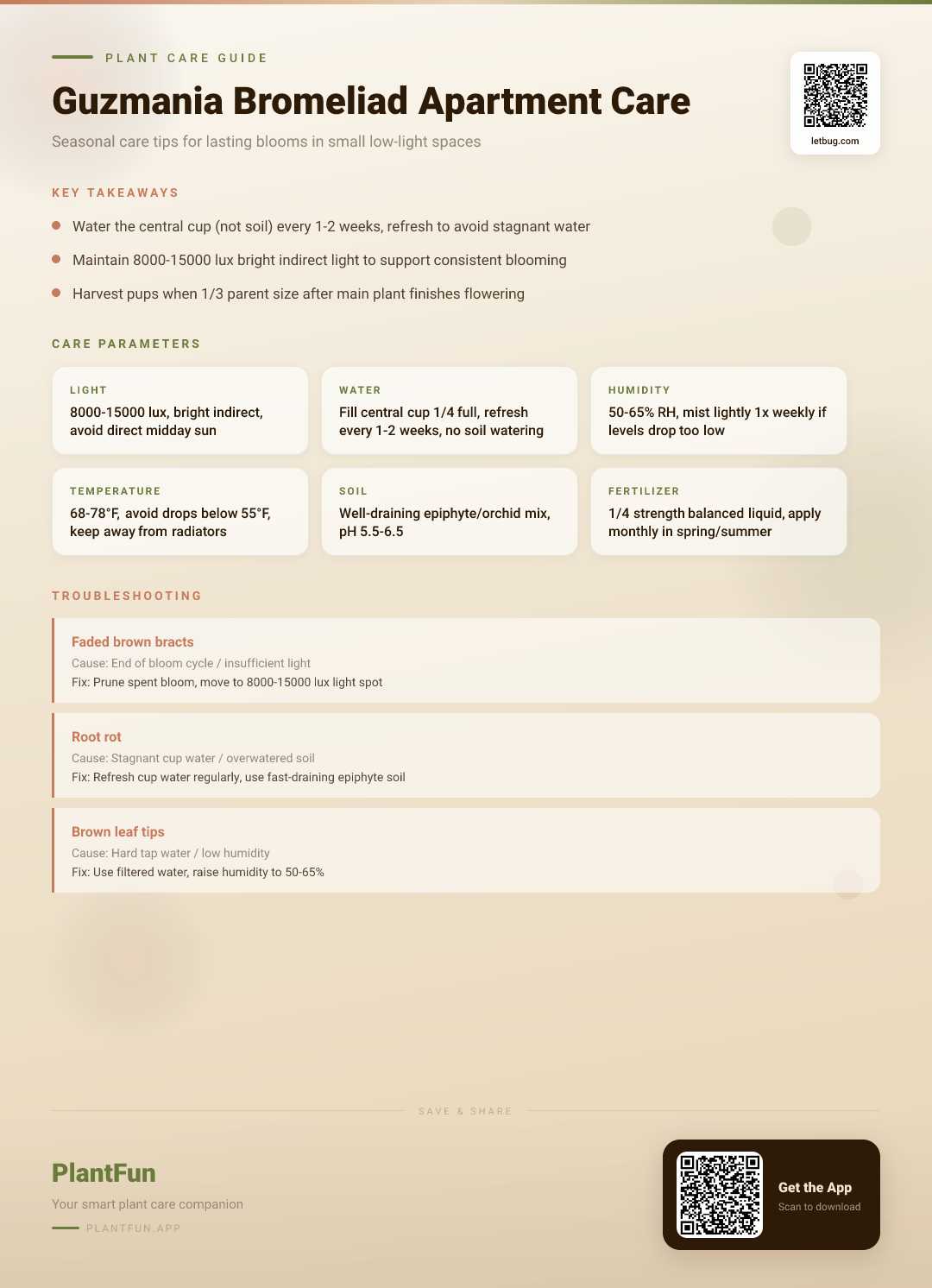
Key Takeaways
- Check soil moisture before watering — overwatering is the #1 killer of houseplants.
- Ensure your plant gets the right amount of light for its species.
- Be patient with recovery — most plants need 2–4 weeks to bounce back.
TL;DR: The Essentials
To keep your Guzmania thriving, mimic its tropical, epiphytic roots. Water the central tank (the cup) rather than the soil, keep temperatures between 68-78°F, and provide bright, indirect light. Don’t panic when the flower fades—that’s just the signal for the plant to start producing ‘pups’ (offsets).
Quick Care Card: Essential Thresholds for Apartment Resiliency
| Feature | Requirement |
|---|---|
| Light | 8,000–15,000 Lux (Bright, indirect) |
| Watering | Reservoir (Fill central cup) |
| Humidity | 50–65% Relative Humidity |
| Temperature | 68–78°F (20–25°C) |
| Soil | Well-draining, airy orchid mix |
| Fertilizer | Diluted balanced liquid (Spring/Summer) |
| Toxicity | Non-toxic (ASPCA, 2026) |
Why Your Bromeliad Matters: Understanding the Tank-Dwelling Lifestyle
When I first brought home a Guzmania, I treated it like a standard houseplant, drenching the soil and leaving it in a dim corner. Within weeks, the base rotted. I learned the hard way that Guzmania are epiphytes—plants that grow on other surfaces like trees in the rainforest. Their roots serve primarily as anchors rather than primary nutrient intake systems (NC State Extension, 2026). They rely on a central ‘tank’ or cup to capture water and organic debris for sustenance.
Format A: The Complete Seasonal Care Calendar
- Spring/Summer: Focus on growth. Keep the central reservoir full and flush it weekly to prevent salt buildup. Use a balanced, water-soluble fertilizer diluted to 1/4 strength, applied only to the soil, not the cup.
- Autumn/Winter: Growth slows. Allow the reservoir to dry out slightly between refills to prevent fungal issues. Move the plant away from cold window drafts or hot radiator vents to maintain stable temperatures (Beeson & Chen, 2018).
Light Requirements: Achieving 8,000-15,000 Lux in Low-Light Corners
Guzmania bromeliads crave bright, filtered light. In a small apartment, this means placing them within 2–3 feet of an east-facing window. If your space lacks natural light, a simple LED grow lamp set for 10–12 hours a day will mimic the necessary intensity to prevent the leaves from stretching (etiolation) and ensure the bracts retain their vibrant color.
The Reservoir Method: Why You Should Water the Center Cup, Not the Soil
Forget the watering can aimed at the soil. To properly care for a bromeliad, fill the central rosette (cup) with distilled or rainwater. This mimics their natural water-collection mechanism. Ensure you flush this water out every 1–2 weeks to avoid mineral deposits or stagnant conditions. If you need a refresher on standard indoor watering, check out our comprehensive houseplant watering guide.
Temperature and Humidity: Maintaining 50-65% Relative Humidity and 68-78°F
These plants are sensitive to the dry air of modern apartments. Aim for 50-65% humidity (NC State Extension, 2026). If your apartment is drier, use a pebble tray or a small humidifier near the plant. Keeping the temperature in the 68–78°F range is vital, as cold snaps below 60°F can stress the plant, while heat above 85°F may dry out the foliage prematurely.
Seasonal Adjustments: Managing Winter Radiator Heat vs. Summer Growth
During winter, central heating creates a desert-like environment. The transpiration rate of the plant can be affected by ambient heat (Beeson & Chen, 2018). I find that placing my Guzmania on a humidity tray helps buffer against the drying effects of radiators. In summer, watch for increased evaporation in the cup—check the water levels every 3–4 days during heatwaves.
Common Mistakes: How to Avoid Root Rot and Faded Bracts
- Mistake: Keeping the soil perpetually soggy. What happens: Root rot and oxygen starvation. Instead: Keep the soil lightly moist, never waterlogged.
- Mistake: Using tap water with high chlorine content. What happens: Brown, crispy leaf tips. Instead: Let tap water sit for 24 hours to dissipate chlorine or use filtered water.
FAQ
- Why is my bromeliad flower turning brown so quickly? It is likely reaching the end of its natural life cycle. The ‘flower’ is actually a bract, which can last several months. Once it turns brown, you can snip it off at the base to redirect energy into pup production.
- How do I remove the pups once the main plant dies? Wait until the pups are at least 1/3 the size of the mother plant. Gently pull them away or use a sterilized knife to cut them from the base, ensuring they have their own small roots.
- Can I use tap water in the center cup of my plant? Yes, but if your water is ‘hard’ (high mineral content), you will see white crusts on the leaves. Filtered or distilled water is preferred for long-term health.
Expert Troubleshooting: When to Prune and When to Fertilize
Yellowing Leaves
Symptom: Leaves lose their deep green color and turn yellowish-pale.
Likely cause: Too much direct, intense sunlight.
Fix:
- Move the plant 1-2 feet further from the window.
- Provide a sheer curtain to filter the light.
Brown Leaf Tips
Symptom: Tips turn brittle and brown.
Likely cause: Low humidity or mineral buildup from water.
Fix:
- Increase localized humidity with a pebble tray.
- Switch to using distilled or filtered water.
Mushy Base
Symptom: The base of the plant feels soft or slimy.
Likely cause: Overwatering the soil, leading to rot.
Fix:
- Stop watering the soil immediately.
- Increase air circulation to dry out the root zone.
References
- ASPCA. (2026). Toxic and Non-Toxic Plants List — ASPCA. https://www.aspca.org/pet-care/animal-poison-control/toxic-and-non-toxic-plants. Accessed 2026-03-19.
- Beeson, R.; Chen, J. (2018). Daily Evapotranspiration of Guzmania ‘Irene’ and Vriesea ‘Carly’ Bromeliads Produced in a Shaded Greenhouse. HortScience. https://doi.org/10.21273/hortsci13351-18. Accessed 2026-03-19.
- Boneh, L.; Kuperus, P.; Van Tienderen, P. (2003). Microsatellites in the bromeliads Tillandsia fasciculata and Guzmania monostachya. Molecular Ecology Notes. https://doi.org/10.1046/j.1471-8286.2003.00432.x. Accessed 2026-03-19.
- NC State Extension. (2026). Guzmania Bromeliads — NC State Extension Gardener Plant Toolbox. https://plants.ces.ncsu.edu/plants/guzmania-bromeliad/. Accessed 2026-03-19.
Optional Helper: Plantfun.App
Plantfun.App identifies your plants by photo, diagnoses pests and diseases with clear fixes, and creates personalised watering and light schedules that adapt to your home conditions — a handy companion for putting this guide into daily practice.
Found an error or have suggestions? We'd love your feedback.
Need help identifying this problem?
Get instant identification, personalized care schedules, and effective pest treatment plans directly on your phone.
Sponsored • We may earn a commission from app downloads
Related Guides
Guzmania Bromeliads in Low-Humidity Apartments: A Simple Care Guide for Lasting Blooms
Revive your fading Bromeliad with our precise tank-watering method. Learn the exact light and humidity needs to keep your Guzmania vibrant in any apartment.
Care GuideThe Complete Bromeliad Care Guide for Small Urban Apartments: Tips for Resilient Growth
Grow lush, long-blooming bromeliads even in tiny apartments with this science-backed guide. Get exact light levels, watering amounts, and space-saving hacks to keep your plant thriving for years.
Care GuideGuzmania Bromeliad Care Guide for Typical Apartments: 8 Steps for Resilient, Long-Blooming Growth
Stop watching your apartment bromeliad wilt after blooming. Get 8 actionable care steps, exact measurable thresholds, and a free printable checklist for resilient, year-round growth.
Pest ControlAnts on Plants: What They Mean and What to Do
Ants usually aren't eating your plant. They are farming other pests.