
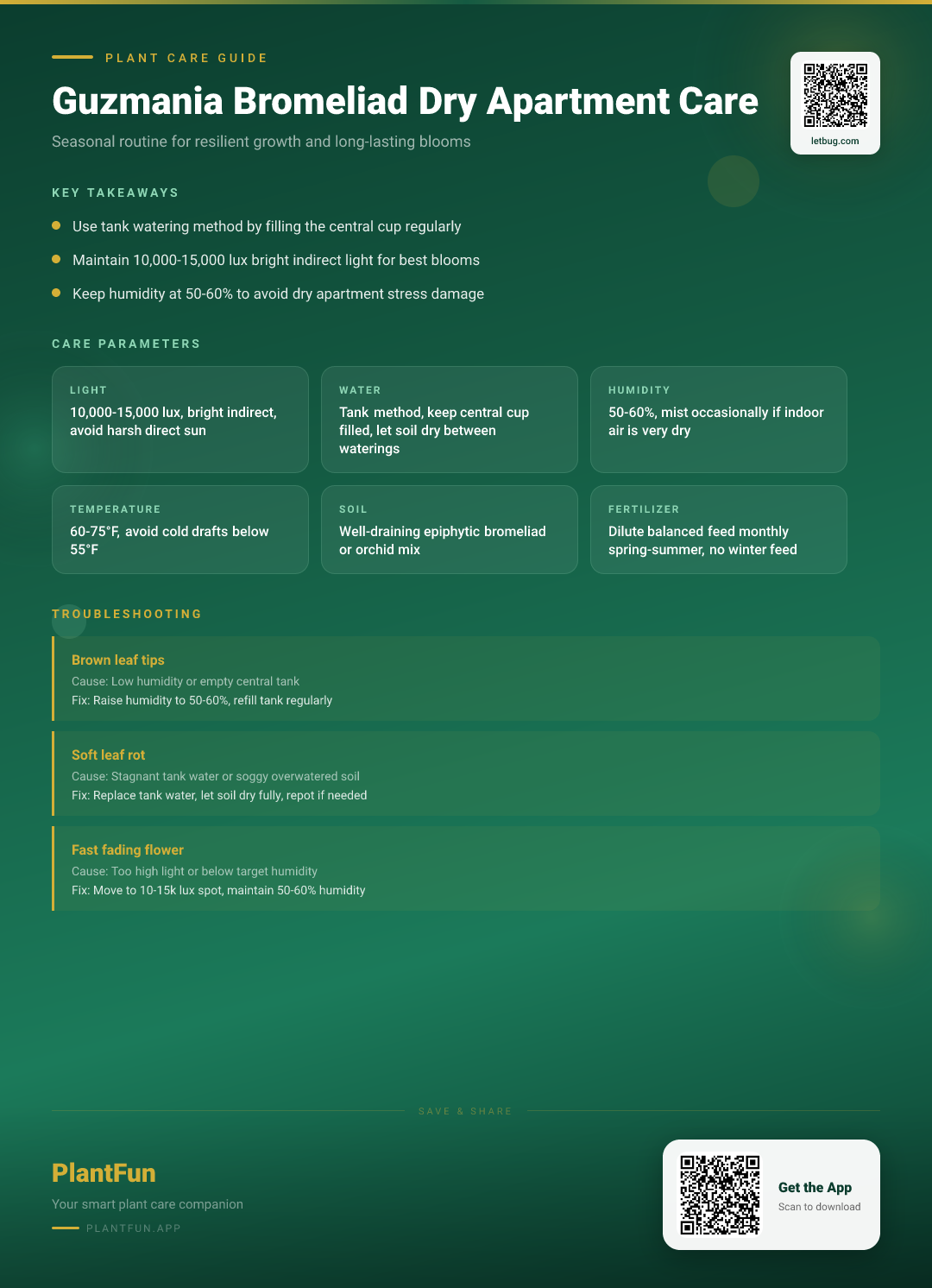
Key Takeaways
- Check soil moisture before watering — overwatering is the #1 killer of houseplants.
- Ensure your plant gets the right amount of light for its species.
- Be patient with recovery — most plants need 2–4 weeks to bounce back.
TL;DR: The Essentials
Guzmania bromeliads thrive by mimicking their native rainforest canopy. To succeed in an apartment, keep the central cup (tank) filled with fresh water, ensure ambient temperatures stay between 60-75°F (NC State Extension, 2026), and provide bright, indirect light (10,000–15,000 lux). Never let the potting mix stay soggy, as this promotes rot; instead, rely on the tank for hydration.
Quick Care Card: Essential Thresholds for Guzmania
| Feature | Requirement |
|---|---|
| Temperature | 60–75°F (15–24°C) |
| Humidity | 50–60% |
| Light | 10,000–15,000 Lux (Bright, indirect) |
| Watering | Tank-watering method; keep cup 1/4 full |
| Soil | Fast-draining orchid or bromeliad mix |
| Fertilizer | Dilute liquid (1/4 strength) in growing season |
| Toxicity | Non-toxic to cats and dogs (ASPCA, 2026) |
My Experience
When I first brought home my very first Guzmania, I treated it like a pothos—drowning the soil every few days. Within weeks, the base turned mushy, and the beautiful bracts started to brown. I realized too late that I was fighting against its unique biology. Once I switched to the “tank-watering” method and stopped over-saturating the roots, the plant stabilized. It’s a learning curve, but once you view them as epiphytes rather than ground-dwellers, they become incredibly resilient apartment companions.
The Biology of the Tank: Why Bromeliads Are Not Like Other Houseplants
Guzmania are epiphytes, meaning in nature, they grow on tree branches, not in soil (NC State Extension, 2026). Their roots serve primarily as an anchor rather than a primary water-intake system. The central “cup” or tank acts as a reservoir to collect rainwater and nutrients in the wild. If you rely solely on soil moisture, you will likely encounter root rot, as the roots cannot process excessive water (Beeson & Chen, 2018).
Seasonal Routine: Spring & Summer Growth Phase vs. Autumn & Winter Dormancy
- Spring/Summer: This is when the plant is most active. Ensure the central tank is consistently refreshed with water. You can introduce a very weak liquid fertilizer into the water, but only at 25% of the recommended strength.
- Autumn/Winter: Growth slows. In cooler months, reduce the water in the tank slightly to prevent stagnant conditions (Beeson & Chen, 2018). Ensure the plant stays away from cold drafts or heating vents, which can plummet local humidity below the 50% threshold.
Decoding Apartment Light: Finding the 10,000-15,000 Lux Sweet Spot
Most apartments are dimmer than a tropical rainforest. A Guzmania needs bright, indirect light to maintain its vibrant bract colors. If your leaves are stretching or losing color, move them closer to an East-facing window. If you notice burn spots, the intensity is too high. Using a simple light-meter app on your phone can help you find that 10,000–15,000 lux zone.
Mastering the Tank-Watering Method: How to Fill the Central Cup (And Why it Matters)
To water your bromeliad correctly, pour distilled or filtered water directly into the central cup (the base of the bracts).
- Fill the cup until it is 1/4 full.
- Use a squeeze bottle to avoid wetting the soil surface excessively.
- Flush the tank every 2-3 weeks to prevent mineral buildup or bacterial growth.
Managing Apartment Humidity: 50-60% Thresholds in Modern Living Spaces
Dry indoor air is the enemy. While 50-60% is ideal, many apartments drop to 30% in winter. I use a pebble tray beneath the pot—not touching the roots—to increase the micro-climate humidity.
Troubleshooting Common Symptoms
Brown Tips
Symptom: Leaf tips turn brown and crisp.
Likely cause: Low humidity or salt buildup in the water.
Fix:
- Increase ambient humidity using a humidifier or pebble tray.
- Switch to using distilled or rainwater instead of tap water.
Leaf Rot
Symptom: The base of the plant becomes mushy or blackened.
Likely cause: Overwatered soil or stagnant water in the tank.
Fix:
- Immediately reduce water in the cup.
- Move the plant to a brighter, airier location to allow the soil to dry out.
Flower Fades
Symptom: The central bright bract (flower) turns brown and loses vibrancy.
Likely cause: This is part of the natural lifecycle.
Fix:
- Accept that the bloom is finishing and focus on caring for the mother plant until she produces pups.
FAQ
- Why is my Guzmania flower turning brown so fast? If the plant is mature, it is likely reaching the end of its natural lifespan (NC State Extension, 2026).
- Can I keep my Bromeliad in a windowless bathroom? Only if you provide an artificial grow light. They cannot survive without adequate light to fuel their metabolism (Beeson & Chen, 2018).
- How often to water Guzmania? Check the tank twice a week; keep it 1/4 full, but never let it sit dry for more than a few days.
Step-by-Step Recovery: Saving a Bromeliad from Overwatered Soil
- Gently remove the plant from its container.
- Inspect the roots: trim any soft, black, or slimy roots with sterile shears.
- Repot into a high-quality, chunky orchid bark mix (NC State Extension, 2026).
- Wait 48 hours before adding any water to the tank to allow the system to recover.
Beyond the Bloom: Understanding the Pup Lifecycle in Small Spaces
After the main bloom dies, the mother plant will produce “pups” at the base. Leave these attached until they are roughly one-third the size of the parent plant. This is the natural way to propagate your indoor plants.
References
- ASPCA. (2026). Toxic and Non-Toxic Plants List — ASPCA. https://www.aspca.org/pet-care/animal-poison-control/toxic-and-non-toxic-plants. Accessed 2026-03-19.
- Beeson, R.; Chen, J. (2018). Daily Evapotranspiration of Guzmania ‘Irene’ and Vriesea ‘Carly’ Bromeliads Produced in a Shaded Greenhouse. HortScience. https://doi.org/10.21273/hortsci13351-18. Accessed 2026-03-19.
- Boneh, L.; Kuperus, P.; Van Tienderen, P. (2003). Microsatellites in the bromeliads Tillandsia fasciculata and Guzmania monostachya. Molecular Ecology Notes. https://doi.org/10.1046/j.1471-8286.2003.00432.x. Accessed 2026-03-19.
- NC State Extension. (2026). Guzmania Bromeliads — NC State Extension Gardener Plant Toolbox. https://plants.ces.ncsu.edu/plants/guzmania-bromeliad/. Accessed 2026-03-19.
Optional Helper: Plantfun.App
Plantfun.App identifies your plants by photo, diagnoses pests and diseases with clear fixes, and creates personalised watering and light schedules that adapt to your home conditions — a handy companion for putting this guide into daily practice.
Found an error or have suggestions? We'd love your feedback.
Need help identifying this problem?
Get instant identification, personalized care schedules, and effective pest treatment plans directly on your phone.
Sponsored • We may earn a commission from app downloads
Related Guides
The Complete Guzmania Bromeliad Care Checklist for Resilient Growth in Small Studio Apartments
Grow a thriving Guzmania bromeliad even in a cramped studio apartment. Get exact light levels, watering amounts, and small-space hacks for year-round vibrant, long-lasting blooms.
Care GuideGuzmania Bromeliad Care Guide for Typical Apartments: 8 Steps for Resilient, Long-Blooming Growth
Stop watching your apartment bromeliad wilt after blooming. Get 8 actionable care steps, exact measurable thresholds, and a free printable checklist for resilient, year-round growth.
Care GuideGuzmania Bromeliads in Low-Humidity Apartments: A Simple Care Guide for Lasting Blooms
Revive your fading Bromeliad with our precise tank-watering method. Learn the exact light and humidity needs to keep your Guzmania vibrant in any apartment.
Pest ControlAnts on Plants: What They Mean and What to Do
Ants usually aren't eating your plant. They are farming other pests.