
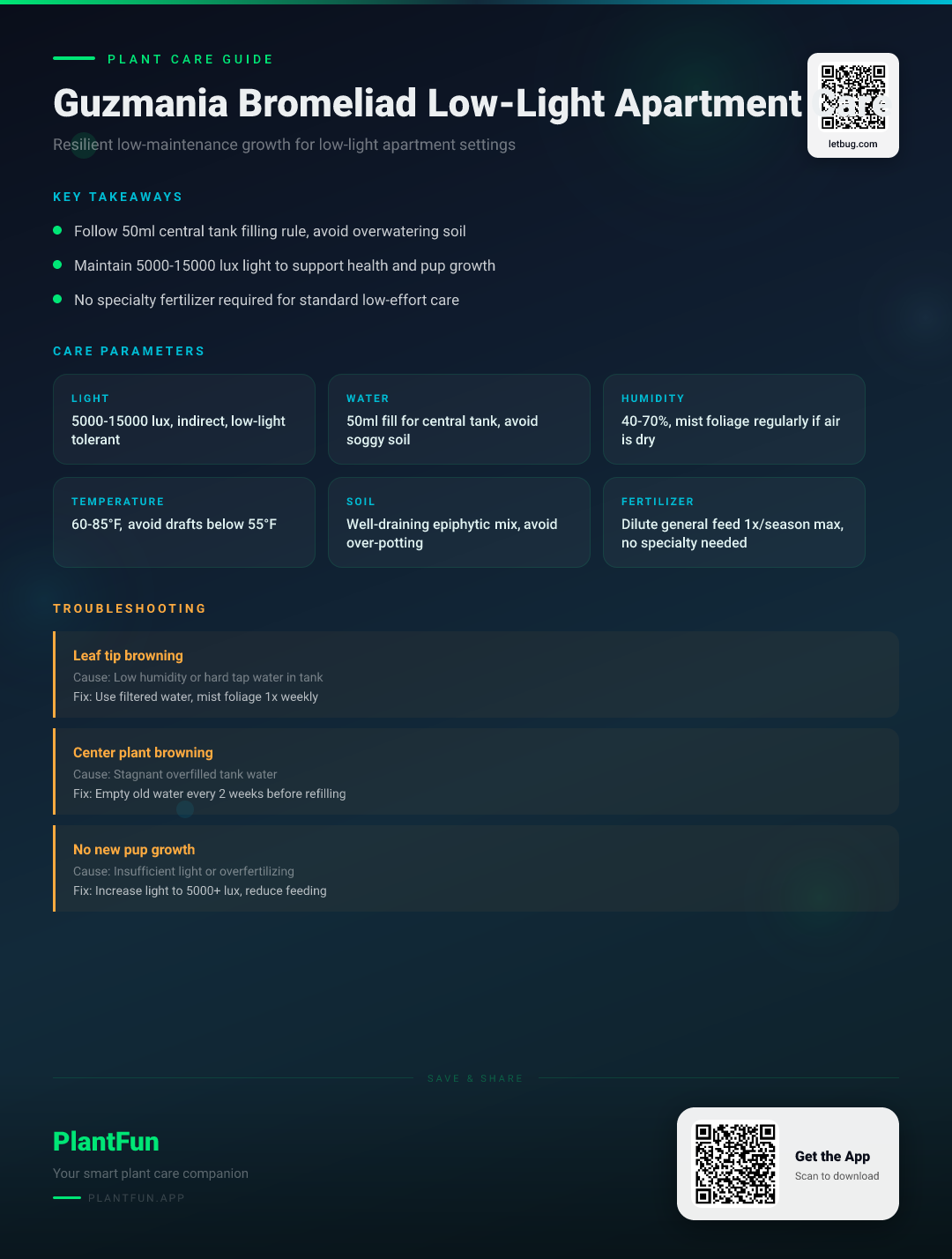
Key Takeaways
- Check soil moisture before watering — overwatering is the #1 killer of houseplants.
- Ensure your plant gets the right amount of light for its species.
- Be patient with recovery — most plants need 2–4 weeks to bounce back.
Quick Care Card: Essential Thresholds for Guzmania (Lux, Humidity, Water, Temperature)
| Feature | Requirement |
|---|---|
| Light | 5,000–15,000 Lux (Bright, indirect) |
| Watering | Fill central tank with 50ml fresh water weekly |
| Humidity | 50–70% (Mist leaves during dry winter) |
| Temperature | 60°F–80°F (15°C–27°C) |
| Soil | Well-draining, airy orchid-bark mix |
| Fertilizer | Diluted, balanced liquid fertilizer (monthly) |
| Toxicity | Non-toxic to cats and dogs (ASPCA, 2026) |
TL;DR: Why Your Bromeliad Is More Than Just a Temporary Decor Piece
Most apartment dwellers treat the Guzmania as a disposable floral arrangement, discarding it once the colorful bract fades. However, these are hardy epiphytes (plants that grow on other surfaces) designed to thrive in specialized niches. By mastering the central tank irrigation method and maintaining stable ambient temperatures, you can keep your bromeliad green for years and successfully propagate new offsets (pups). It is not a temporary piece; it is a permanent resident waiting for you to understand its unique biology.
Understanding the Guzmania: Natural Habitat vs. The Modern Studio Apartment
When I first got my Guzmania, I made the mistake of treating it like a standard houseplant, burying it in dense potting soil and watering it from the bottom. I quickly learned that this is the fastest way to invite rot. In their native rainforest canopy, Guzmania species cling to tree branches, capturing water and nutrients through their central tank, or “cup” (NC State Extension, 2026). In your apartment, you must replicate this by prioritizing airflow to the roots while mimicking the consistent, mineral-light water source they receive from tropical rainfall.
The 50ml Rule: Why Watering the Tank Matters More Than Watering the Soil
Watering a Guzmania is less about the soil and more about the central vase.
- Use a measuring tool or small squeeze bottle to deposit exactly 50ml of room-temperature, filtered water into the central cup.
- Ensure the water level reaches the base of the inner leaves but does not overflow excessively into the potting medium.
- Every 4-6 weeks, flush the tank entirely to prevent mineral buildup and bacterial growth.
- Keep the soil only slightly moist—if you touch the soil and it feels soggy, you are overwatering (NC State Extension, 2026).
Light Requirements: How to Achieve 5,000–15,000 Lux in an Apartment Setting
Guzmania requires bright, indirect light. While they can handle lower light levels than other tropicals, they will lose their vibrant color if kept in total shade.
- Measuring Lux: Use a free light-meter app on your smartphone to measure the foot-candles or lux near your windowsill.
- Placement: A north or east-facing window is ideal.
- The Adjustment: If your plant’s leaves are stretching (etiolation), move it closer to the window by 6 inches or add a supplementary LED grow light.
Step-by-Step: The Budget-Friendly Maintenance Routine for Year-Round Health
- Routine Check: Once a week, check the tank level. If it’s empty, refill with 50ml.
- Cleaning: Dust leaves with a damp microfiber cloth to ensure the plant can perform photosynthesis efficiently.
- Pruning: Remove dead, crispy outer leaves at the base using sterilized shears.
- Soil Check: If the potting medium feels completely dry, run a small amount of water through the soil once a month to hydrate the roots, then drain it thoroughly.
Myth-Busting: Do You Really Need Specialty Fertilizer for a Bromeliad?
It is a myth that you need expensive “Bromeliad Food.” Guzmania are light feeders. According to research on plant quality, nutrient management can influence flowering, but for indoor maintenance, a balanced liquid fertilizer diluted to 1/4 strength is perfectly sufficient (Issarakraisila et al., 2017). Apply this to the soil once every two months during the growing season; never fertilize directly into the tank, as this can cause salt burn.
Seasonal Care: Adjusting Your Strategy from Central Heating Winters to Humid Summers
- Winter: Central heating dries the air rapidly. Place your bromeliad on a pebble tray filled with water to boost local humidity (Abreu et al., 2018).
- Summer: Higher temperatures increase evaporation. Check the tank levels twice a week, as the 50ml capacity may evaporate faster in heat waves.
Troubleshooting Guide: Identifying Leaf Tip Browning and Tank Rot
[Leaf Tip Browning]
Symptom: The tips of the leaves turn brown and crispy.
Likely cause: Low humidity or chlorine/fluoride in tap water.
Fix:
- Increase humidity by using a room humidifier.
- Switch to distilled or rainwater for your tank refills.
[Tank Rot/Foul Odor]
Symptom: A pungent, swampy smell originating from the center of the plant.
Likely cause: Stagnant water or trapped debris in the cup.
Fix:
- Tip the plant sideways to drain the old, stagnant water.
- Gently rinse the cup with fresh, clean water and let it dry out for 24 hours.
Voice Search FAQ: How do I get my Guzmania to produce new pups?
Once the mother plant finishes blooming, it will slowly fade. During this time, it directs energy into growing “pups” or offsets at the base. Leave these attached until they are at least one-third the size of the parent plant, then use a clean knife to separate them.
Voice Search FAQ: Why is the center of my bromeliad turning brown?
This is often a result of ‘tank rot’ or mineral accumulation from tap water. Ensure you are using filtered or distilled water and flushing the tank periodically to prevent salt crusting in the cup.
Voice Search FAQ: Is tap water safe for my Guzmania tank?
Tap water is often treated with chemicals that can irritate sensitive bromeliad leaves. If you notice white deposits on the leaves, switch to filtered water to maintain the health of your plant.
Common Mistakes to Avoid: Over-potting and Soil Mismanagement
- Mistake: Using a giant pot. What happens: Excessive soil holds too much water, leading to root rot. Instead: Keep the plant in a snug nursery pot or use a small decorative cachepot that allows for fast drainage.
- Mistake: Burying the plant too deep. What happens: The stem crown rots. Instead: Only bury the roots; keep the base of the foliage above the soil line.
References
- Issarakraisila, M.; Rundon, P.; Nuanla-ong, S. (2017). Effect of ethephon and urea mixtures on flowering and plant quality of bromeliad (Guzmania lingulata). Acta Horticulturae. https://doi.org/10.17660/actahortic.2017.1167.51. Accessed 2026-03-16.
- Abreu, M.; Carvalho, V.; Mercier, H. (2018). Antioxidant capacity along the leaf blade of the C3-CAM facultative bromeliad Guzmania monostachia under water deficit conditions. Functional Plant Biology. https://doi.org/10.1071/fp17162. Accessed 2026-03-16.
- ASPCA. (2026). Toxic and Non-Toxic Plants List — ASPCA. https://www.aspca.org/pet-care/animal-poison-control/toxic-and-non-toxic-plants. Accessed 2026-03-16.
- NC State Extension. (2026). Guzmania Bromeliad — NC State Extension Gardener Plant Toolbox. https://plants.ces.ncsu.edu/plants/guzmania-bromeliad/. Accessed 2026-03-16.
Optional Helper: Plantfun.App
Plantfun.App identifies your plants by photo, diagnoses pests and diseases with clear fixes, and creates personalised watering and light schedules that adapt to your home conditions — a handy companion for putting this guide into daily practice.
Found an error or have suggestions? We'd love your feedback.
Need help identifying this problem?
Get instant identification, personalized care schedules, and effective pest treatment plans directly on your phone.
Sponsored • We may earn a commission from app downloads
Related Guides
Guzmania Bromeliad Care Guide for Typical Apartments: 8 Steps for Resilient, Long-Blooming Growth
Stop watching your apartment bromeliad wilt after blooming. Get 8 actionable care steps, exact measurable thresholds, and a free printable checklist for resilient, year-round growth.
Care GuideGuzmania Bromeliads in Low-Humidity Apartments: A Simple Care Guide for Lasting Blooms
Revive your fading Bromeliad with our precise tank-watering method. Learn the exact light and humidity needs to keep your Guzmania vibrant in any apartment.
Care GuideThe Complete Guzmania Bromeliad Care Checklist for Resilient Growth in Small Studio Apartments
Grow a thriving Guzmania bromeliad even in a cramped studio apartment. Get exact light levels, watering amounts, and small-space hacks for year-round vibrant, long-lasting blooms.
Pest ControlAnts on Plants: What They Mean and What to Do
Ants usually aren't eating your plant. They are farming other pests.