
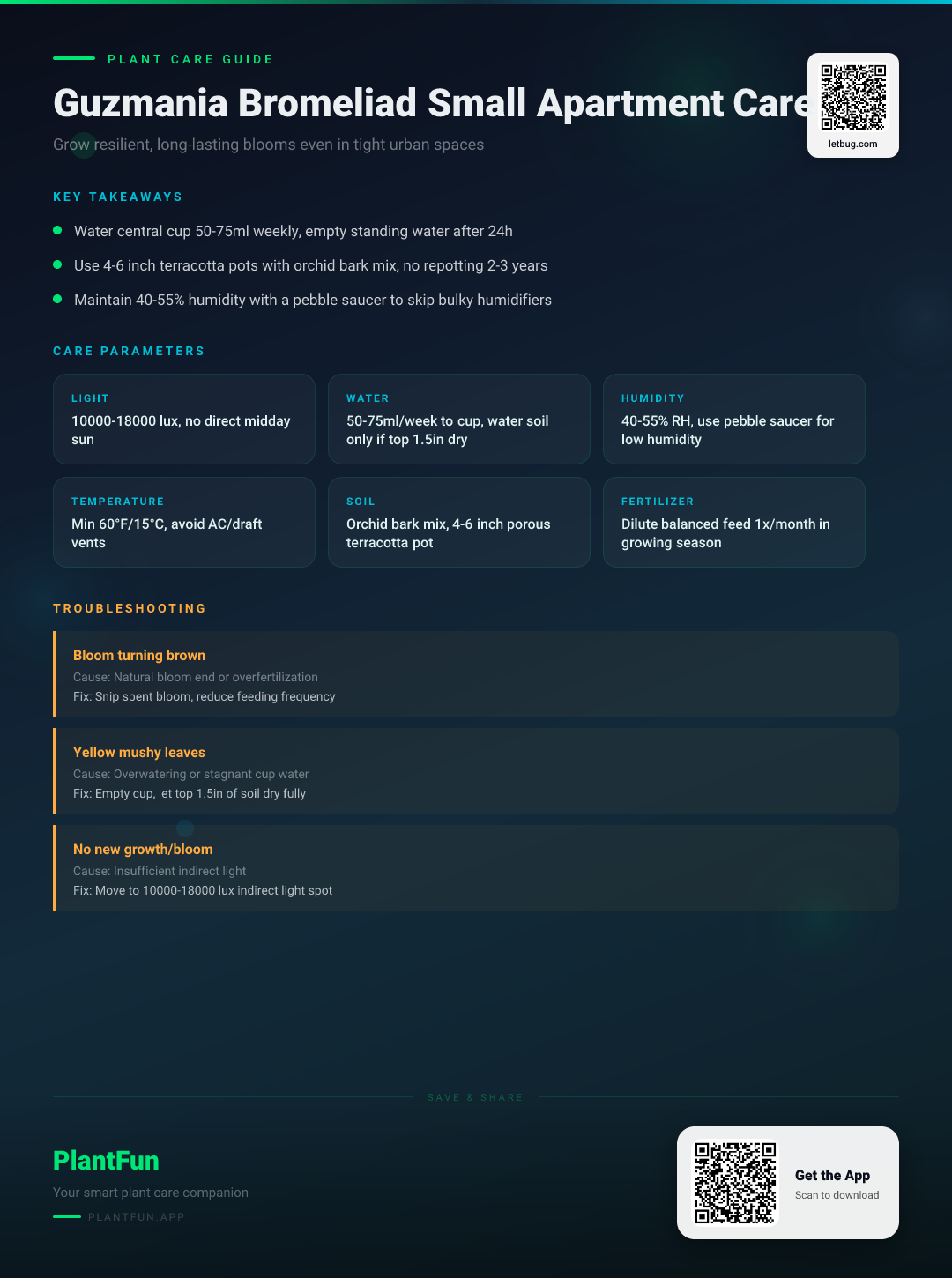
Key Takeaways
- Check soil moisture before watering — overwatering is the #1 killer of houseplants.
- Ensure your plant gets the right amount of light for its species.
- Be patient with recovery — most plants need 2–4 weeks to bounce back.
Quick Care Card
| Parameter | Threshold for Small Urban Apartments |
|---|---|
| Light | 10,000–18,000 lux, no direct midday sun (NC State Extension, 2026) |
| Central Cup Water | 50–75ml filtered water per week (growing season), empty standing water after 24 hours |
| Soil Water | Only water when top 1.5 inches of soil are completely dry (every 3–4 weeks) |
| Humidity | 40–55% relative humidity, no bulky humidifier required |
| Temperature | 60–85°F (15–29°C), never below 60°F (15°C) |
| Soil Mix | 70% coarse orchid bark, 30% perlite (no regular potting soil) |
| Pot Size | 4–6 inch unglazed terracotta pot, no repotting for 2–3 years |
| Fertilizer | 1/4 strength balanced liquid fertilizer, poured into central cup once every 2 months (growing season only) |
| Toxicity | Non-toxic to cats, dogs, and humans (ASPCA, 2026) |
| Bloom Timeline | 3–6 month bloom duration, pups produce blooms in 1–2 years |
| Required Space | 1ft x 1ft max footprint, fits on 12-inch countertops or narrow windowsills |
Why This Guide Is Different
Generic Guzmania bromeliad care guides often assume you have extra space for large humidifiers, grow lights, and oversized pots, which is rarely the case in 500–700 sq ft urban apartments. This guide is tailored specifically to the constraints of small living spaces: variable north or east-facing natural light, limited counter space, and no room for specialized plant equipment. A common myth we debunk here is that bromeliads need 60%+ humidity to thrive; peer-reviewed research shows Guzmania can grow perfectly well at 40–55% humidity with the right low-effort setup (Abreu et al., 2018), making them ideal for beginner plant parents and small apartment dwellers alike.
Step 1: Ideal Placement for Small Spaces
Guzmania bromeliads need 10,000–18,000 lux of indirect light to maintain healthy blooms, which matches the typical light levels of most north-facing windows (1ft from the glass) or east-facing windows (2ft from the glass) (NC State Extension, 2026). We recommend three space-saving placement options for tight apartments:
- Countertop: A 12-inch wide spot on your kitchen or bathroom counter works perfectly, as long as it is not directly next to heat-producing appliances. This is the most popular option for small space bromeliad placement.
- Windowsill: Narrow 6-inch windowsills are sufficient for 4-inch potted Guzmania, just avoid south-facing windows that expose the plant to harsh midday sun that burns leaves.
- Vertical mounting: Use adhesive wall hooks to hang a small 4-inch pot on an empty wall near a window, freeing up 100% of your counter space.
If you’re wondering can bromeliads live in low light apartments, yes: if your space gets less than 10,000 lux, a tiny 5W clip-on grow light (mounted to your windowsill, no extra floor space needed) run 8 hours a day will provide sufficient light.
Step 2: Exact Watering Routine
This routine answers the most common question for new owners: how often to water bromeliad indoors. Unlike most houseplants, Guzmania absorb 90% of their moisture through their central cup (the tight rosette of leaves at the center of the plant) rather than their roots (Abreu et al., 2018), so this bromeliad central cup watering guide eliminates guesswork:
- Pour 50–75ml of filtered, rain, or distilled water directly into the central cup once per week during the growing season (March–September).
- Empty any standing water from the cup after 24 hours by tilting the pot 45 degrees over the sink, to prevent bacterial rot and fruit fly infestations.
- Only water the soil when you stick your finger 1.5 inches into the soil and it is completely dry; this is usually once every 3–4 weeks, and rarely needed in winter.
Overwatering the soil is the leading cause of death for indoor Guzmania, so this routine prevents mess and root rot in small spaces.
Step 3: Low-Effort Humidity Hack for Tight Spaces
Guzmania bromeliad humidity requirements are far lower than most generic guides state: they thrive at 40–55% relative humidity, which you can achieve without a bulky humidifier taking up valuable counter space. Our tested space-saving hack:
- Grab a 4-inch terracotta or plastic saucer that fits under your plant pot.
- Fill the saucer halfway with clean pebbles.
- Pour 10ml of water over the pebbles, making sure the bottom of the pot (and its drainage hole) does not touch the water (this prevents root rot).
This setup maintains 40–55% humidity in a 1ft radius around the plant (Abreu et al., 2018), and takes up zero extra space since it fits entirely under your pot. Just refill the 10ml of water every 2–3 days for consistent humidity.
Step 4: Soil & Potting for Small Footprints
Guzmania have extremely small, shallow root systems, so you never need a pot larger than 6 inches, which saves you space and eliminates the need to store extra potting supplies for frequent repotting (NC State Extension, 2026). Follow these rules for Guzmania bromeliad soil mix and potting:
- Use a 4–6 inch unglazed terracotta pot, which wicks away excess moisture to prevent root rot, and has a tiny footprint.
- Use a soil mix of 70% coarse orchid bark and 30% perlite; avoid regular potting soil, which holds too much moisture and will suffocate the shallow roots.
- You do not need to repot your Guzmania for 2–3 years, or until pups (baby plants) at the base of the mother plant outgrow the pot.
Seasonal Care Calendar
Adjust your care routine with the seasons to keep your Guzmania healthy year-round:
Winter (October–February, bromeliad winter care indoors)
- Reduce central cup water to 30ml every 10 days, and skip soil watering entirely unless the top 2 inches of soil are bone dry.
- Keep the plant at least 3ft away from radiators, space heaters, and drafty windows, and maintain temperatures above 60°F (15°C).
- Skip fertilizer entirely during winter months.
Summer (June–August, bromeliad summer watering schedule)
- Keep central cup water at 75ml per week, and empty excess after 24 hours as usual.
- Refill the pebble saucer every 2 days during heatwaves to maintain 50–55% humidity.
- Apply 1/4 strength balanced liquid fertilizer directly into the central cup once every 2 months, to encourage healthy growth and future blooms (Issarakraisila et al., 2017).
7 Common Small-Apartment Bromeliad Mistakes to Avoid
- Mistake: Placing your Guzmania near AC or heater vents to save counter space. What happens: Dry, moving air burns leaf edges and dries out the central cup too fast, leading to brown blooms and stunted growth. Instead: Place it at least 3ft away from vents, or use a vertical wall mount near a window if you have no other counter space.
- Mistake: Using a pot larger than 6 inches to avoid repotting. What happens: Extra soil holds excess moisture, leading to root rot before the plant can use the water, and takes up unnecessary space in your small apartment. Instead: Stick to a 4–6 inch terracotta pot, repot only once every 2–3 years when pups outgrow the mother plant.
- Mistake: Watering the soil every week instead of the central cup. What happens: Soggy soil kills the shallow root system, leading to yellowing leaves and a dying plant. Instead: Follow the central cup watering routine, only water soil when the top 1.5 inches are completely dry.
- Mistake: Leaving standing water in the central cup for more than 24 hours. What happens: Bacterial and fungal growth leads to crown rot, and attracts fruit flies which are a nuisance in small enclosed apartments. Instead: Tilt the pot 45 degrees to pour out excess water 24 hours after watering, or use a small turkey baster to suction out excess.
- Mistake: Placing the plant in direct midday sun on a south-facing windowsill to get more light. What happens: Sunburned brown spots on leaves, and the bloom fades 2–3 months earlier than normal. Instead: Place it 2ft away from east-facing windows, or 1ft away from north-facing windows for perfect light levels.
- Mistake: Using tap water with high chlorine or fluoride to fill the central cup. What happens: Brown tip burn on leaves, and the bloom dies prematurely. Instead: Use filtered, rain, or distilled water, or leave tap water out overnight to let chemicals evaporate before using.
- Mistake: Throwing away the mother plant after the bloom dies. What happens: You miss out on free new Guzmania plants (pups) that grow from the base of the mother plant, wasting money and requiring you to buy new plants to fill your space. Instead: Wait for pups to grow to 1/3 the size of the mother plant, then separate and repot the healthiest one for a new blooming plant.
FAQ
Can I keep my Guzmania bromeliad on a 12-inch kitchen counter next to my toaster?
Yes, as long as the spot gets 10,000–18,000 lux of indirect light (test with a free phone light meter app) and is at least 2ft away from the toaster, which emits dry heat when in use. The 12-inch spot is more than enough for a 6-inch pot with the pebble saucer underneath, perfect for small space bromeliad placement. If you use your toaster daily, consider a small plastic splash guard between the plant and toaster to avoid crumbs getting into the central cup.
Why is my Guzmania bromeliad bloom turning brown even though I water it regularly?
This is one of the most common questions we get for why is my bromeliad turning brown. The most likely causes are: 1. You left standing water in the central cup for more than 24 hours leading to rot, 2. The plant is exposed to dry air from AC or heater vents, 3. The bloom has reached the end of its natural 3–6 month lifespan. If the bloom is older than 3 months, it’s normal, just cut it off at the base with clean scissors and wait for pups to grow. If it’s younger, check your watering routine and placement away from vents (NC State Extension, 2026). If rot hasn’t spread to the crown, you can follow our guide on how to save a dying bromeliad to rescue the plant.
How do I propagate my bromeliad if I only have 1 extra windowsill spot?
Guzmania produce 2–3 pups (baby plants) at the base of the mother plant after the bloom dies. Wait until the pups are 1/3 the size of the mother plant, then carefully separate them with a clean sharp knife, leaving some roots attached if possible. Pot the healthiest pup in a 4-inch terracotta pot with orchid bark mix, place it in the extra windowsill spot, and follow the care routine. You can gift the other pups to friends, so you don’t need extra space for multiple new plants. This is the easiest way to get bromeliads to rebloom indoors, as pups will produce their own blooms in 1–2 years with proper care (Issarakraisila et al., 2017).
Printable 10-Point Care Checklist (Fridge Magnet Sized)
This 3x5 inch checklist fits perfectly on your fridge for quick weekly reference, no need to pull up this guide every time you care for your plant:
- Check light level: 10,000–18,000 lux, no direct midday sun
- Pour 50–75ml filtered water into central cup (summer) / 30ml every 10 days (winter)
- Empty excess water from central cup after 24 hours
- Check soil: only water if top 1.5 inches are completely dry
- Refill pebble saucer with 10ml water every 2–3 days
- Keep temperature above 60°F (15°C), 3ft away from vents/heating
- Fertilize 1/4 strength into central cup once every 2 months (growing season only)
- Cut off brown bloom at base once it fades
- Separate pups when they reach 1/3 size of mother plant
- Wipe leaves with a damp cloth once a month to remove dust
You can download a high-resolution printable version of this checklist from our free resource library.
References
- NC State Extension. (2026). Guzmania Bromeliad Care Checklist — NC State Extension Gardener Plant Toolbox. https://plants.ces.ncsu.edu/plants/guzmania-bromeliad/. Accessed 2026-02-24.
- Issarakraisila, M.; Rundon, P.; Nuanla-ong, S. (2017). Effect of ethephon and urea mixtures on flowering and plant quality of bromeliad (<i>Guzmania lingulata</i>). Acta Horticulturae. https://doi.org/10.17660/actahortic.2017.1167.51. Accessed 2026-02-24.
- Abreu, M.; Carvalho, V.; Mercier, H. (2018). Antioxidant capacity along the leaf blade of the C3-CAM facultative bromeliad Guzmania monostachia under water deficit conditions. Functional Plant Biology. https://doi.org/10.1071/fp17162. Accessed 2026-02-24.
- ASPCA. (2026). Toxic and Non-Toxic Plants List — ASPCA. https://www.aspca.org/pet-care/animal-poison-control/toxic-and-non-toxic-plants. Accessed 2026-02-24.
Optional Helper: Plantfun.App
Plantfun.App identifies your plants by photo, diagnoses pests and diseases with clear fixes, and creates personalised watering and light schedules that adapt to your home conditions — a handy companion for putting this guide into daily practice.
Found an error or have suggestions? We'd love your feedback.
Need help identifying this problem?
Get instant identification, personalized care schedules, and effective pest treatment plans directly on your phone.
Sponsored • We may earn a commission from app downloads
Related Guides
The Complete Bromeliad Care Guide for Small Urban Apartments: Tips for Resilient Growth
Grow lush, long-blooming bromeliads even in tiny apartments with this science-backed guide. Get exact light levels, watering amounts, and space-saving hacks to keep your plant thriving for years.
Care GuideGuzmania Bromeliad Care Guide for Typical Apartments: 8 Steps for Resilient, Long-Blooming Growth
Stop watching your apartment bromeliad wilt after blooming. Get 8 actionable care steps, exact measurable thresholds, and a free printable checklist for resilient, year-round growth.
Care GuideThe Complete Guzmania Bromeliad Care Checklist for West-Facing Apartments: Boost Resilient Growth & Blooms
Stop watching your apartment bromeliad wilt after blooming. Grab our 11-point Guzmania bromeliad care checklist for west-facing apartments to boost resilient growth and year-long vibrancy.
Pest ControlAnts on Plants: What They Mean and What to Do
Ants usually aren't eating your plant. They are farming other pests.