
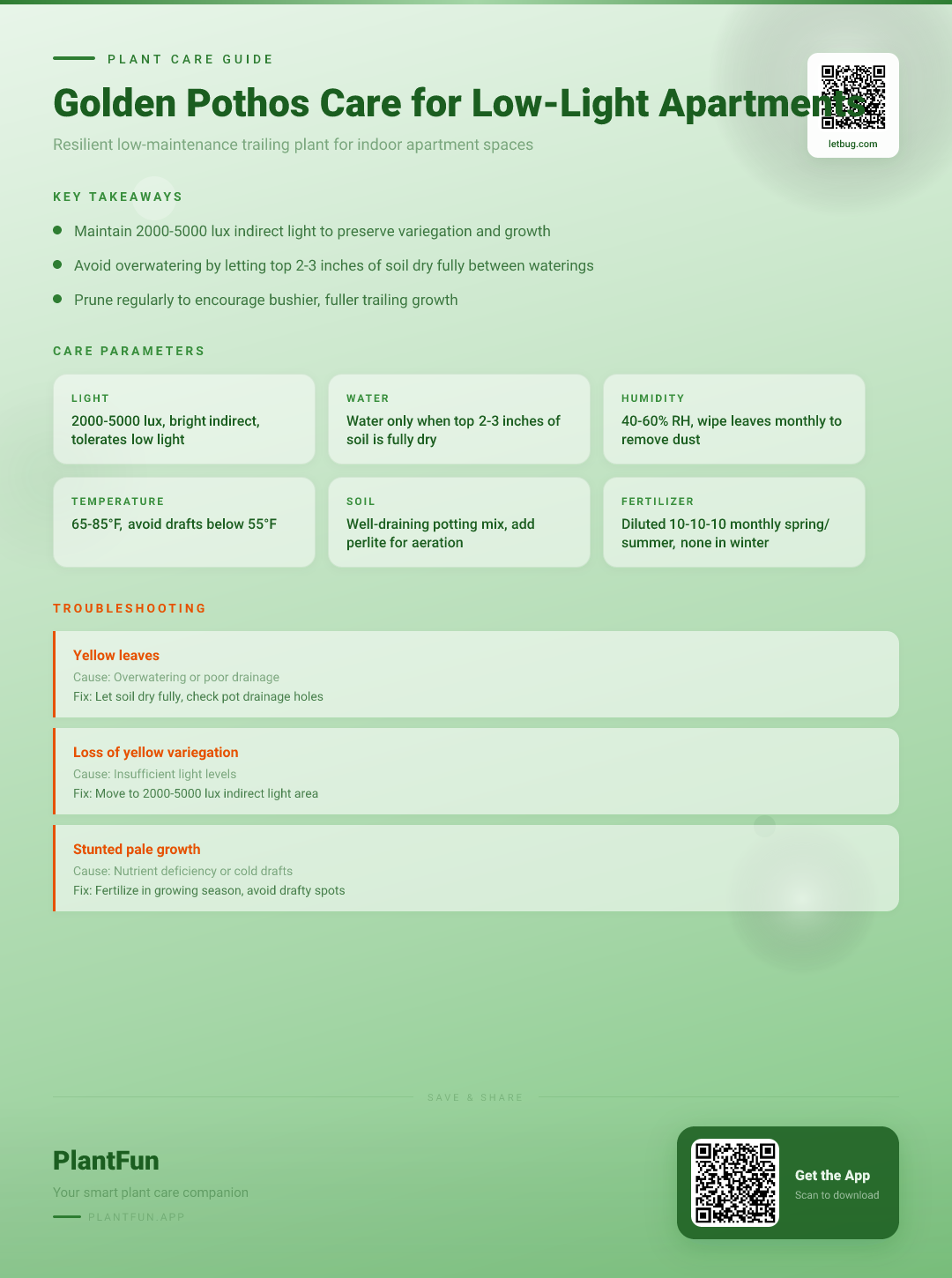
Key Takeaways
- Check soil moisture before watering — overwatering is the #1 killer of houseplants.
- Ensure your plant gets the right amount of light for its species.
- Be patient with recovery — most plants need 2–4 weeks to bounce back.
Quick Care Card: Essential Thresholds for Epipremnum aureum
| Feature | Requirement |
|---|---|
| Light | 2,000–5,000 Lux (Bright, indirect) |
| Watering | When soil is 50% dry (depth test) |
| Humidity | 40–60% Relative Humidity |
| Temperature | 65–75°F (18–24°C) |
| Soil | Well-draining, peat-based mix |
| Fertilizer | Balanced NPK (1-1-1) during growing season |
| Toxicity | Toxic to cats and dogs (ASPCA, 2026) |
TL;DR: The Low-Light Reality Check
Your Golden Pothos will survive in low-light apartments, but it won’t thrive without intervention. To prevent legginess, maintain light levels between 2,000 and 5,000 lux (NC State Extension, 2026). Water only when the top 50% of the soil is dry to prevent root rot, and keep your plant away from cold drafts. If your plant is stretching, it is searching for energy—relocate it immediately.
Understanding Your Apartment Micro-Climate: Light and Airflow
When I first moved into my city apartment, I placed my Epipremnum aureum in a dark corner, thinking it was ‘low-light tolerant.’ I quickly learned that ‘tolerant’ doesn’t mean ‘thriving.’ The micro-climate of an apartment—often characterized by stagnant air and inconsistent lighting—can stress a plant.
Light intensity drops exponentially the further you move from a window. I found that using a simple light meter app (or a dedicated sensor) changed everything; I moved my pothos just three feet closer to the window, and the growth rate doubled. Proper airflow is equally vital; stagnant, humid air can lead to fungal issues, so ensure your plant has enough room to breathe.
Mistake #1: The Overwatering Cycle (and how to avoid it)
Many beginners treat watering like a chore to be done on a schedule, but in low-light apartments, your plant’s metabolic rate slows down significantly.
- Mistake: Watering on a calendar schedule (e.g., every Monday).
- What happens: The soil stays saturated, leading to root rot, which kills the plant’s ability to uptake nutrients (Current Science International, 2019).
- Instead: Use the finger test. Push your finger 2 inches into the soil. If it feels moist, do not water. Wait until the soil is dry halfway down the pot.
Mistake #2: Ignoring the 2,000–5,000 Lux Light Requirement
Plants need light for photosynthesis, which creates the energy for new leaves. When light is below 2,000 lux, the plant compensates by stretching its internodes—the stem space between leaves—resulting in a ‘leggy’ appearance (NC State Extension, 2026).
Mistake #3: Neglecting Humidity and Dust Accumulation
Dust acts as a physical barrier to light absorption. In a city apartment, fine particles settle on the wide, waxy leaves of your Pothos. I wipe my leaves every two weeks with a damp microfiber cloth. This also helps with air purification efficiency (EL Sayed, 2020).
Step-by-Step Recovery: Pruning for Fullness and Bushy Growth
If your plant has become a long, thin vine, it needs a reset:
- Locate the nodes: Look for the small brown bumps where leaves meet the stem.
- Make the cut: Snip the vine about 1/4 inch above a node. This signals the plant to redirect energy to dormant axillary buds.
- Propagate: Place the cut vines in water. Once roots are 1-2 inches long, plant them back into the original pot to fill in sparse gaps.
Seasonal Maintenance: Adapting to Apartment Temperature Swings
Your Pothos prefers 65–75°F (18–24°C) (NC State Extension, 2026). In winter, keep your plant away from radiators and windows that leak cold drafts. Fertilizer should be reduced during the dormant months to match the lower light levels (Current Science International, 2019).
FAQ
Why is my Pothos losing its yellow variegation?
This is a classic sign of insufficient light. The plant is shedding its decorative yellow pigments to produce more chlorophyll to capture what little light is available. Move it to a brighter spot.
Can I put my pothos in the bathroom for humidity?
Yes, but only if there is a window. If the bathroom is windowless, it will not support growth long-term.
How do I know if my apartment has enough light for a Pothos?
If you can read a book comfortably without turning on a lamp, you are likely in the 2,000+ lux range. If not, your plant will likely require a supplemental grow light.
Can I fertilize my Pothos during the winter months?
Only if the plant is still actively producing new leaves. If growth has stalled due to low light, skip fertilization until spring (Current Science International, 2019).
Troubleshooting Guide: Identifying Common Nutrient Deficiencies
Yellowing Lower Leaves
Symptom: The oldest leaves turn yellow and drop off.
Likely cause: Overwatering or nitrogen deficiency.
Fix:
- Check for root rot (mushy, dark roots).
- If the soil is waterlogged, repot in fresh, well-draining medium.
Pale, Stunted Growth
Symptom: Small leaves and very slow growth rate.
Likely cause: Lack of NPK nutrients or insufficient light.
Fix:
- Apply a balanced, water-soluble fertilizer at half-strength during the growing season (Current Science International, 2019).
- Evaluate if the plant needs a brighter location.
Brown, Crispy Leaf Tips
Symptom: The tips of the leaves are turning brown and brittle.
Likely cause: Low humidity or salt buildup in the soil.
Fix:
- Increase ambient humidity with a humidifier (aim for 40-60%).
- Flush the soil with distilled water to remove excess fertilizer salts.
References
- EL Sayed, N. (2020). Spray Golden Pothos and Croton Plants with Glutathione and Bilirubin to Purify the Indoor Air from Pollutants. Journal of Plant Production. https://doi.org/10.21608/jpp.2020.102766. Accessed 2026-03-17.
- Current Science International. (2019). Growth of Golden Pothos (Epipremnum aureum) Plant as Affected by NPK Formula and rate. Current Science International. https://doi.org/10.36632/csi/2019.8.4.1. Accessed 2026-03-17.
- ASPCA. (2026). Toxic and Non-Toxic Plants List — ASPCA. https://www.aspca.org/pet-care/animal-poison-control/toxic-and-non-toxic-plants. Accessed 2026-03-17.
- NC State Extension. (2026). Golden Pothos — NC State Extension Gardener Plant Toolbox. https://plants.ces.ncsu.edu/plants/pothos-care/. Accessed 2026-03-17.
Optional Helper: Plantfun.App
Plantfun.App identifies your plants by photo, diagnoses pests and diseases with clear fixes, and creates personalised watering and light schedules that adapt to your home conditions — a handy companion for putting this guide into daily practice.
Found an error or have suggestions? We'd love your feedback.
Need help identifying this problem?
Get instant identification, personalized care schedules, and effective pest treatment plans directly on your phone.
Sponsored • We may earn a commission from app downloads
Related Guides
Golden Pothos in a Low-Light Studio Apartment: The Ultimate Space-Saving Growth Guide
Transform your leggy pothos into a lush statement piece. Learn the exact light thresholds and pruning hacks to maximize dense growth in small, dark apartments.
Care GuideGolden Pothos in Low-Light Apartments: A Budget-Friendly Guide to Resilient Indoor Growth
Transform your dim apartment into an indoor jungle. Follow our budget-friendly Golden Pothos care guide for 3 secret growth hacks and a simple watering schedule.
Care GuideGolden Pothos in Small Apartments: The Seasonal Care Guide for Resilient, Trailing Growth
Transform your dim apartment into a lush jungle. Follow this seasonal Pothos care guide for exact light levels, watering schedules, and 3 secrets to longer vines.
Pest ControlHow to Spot Pests on Golden Pothos in Low-Light Entryways: A Weekly Inspection & Rescue Plan
Catch pest infestations on your low-light entryway golden pothos early with our 5-minute weekly inspection plan, plus step-by-step non-toxic rescue steps to fix spider mites, mealybugs and gnats before foliage damage becomes irreversible.