
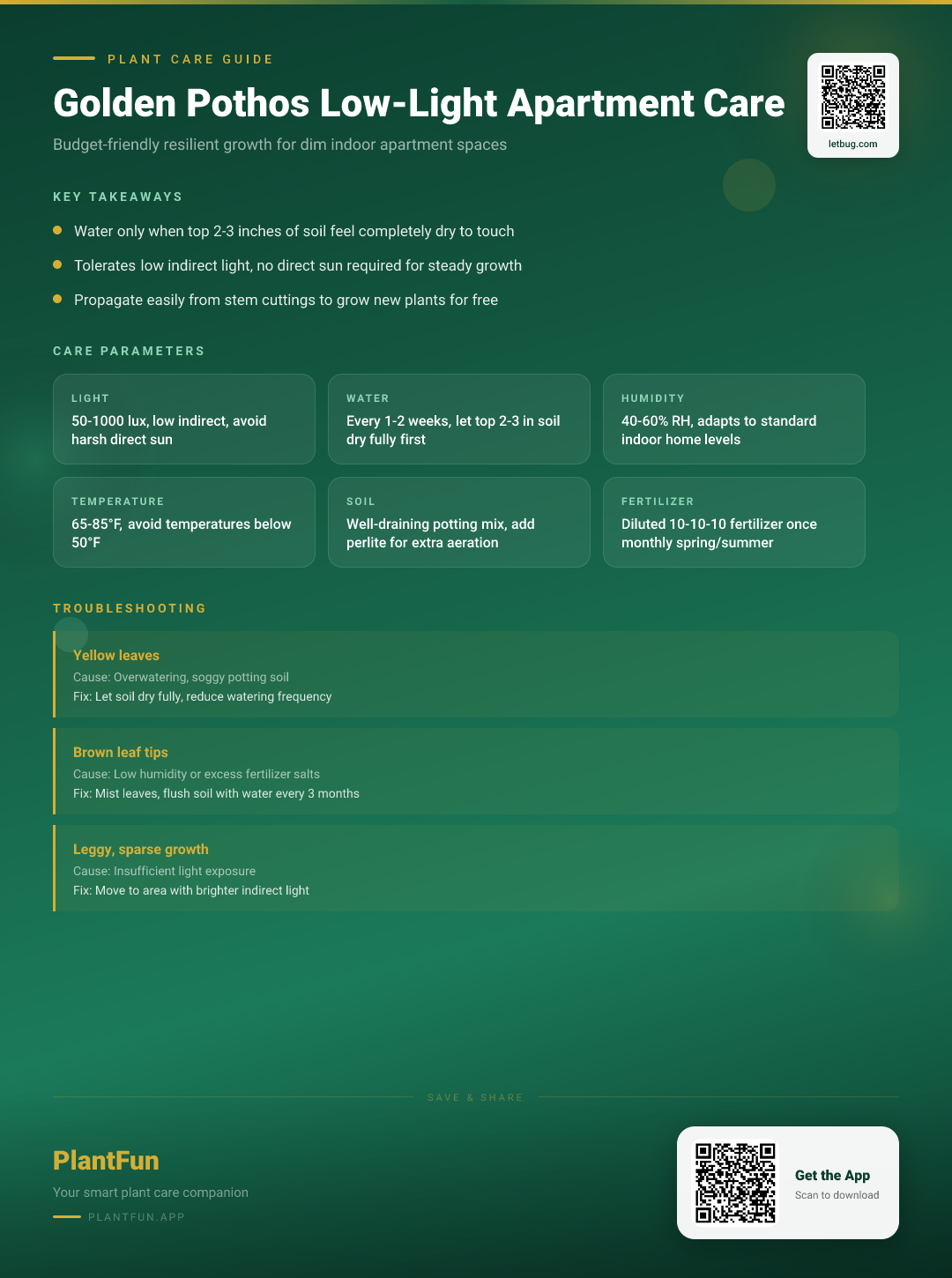
Key Takeaways
- Check soil moisture before watering — overwatering is the #1 killer of houseplants.
- Ensure your plant gets the right amount of light for its species.
- Be patient with recovery — most plants need 2–4 weeks to bounce back.
Quick Care Card: Essential Thresholds for Epipremnum aureum
| Feature | Threshold |
|---|---|
| Light | Low to Bright Indirect (100–1000 lux) |
| Water | Dry out top 50% of soil before watering |
| Humidity | 40%–60% (Average household levels) |
| Temperature | 65°F–85°F (18°C–29°C) |
| Soil | Well-draining peat-based potting mix |
| Fertilizer | Balanced liquid 20-20-20 (monthly in summer) |
| Toxicity | Toxic to cats and dogs (ASPCA, 2026) |
TL;DR: The Minimalist Pothos Philosophy
Epipremnum aureum is the ultimate apartment survivor. It thrives on neglect rather than excess. To keep it healthy, prioritize consistent but infrequent watering and avoid direct sunlight that scorches leaves. You don’t need expensive gear; your finger is the only moisture sensor you need. If the top two inches of soil are dry, it’s time to hydrate. Keep it out of reach of pets, as it is toxic (ASPCA, 2026).
Why Golden Pothos Thrive in Challenging Apartment Conditions
When I first started my indoor garden, I made the mistake of over-nurturing my plants. I moved my first Pothos around the room trying to find “perfect” light, only to stunt its growth. Epipremnum aureum is resilient because it has evolved to tolerate fluctuating environments. In fact, it is biologically equipped to handle lower light conditions and even contribute to air quality (Tada et al., 2010).
Setting the Scene: Ideal Lighting and Temperature Ranges
While this plant is marketed as a low-light champion, don’t mistake “low light” for “no light.” Aim for a spot where you can comfortably read a book without flicking on a lamp. Temperatures should stay between 65°F and 85°F. Avoid placing your trailing plant directly in front of air conditioning vents or heaters, which cause rapid moisture loss and stress the plant tissue (NC State Extension, 2026).
Step-by-Step Care: Watering, Soil, and Budget-Friendly Nutrition
- The Finger Test: Insert your index finger 2 inches into the soil. If it feels dry, proceed to water.
- Hydration Routine: Water thoroughly until liquid drains from the bottom holes. Discard the excess to prevent root rot.
- Soil Selection: Use a standard, budget-friendly potting mix amended with a handful of perlite for drainage.
- Feeding: You do not need boutique fertilizers. A basic, balanced liquid fertilizer applied at half-strength during the growing season is sufficient to support vigor.
Seasonal Adjustments: Managing Growth Cycles from Summer to Winter
Growth slows down as the days shorten. During winter, cut back on watering by roughly 30% because the plant is not photosynthesizing as intensely. Do not fertilize between November and February. When summer returns, your Pothos will respond to the increase in natural light with faster growth, signaling it is time to resume your monthly feeding schedule.
Common Mistakes That Kill Resilient Pothos
- Mistake: Overwatering the plant because you are “worried” about it. What happens: Root rot, leading to mushy stems and browning leaf edges. Instead: Use the finger test every time.
- Mistake: Cleaning leaves with harsh chemicals. What happens: Clogged stomata and leaf burn. Instead: Gently wipe leaves with a damp, clean cloth to keep them free of dust, which improves photosynthetic efficiency (EL Sayed, 2020).
Voice Search FAQ: Can I leave my Pothos in a windowless bathroom?
No. While Epipremnum aureum is hardy, it requires some light to survive. If your bathroom has no windows, the plant will eventually exhaust its stored energy. Rotate it to a brighter location every two weeks if you must keep it there.
Voice Search FAQ: How do I know if my Pothos needs water?
Beyond the finger test, the leaves will lose their turgidity and begin to droop slightly. If the soil has pulled away from the edges of the pot, it is definitely time for a drink.
Voice Search FAQ: Why are my Pothos leaves turning yellow?
Yellowing is usually a sign of overwatering or poor drainage. Check the roots; if they are firm and white, you may just need to adjust your watering frequency. If they are dark and slimy, you are dealing with rot (NC State Extension, 2026).
Yellowing Leaves
Symptom: Leaves turn yellow, starting from the base of the plant.
Likely cause: Overwatering leading to root suffocation.
Fix:
- Stop watering immediately.
- Check for drainage holes in your container.
- Allow the soil to dry out completely before next watering.
Root Cause Analysis: When to Re-pot or Propagate
If you see roots growing out of the bottom drainage holes, it is time to move up one pot size. For propagation, simply snip a vine just below a node (the small bump on the stem). Place the cutting in a glass of water, and watch as it develops new roots within 2–3 weeks—the most budget-friendly way to expand your collection.
References
- EL Sayed, N. (2020). Spray Golden Pothos and Croton Plants with Glutathione and Bilirubin to Purify the Indoor Air from Pollutants. Journal of Plant Production. https://doi.org/10.21608/jpp.2020.102766. Accessed 2026-03-12.
- Tada, Y.; Matsuzaki, T.; Tanaka, Y. (2010). Isolation and characterization of formaldehyde-responsive genes from golden pothos (Epipremnum aureum). Plant Biotechnology. https://doi.org/10.5511/plantbiotechnology.27.325. Accessed 2026-03-12.
- ASPCA. (2026). Toxic and Non-Toxic Plants List — ASPCA. https://www.aspca.org/pet-care/animal-poison-control/toxic-and-non-toxic-plants. Accessed 2026-03-12.
- NC State Extension. (2026). Golden Pothos — NC State Extension Gardener Plant Toolbox. https://plants.ces.ncsu.edu/plants/pothos-care/. Accessed 2026-03-12.
Optional Helper: Plantfun.App
Plantfun.App identifies your plants by photo, diagnoses pests and diseases with clear fixes, and creates personalised watering and light schedules that adapt to your home conditions — a handy companion for putting this guide into daily practice.
Found an error or have suggestions? We'd love your feedback.
Need help identifying this problem?
Get instant identification, personalized care schedules, and effective pest treatment plans directly on your phone.
Sponsored • We may earn a commission from app downloads
Related Guides
Golden Pothos in Low-Light Apartments: A Resilient Growth Guide for Beginners
Transform your dim apartment into a lush jungle with our Golden Pothos guide. Learn exact light, water, and soil ratios for resilient, fast-growing vines today.
Care GuideGolden Pothos Care for Apartment Living: A Resilient Guide for Dim, Small Spaces
Transform your small apartment into a lush oasis with our expert Golden Pothos care guide. Get precise light, watering, and growth thresholds for resilient vines.
Care GuideGolden Pothos in a Low-Light Apartment: The Complete Care Guide for Resilient Growth
Transform your dim apartment with a thriving Golden Pothos. Learn exact light thresholds, watering schedules, and 3 simple hacks to prevent yellow leaves today.
Pest ControlHow to Spot Pests on Golden Pothos in Low-Light Entryways: A Weekly Inspection & Rescue Plan
Catch pest infestations on your low-light entryway golden pothos early with our 5-minute weekly inspection plan, plus step-by-step non-toxic rescue steps to fix spider mites, mealybugs and gnats before foliage damage becomes irreversible.