
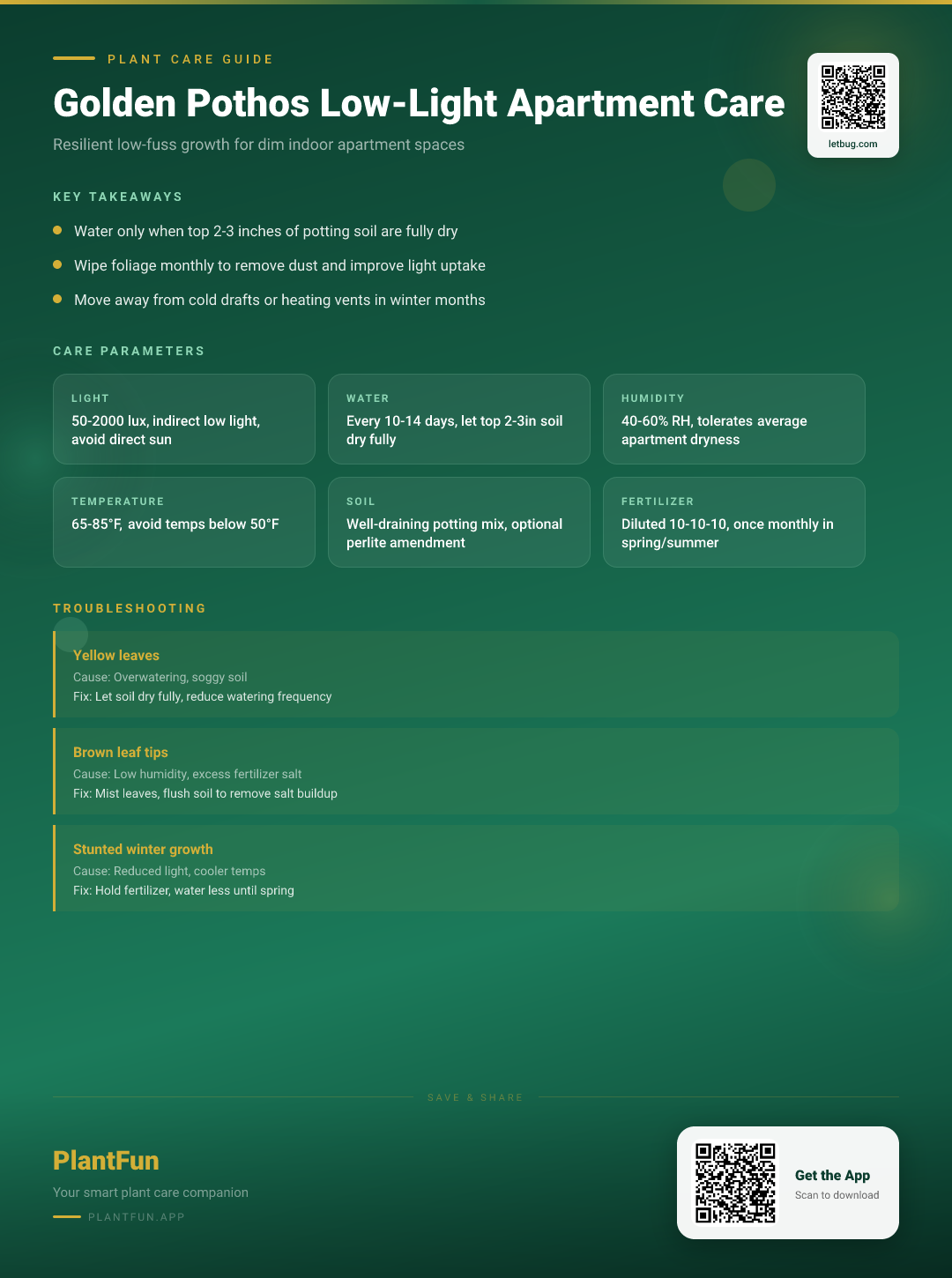
Key Takeaways
- Check soil moisture before watering — overwatering is the #1 killer of houseplants.
- Ensure your plant gets the right amount of light for its species.
- Be patient with recovery — most plants need 2–4 weeks to bounce back.
Quick Care Card: Essential Data for Your Pothos
| Feature | Requirement |
|---|---|
| Light | 500–1,500 Lux (Low to Medium indirect) |
| Watering | Every 7–10 days (allow top 2 inches of soil to dry) |
| Humidity | 40–60% (average household levels) |
| Temperature | 65°F – 80°F (18°C – 27°C) |
| Soil | Well-draining, peat-based mix with perlite |
| Fertilizer | Balanced liquid feed during growing season |
| Toxicity | Toxic to cats and dogs (ASPCA, 2026) |
TL;DR: The Bottom Line for Apartment Pothos Care
To keep your Golden Pothos (Epipremnum aureum) alive in a low-light apartment, prioritize consistent drainage and light exposure. Water only when the top two inches of soil feel dry to the touch—never keep the roots sitting in stagnant water. Maintain temperatures above 65°F (18°C) and wipe leaves monthly to ensure efficient photosynthesis, even in dim conditions.
Why Your Apartment Is a Unique Pothos Habitat
When I first started keeping plants in a studio apartment, I made the mistake of placing my Pothos in a windowless corner, thinking its reputation for “indestructibility” meant it didn’t need light. I watched in frustration as the vines grew leggy and the variegation faded to dull green.
Your apartment is a micro-climate defined by low air circulation and inconsistent light. Unlike a greenhouse, indoor environments often lack the gas exchange necessary for optimal plant health. However, Epipremnum aureum is uniquely equipped to handle this; it has evolved genetic responses to indoor pollutants like formaldehyde (Tada et al., 2010). By understanding that your apartment is a “contained” system, you can treat your Pothos not just as decor, but as a biological partner in your living space.
Step-by-Step Guide: Managing Light and Hydration
- Assess the Light: Use a light meter app or a dedicated sensor to ensure your plant is receiving at least 500 Lux. If the area is dimmer, move the plant closer to an artificial light source.
- The Finger Test: Before watering, stick your index finger 2 inches into the soil. If you feel moisture, wait 48 hours and test again.
- Hydration Volume: Water until you see liquid exiting the bottom drainage hole—this ensures the root ball is fully saturated. Discard any excess water from the saucer within 15 minutes to prevent root rot.
- Cleaning: Dust buildup inhibits light absorption. Wipe leaves with a damp cloth every 30 days to maximize the photosynthetic surface area.
Measurable Thresholds: Lux, Humidity, and Temperature Metrics
While Pothos are resilient, they have physiological “failure points.”
- Light: While they survive at 200 Lux, they thrive at 1,000+ Lux. Below 500 Lux, growth will significantly taper off.
- Humidity: While they tolerate standard 40% humidity, supplementing with a pebble tray can improve leaf turgor pressure.
- Temperature: Drops below 60°F (15°C) can cause metabolic slowdown. Keep them away from drafty vents.
Common Apartment Mistakes: The ‘Set It and Forget It’ Trap
- Mistake: Watering on a calendar schedule (e.g., “Every Sunday”).
- What happens: Seasonal changes in light levels mean your plant’s metabolic rate shifts; Sunday watering may lead to root rot in winter.
- Instead: Water based on soil moisture levels.
- Mistake: Using a pot without drainage holes.
- What happens: Stagnant water creates anaerobic conditions, leading to root death.
- Instead: Repot into a container with holes or use a nursery pot inside a decorative cachepot.
Symptom-to-Action: Why Are My Leaves Turning Yellow or Brown?
Yellowing Lower Leaves
Symptom: The oldest leaves near the base turn yellow and drop.
Likely cause: Overwatering or poor drainage is causing the root system to suffocate.
Fix:
- Check the soil for swampiness.
- Inspect the roots for mushy, dark textures, and trim if necessary.
Crispy Brown Tips
Symptom: Leaf tips turn brown and brittle.
Likely cause: Low humidity or inconsistent watering cycles.
Fix:
- Increase watering frequency slightly.
- Place a small humidifier nearby to stabilize ambient moisture levels.
Fading Variegation
Symptom: New leaves are solid green rather than gold-splashed.
Likely cause: The plant is compensating for low light by producing more chlorophyll.
Fix:
- Move the plant to a brighter spot or supplement with a grow light.
FAQ: Can I keep my Pothos in a windowless bathroom?
While a Pothos can survive in a bathroom with artificial light, it will not thrive without regular illumination. Ensure you leave the bathroom light on for at least 8-10 hours a day or consider a dedicated LED grow bulb to replace standard bathroom lighting.
FAQ: Why is my Pothos growth slowing down in the winter?
Plants enter a period of reduced metabolic activity during winter due to shorter days and lower solar intensity (Epipremnum aureum care). This is a natural dormant phase; do not increase fertilizer during this time, or you risk salt buildup in the soil.
Seasonal Maintenance Calendar for Indoor Pothos
- Spring/Summer: Fertilize once a month with a balanced 20-20-20 liquid feed diluted to half strength. Rotate the pot 90 degrees weekly to encourage even growth.
- Fall/Winter: Reduce watering frequency by 25%. Cease all fertilization. Focus on cleaning leaves to maximize light intake during short winter days.
References and Botanical Resources
- EL Sayed, N. (2020). Spray Golden Pothos and Croton Plants with Glutathione and Bilirubin to Purify the Indoor Air from Pollutants. Journal of Plant Production. https://doi.org/10.21608/jpp.2020.102766. Accessed 2026-03-13.
- Tada, Y., Matsuzaki, T., Tanaka, Y. (2010). Isolation and characterization of formaldehyde-responsive genes from golden pothos (Epipremnum aureum). Plant Biotechnology. https://doi.org/10.5511/plantbiotechnology.27.325. Accessed 2026-03-13.
- ASPCA. (2026). Toxic and Non-Toxic Plants List — ASPCA. https://www.aspca.org/pet-care/animal-poison-control/toxic-and-non-toxic-plants. Accessed 2026-03-13.
Optional Helper: Plantfun.App
Plantfun.App identifies your plants by photo, diagnoses pests and diseases with clear fixes, and creates personalised watering and light schedules that adapt to your home conditions — a handy companion for putting this guide into daily practice.
Found an error or have suggestions? We'd love your feedback.
Need help identifying this problem?
Get instant identification, personalized care schedules, and effective pest treatment plans directly on your phone.
Sponsored • We may earn a commission from app downloads
Related Guides
Golden Pothos in Low-Light Apartments: A Budget-Friendly Guide to Resilient Indoor Growth
Transform your dim apartment into an indoor jungle. Follow our budget-friendly Golden Pothos care guide for 3 secret growth hacks and a simple watering schedule.
Care GuideGolden Pothos in Low-Light Apartments: A Resilient Growth Guide for Beginners
Transform your dim apartment into a lush jungle with our Golden Pothos guide. Learn exact light, water, and soil ratios for resilient, fast-growing vines today.
Care GuideGolden Pothos Care for Dim Apartments: A Budget-Friendly Guide to Resilient Indoor Greenery
Transform your dim apartment with a lush Golden Pothos. Master precise watering, ideal lux levels, and budget-friendly growth tips for a resilient, vibrant plant.
Pest ControlHow to Spot Pests on Golden Pothos in Low-Light Entryways: A Weekly Inspection & Rescue Plan
Catch pest infestations on your low-light entryway golden pothos early with our 5-minute weekly inspection plan, plus step-by-step non-toxic rescue steps to fix spider mites, mealybugs and gnats before foliage damage becomes irreversible.