
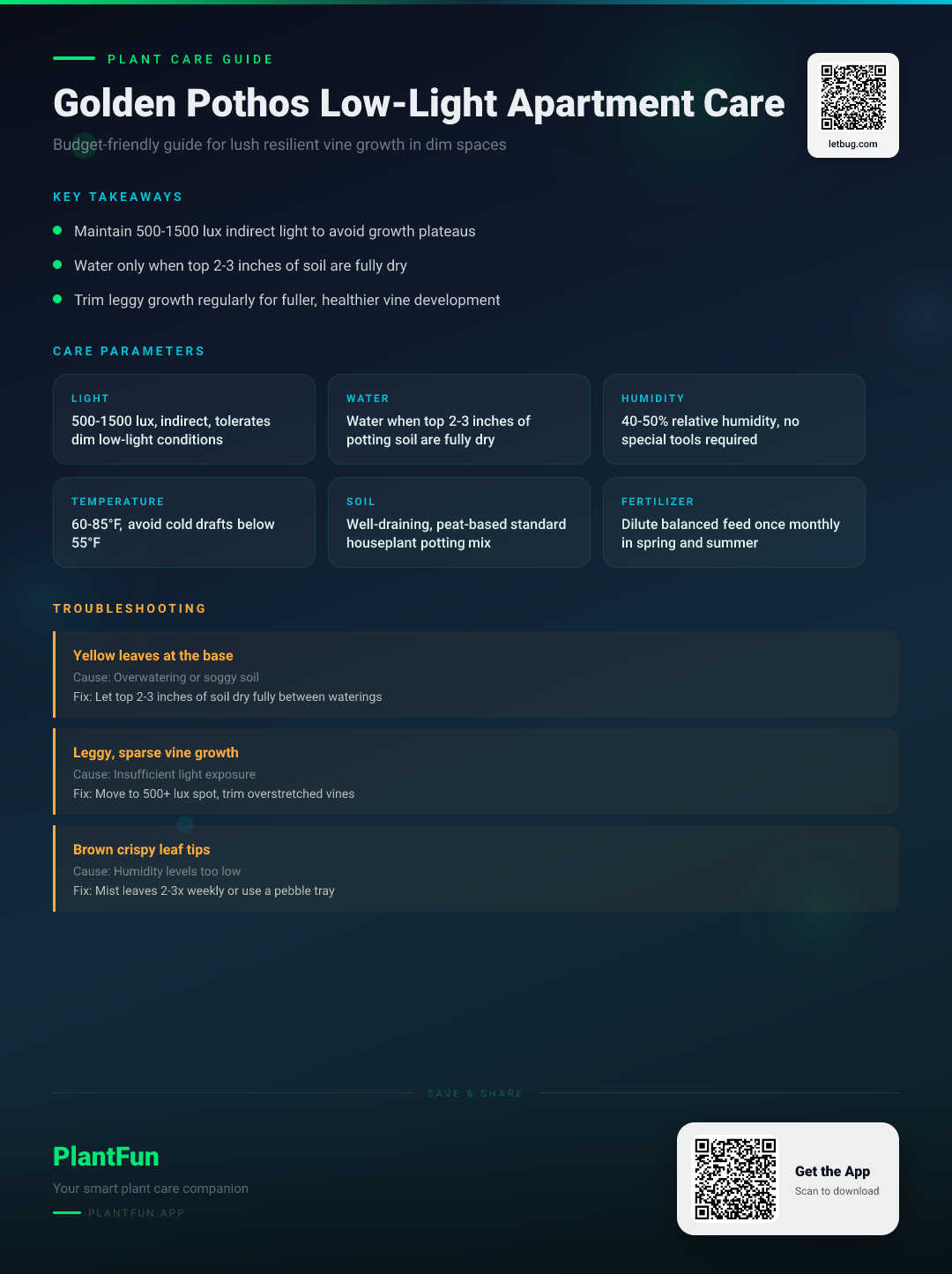
Key Takeaways
- Check soil moisture before watering — overwatering is the #1 killer of houseplants.
- Ensure your plant gets the right amount of light for its species.
- Be patient with recovery — most plants need 2–4 weeks to bounce back.
When I first moved into my studio apartment, I was convinced that my lack of natural sunlight would be the death of any indoor plant. I bought my first Epipremnum aureum (Golden Pothos) on a whim, thinking it would last a week. Six years later, that same plant has trailed across three different bookshelves.
Quick Care Card: The Essential Metrics for Golden Pothos (Epipremnum aureum)
| Metric | Requirement |
|---|---|
| Light | 500–1,500 lux (Indirect low-to-medium) |
| Water | Allow top 2 inches of soil to dry out |
| Humidity | 40–50% (Ambient home levels) |
| Temperature | 65°F–85°F (18°C–29°C) |
| Soil | Well-draining, peat-based potting mix |
| Fertilizer | Balanced NPK (e.g., 10-10-10) monthly in spring/summer |
| Toxicity | Toxic to cats and dogs (ASPCA, 2026) |
TL;DR: The Golden Pothos Success Summary for Apartment Dwellers
Golden Pothos is the ultimate resilient houseplant for low-light apartments. To thrive, place it within 3-5 feet of a window, water only when the top two inches of soil feel dry, and avoid over-fertilizing. It prefers consistent, moderate temperatures and can tolerate standard household humidity (NC State Extension, 2026).
Why Your Apartment Pothos Is Stalled: Understanding the ‘Growth Plateau’
When I first got my Pothos, I made the mistake of thinking it was “indestructible.” I left it in a dark corner for months, and it simply stopped growing. This is a common “growth plateau.” Because the plant is performing photosynthesis at a lower rate, it lacks the energy to produce new leaves. According to growth studies, consistent NPK nutrition can help mitigate stunted development in these lower light conditions (Current Science International, 2019).
Lighting Thresholds: Navigating 500-1,500 lux Environments
Your Pothos doesn’t need a professional grow light; it needs consistency. In a typical apartment, 500-1,500 lux is sufficient to maintain foliage, though you may notice a loss of variegation—those beautiful yellow splashes—if the light is too dim. If the leaves turn solid green, it’s a sign the plant is maximizing chlorophyll production to capture more light (NC State Extension, 2026).
Watering Mastery: Precise ml per Container Size and Soil Dryness Checks
Overwatering is the number one killer of indoor Pothos. Forget “once a week” schedules. Instead, use the finger test: push your finger two inches deep into the soil. If it is damp, do not water. For a standard 6-inch nursery pot, I typically use about 150-200ml of water, ensuring it drains completely through the holes. Never let your plant sit in a saucer of standing water.
Seasonal Humidity and Airflow: Maintaining 40-50% Without Costly Tools
Most apartments hover around 40-50% humidity, which is perfect for Epipremnum aureum. You don’t need a humidifier. If your space is exceptionally dry, group your plants together; they create a microclimate that traps moisture between their leaves. Good airflow is just as vital as humidity, as it helps prevent fungal growth on the soil surface.
Budget-Friendly Nutrition: The Homemade Care Schedule for Consistent Development
I avoid expensive boutique fertilizers. A standard, balanced water-soluble fertilizer applied at half-strength once a month during the growing season (March–September) is more than enough. If you’re looking to support plant health, keeping the leaves clean of dust is a high-impact, zero-cost way to ensure gas exchange occurs efficiently (EL Sayed, 2020).
Step-by-Step Recovery: How to Resurrect a Leggy Pothos in Minutes
- Identify the “bare” stems that have lost leaves.
- Use sterilized pruning shears to cut back the stem just above a node (the little brown bump where a leaf meets the stem).
- Take the healthy cuttings and place them in a glass of water. They will root within 2-3 weeks.
- Once roots are 1 inch long, replant them back into the original pot to make the plant look fuller.
Voice Search FAQ: Can I leave my Pothos in a windowless bathroom?
No, even a resilient Pothos requires some light to survive. Without any light source (like a window or a high-output LED), the plant will eventually exhaust its stored energy reserves (NC State Extension, 2026).
Voice Search FAQ: How often should I actually water my Pothos in a dry apartment?
Instead of a specific frequency, water based on the plant’s needs. Check the soil every 7-10 days. In the summer, you may water every 7 days; in the winter, that might stretch to every 14-20 days.
Voice Search FAQ: Why are the leaves on my Pothos turning yellow at the base?
This is usually a sign of overwatering. Check the soil—if it’s soggy, hold off on watering until the top two inches are bone dry (NC State Extension, 2026).
Common Mistakes: Stop These Three Habits That Kill Pothos Resilience
- Mistake: Using pots without drainage holes. What happens: Water accumulates at the bottom, leading to root rot. Instead: Always use a nursery liner inside decorative pots.
- Mistake: Repotting into massive containers. What happens: Too much soil retains too much water. Instead: Only size up by 1-2 inches in diameter.
- Mistake: Placing the plant near a heating vent. What happens: The rapid moisture loss will cause crispy leaf edges. Instead: Move the plant at least 3 feet away from any forced-air vents.
Seasonal Care Calendar: From High-Growth Summer to Dormant Winter
- Spring: Repot if rootbound; begin monthly fertilization.
- Summer: Increase water frequency as growth accelerates; check for dust on leaves.
- Fall: Reduce watering as temperatures drop; stop all fertilizing.
- Winter: Keep the plant away from cold drafts; monitor for soil drying out too slowly (NC State Extension, 2026).
References: Botanical Sources and Horticultural Best Practices
- ASPCA. (2026). Toxic and Non-Toxic Plants List — ASPCA. https://www.aspca.org/pet-care/animal-poison-control/toxic-and-non-toxic-plants. Accessed 2026-03-18.
- Current Science International. (2019). Growth of Golden Pothos (Epipremnum aureum) Plant as Affected by NPK Formula and rate. https://doi.org/10.36632/csi/2019.8.4.1. Accessed 2026-03-18.
- EL Sayed, N. (2020). Spray Golden Pothos and Croton Plants with Glutathione and Bilirubin to Purify the Indoor Air from Pollutants. Journal of Plant Production. https://doi.org/10.21608/jpp.2020.102766. Accessed 2026-03-18.
- NC State Extension. (2026). Golden Pothos — NC State Extension Gardener Plant Toolbox. https://plants.ces.ncsu.edu/plants/pothos-care/. Accessed 2026-03-18.
Optional Helper: Plantfun.App
Plantfun.App identifies your plants by photo, diagnoses pests and diseases with clear fixes, and creates personalised watering and light schedules that adapt to your home conditions — a handy companion for putting this guide into daily practice.
Found an error or have suggestions? We'd love your feedback.
Need help identifying this problem?
Get instant identification, personalized care schedules, and effective pest treatment plans directly on your phone.
Sponsored • We may earn a commission from app downloads
Related Guides
Golden Pothos in a Dim Apartment: The Only Care Guide You’ll Ever Need
Transform your dim apartment into a lush oasis. Master Pothos care with 4 simple environmental thresholds and a seasonal routine that guarantees resilient growth.
Care GuideGolden Pothos Care for Apartment Living: A Resilient Guide for Dim, Small Spaces
Transform your small apartment into a lush oasis with our expert Golden Pothos care guide. Get precise light, watering, and growth thresholds for resilient vines.
Care GuideGolden Pothos in Low-Light Apartments: A Budget-Friendly Guide to Resilient Indoor Growth
Transform your dim apartment into an indoor jungle. Follow our budget-friendly Golden Pothos care guide for 3 secret growth hacks and a simple watering schedule.
Pest ControlHow to Spot Pests on Golden Pothos in Low-Light Entryways: A Weekly Inspection & Rescue Plan
Catch pest infestations on your low-light entryway golden pothos early with our 5-minute weekly inspection plan, plus step-by-step non-toxic rescue steps to fix spider mites, mealybugs and gnats before foliage damage becomes irreversible.