
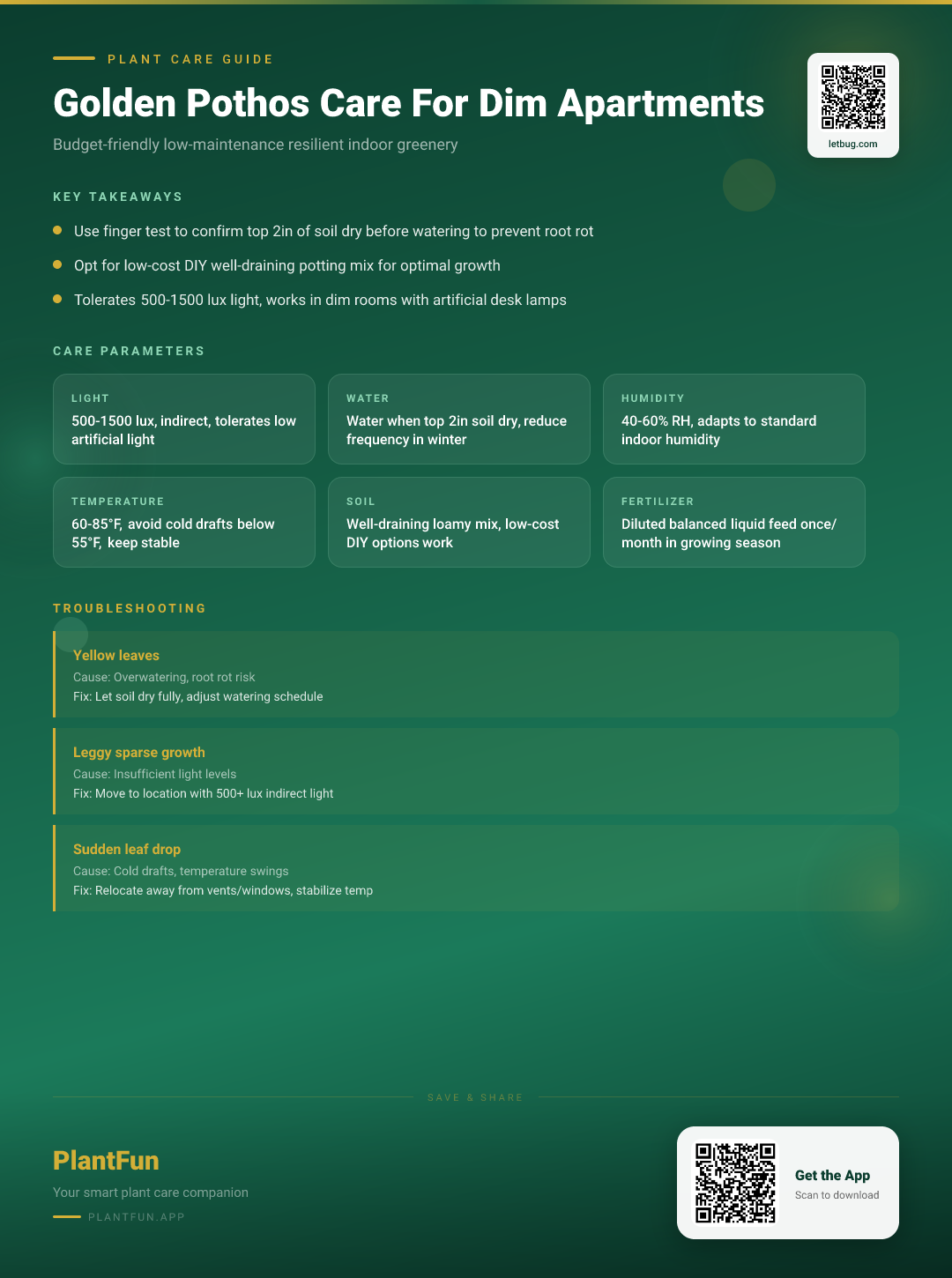
Key Takeaways
- Check soil moisture before watering — overwatering is the #1 killer of houseplants.
- Ensure your plant gets the right amount of light for its species.
- Be patient with recovery — most plants need 2–4 weeks to bounce back.
Quick Care Card: Essential thresholds for Epipremnum aureum
| Feature | Requirement |
|---|---|
| Light | 500–1,500 lux (Low to Medium indirect) |
| Water | Allow top 2 inches of soil to dry out |
| Humidity | 40–60% (Average household) |
| Temperature | 65°F–80°F (18°C–27°C) |
| Soil | Well-draining peat-based mix |
| Fertilizer | Balanced liquid feed, monthly in spring/summer |
| Toxicity | Toxic to cats and dogs (ASPCA, 2026) |
TL;DR: Why the Golden Pothos is the ultimate apartment survivor
The Golden Pothos (Epipremnum aureum) is the gold standard for apartment living because it is incredibly forgiving of inconsistent care. It thrives in low-light environments, tolerates irregular watering, and can even help improve your indoor air quality by filtering volatile organic compounds (Tada et al., 2010). If you want a lush, trailing vine that doesn’t require an expensive lighting setup, this is your plant.
My Experience: The “Too-Much-Love” Lesson
When I first started gardening in a basement apartment, I thought my Pothos needed a constant, moist environment to mimic a tropical jungle. I made the mistake of watering it every two days. Within a month, the stems turned mushy and yellow at the base. I learned the hard way that Epipremnum aureum prefers a cycle of drying out over being constantly soggy. Now, I let my Pothos dictate its needs based on the soil texture, not a calendar.
Why your apartment lighting is enough: Understanding 500-1,500 lux requirements
Many assume plants need direct sunlight, but your Pothos actually prefers consistent, indirect light. In a dim apartment, you likely have around 500–1,000 lux. This is perfectly adequate to keep the plant alive, though growth may be slower compared to brighter conditions (NC State Extension, 2026). If you notice the golden variegation on the leaves fading to solid green, simply move the plant a few feet closer to a window.
Step-by-Step Watering Protocol: Avoiding root rot with the finger-test method
- Check the soil: Before adding a drop of water, stick your finger 2 inches into the potting medium. If you feel any moisture, wait two more days.
- The visual cue: When the leaves begin to look slightly “droopy” or less turgid, that is your signal to water.
- The saturation: Water thoroughly until you see liquid running out of the drainage holes in your pot. This flushes out salt buildup.
- The drain: Never let the plant sit in a saucer of standing water. If it sits for more than 15 minutes, dump the excess to prevent root suffocation.
Soil and Potting: A budget-friendly DIY mix for optimal drainage
You don’t need expensive “premium” mixes. A simple, effective blend for your Pothos can be made by combining two parts standard indoor potting soil with one part perlite. The perlite creates air pockets that prevent the soil from becoming compacted, which is essential for healthy root development (NC State Extension, 2026).
The 70-degree balance: Why temperature stability matters in urban studios
In small apartments, drafts are common. Avoid placing your Pothos directly in front of an AC vent or a leaky window during winter. Consistent temperatures between 65°F and 80°F are ideal. Sudden fluctuations can cause the plant to drop older leaves as a stress response.
Seasonal growth cycles: Adjusting your care from summer to winter
During the spring and summer, your Pothos will actively produce new vines. You can support this with a diluted balanced fertilizer once a month. As temperatures drop in winter, growth naturally slows down. During this period, reduce your watering frequency by about 30% and stop fertilizing entirely, as the plant is in a state of semi-dormancy.
Common Mistakes to Avoid
- Mistake: Using a pot without a drainage hole.
- What happens: Water accumulates at the bottom, leading to root rot.
- Instead: Use a plastic nursery pot inside a decorative cover pot, or drill holes into your cachepot.
- Mistake: Over-fertilizing in low light.
- What happens: The plant cannot metabolize the excess nutrients, leading to burned roots.
- Instead: Fertilize only during active growth (March–September) at half-strength.
FAQ: Why is my Pothos dropping leaves in my apartment?
This is typically a sign of overwatering or lack of light. If the leaves are yellowing and dropping, check the soil moisture. If it’s soaking wet, you’ve likely overwatered. If the plant is in near-total darkness, it may be shedding leaves to conserve energy.
FAQ: Can I keep my Pothos in a windowless room with just a desk lamp?
Technically, yes, if the desk lamp uses a full-spectrum LED bulb and is positioned within 12 inches of the leaves for at least 8–10 hours a day. However, a windowless room is not ideal for long-term health.
FAQ: How do I know when it’s time to repot my Pothos?
If you see roots growing out of the drainage holes or if the plant dries out within 24 hours of watering, it is root-bound and needs a new home. Move up only one size—roughly 1 to 2 inches larger in diameter.
Expert Troubleshooting: Solving yellow leaves and leggy stems
[Yellowing Leaves]
Symptom: Leaves turn yellow and feel soft or mushy.
Likely cause: Overwatering is the primary culprit (NC State Extension, 2026).
Fix:
- Stop watering immediately.
- Check for root rot by inspecting the roots for a brown, slimy appearance.
- Repot in fresh, dry, well-draining soil.
[Leggy, Bare Stems]
Symptom: Large gaps between leaves on the vine.
Likely cause: The plant is stretching in a desperate search for more light.
Fix:
- Move the plant to a brighter location (closer to a window).
- Prune back the leggy stems to encourage new, fuller growth from the nodes.
References
- EL Sayed, N. (2020). Spray Golden Pothos and Croton Plants with Glutathione and Bilirubin to Purify the Indoor Air from Pollutants. Journal of Plant Production. https://doi.org/10.21608/jpp.2020.102766. Accessed 2026-03-12.
- Tada, Y.; Matsuzaki, T.; Tanaka, Y. (2010). Isolation and characterization of formaldehyde-responsive genes from golden pothos (Epipremnum aureum). Plant Biotechnology. https://doi.org/10.5511/plantbiotechnology.27.325. Accessed 2026-03-12.
- ASPCA. (2026). Toxic and Non-Toxic Plants List — ASPCA. https://www.aspca.org/pet-care/animal-poison-control/toxic-and-non-toxic-plants. Accessed 2026-03-12.
- NC State Extension. (2026). Golden Pothos Care — NC State Extension Gardener Plant Toolbox. https://plants.ces.ncsu.edu/plants/pothos-care/. Accessed 2026-03-12.
Optional Helper: Plantfun.App
Plantfun.App identifies your plants by photo, diagnoses pests and diseases with clear fixes, and creates personalised watering and light schedules that adapt to your home conditions — a handy companion for putting this guide into daily practice.
Found an error or have suggestions? We'd love your feedback.
Need help identifying this problem?
Get instant identification, personalized care schedules, and effective pest treatment plans directly on your phone.
Sponsored • We may earn a commission from app downloads
Related Guides
Golden Pothos in Small Apartments: The Seasonal Care Guide for Resilient, Trailing Growth
Transform your dim apartment into a lush jungle. Follow this seasonal Pothos care guide for exact light levels, watering schedules, and 3 secrets to longer vines.
Care GuideGolden Pothos Care for Apartment Living: A Resilient Guide for Dim, Small Spaces
Transform your small apartment into a lush oasis with our expert Golden Pothos care guide. Get precise light, watering, and growth thresholds for resilient vines.
Care GuideGolden Pothos in Low-Light Apartments: A Budget-Friendly Guide to Resilient Indoor Growth
Transform your dim apartment into an indoor jungle. Follow our budget-friendly Golden Pothos care guide for 3 secret growth hacks and a simple watering schedule.
Pest ControlHow to Spot Pests on Golden Pothos in Low-Light Entryways: A Weekly Inspection & Rescue Plan
Catch pest infestations on your low-light entryway golden pothos early with our 5-minute weekly inspection plan, plus step-by-step non-toxic rescue steps to fix spider mites, mealybugs and gnats before foliage damage becomes irreversible.