
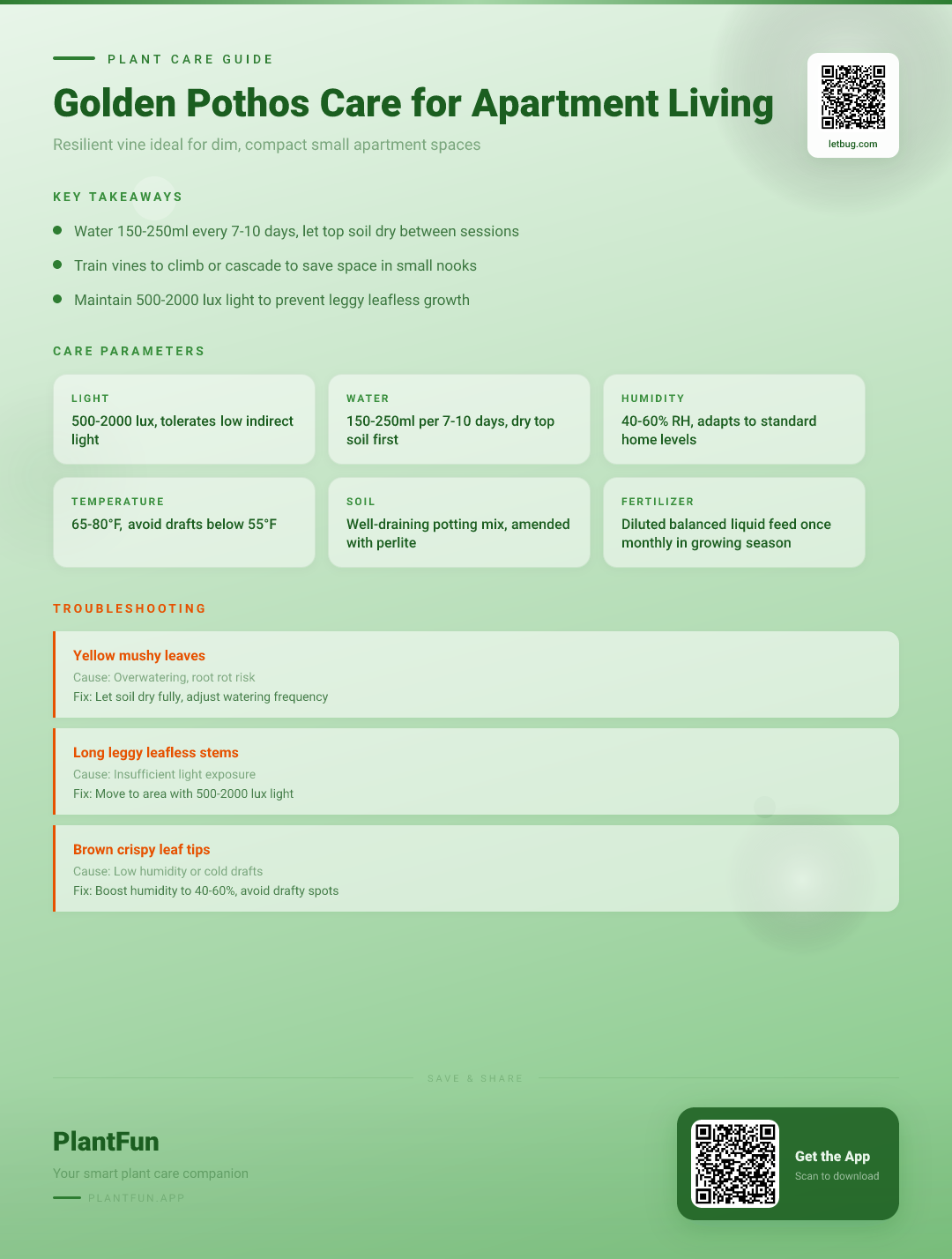
Key Takeaways
- Check soil moisture before watering — overwatering is the #1 killer of houseplants.
- Ensure your plant gets the right amount of light for its species.
- Be patient with recovery — most plants need 2–4 weeks to bounce back.
Quick Care Card: Essential Metrics for Success
| Metric | Requirement |
|---|---|
| Light | 500–2,000 lux (bright, indirect light) |
| Water | 150–250ml per 7–10 days |
| Humidity | 40–60% |
| Temperature | 65–80°F (18–27°C) |
| Soil | Well-draining, peat-based potting mix |
| Fertilizer | Balanced NPK formula monthly during growth |
| Toxicity | Toxic to cats and dogs (ASPCA, 2026) |
TL;DR: The Apartment Dweller’s Golden Rule for Pothos
If you want your Epipremnum aureum to thrive in a cramped studio, stop over-parenting. Your Golden Pothos wants consistent, indirect light and soil that dries out 50% between waterings. Use a small measuring cup for your water, keep it away from direct HVAC blasts, and trim leggy vines to encourage bushiness.
My Experience: Why Pothos Fail in Small Apartments
When I first started collecting plants in my tiny 400-square-foot studio, I made the mistake of placing my Pothos directly against a drafty window and watering it whenever I felt “generous.” The result? Yellowing, mushy leaves and bare stems. I learned the hard way that environmental constraints—specifically poor airflow and temperature swings—are the primary killers of indoor Pothos. Pothos are incredibly resilient, but they are not immortal; they require stable conditions to sustain their trailing growth (NC State Extension, 2026).
Light Requirements: How to Measure 500-2,000 Lux Without a Light Meter
Most apartments suffer from lower light than we perceive. While Pothos are categorized as low-light tolerant, they need 500 to 2,000 lux to maintain their signature variegation. If you don’t have a light meter, use the “Shadow Test”: place your hand 12 inches above the soil. If your shadow is soft and fuzzy, you are in the 500–1,000 lux range (perfect for maintenance). If there is no shadow, your plant is starving and will likely lose its yellow variegation.
Strategic Watering: Exactly How Many Milliliters Your Pothos Needs
Overwatering is the fastest route to root rot. Instead of guessing, I use a 250ml graduated measuring cup. For a 6-inch pot, I provide 150ml to 250ml of water only when the top 2 inches of soil are completely dry. If the soil stays wet for more than 10 days, the root system cannot respire (Current Science International, 2019).
Space-Optimization: Training Your Vines to Cascade
In small nooks, use adhesive wall hooks to train vines along the perimeter of your ceiling or windows. This mimics the plant’s natural climbing habit in tropical canopies, which often leads to larger leaf development. If space is tight, keep the main pot on a pedestal to allow the vines to cascade without touching the floor.
Voice FAQ
Why is my Pothos growing long, empty stems with no leaves?
This is typically a light-starvation response. When the plant doesn’t get enough energy, it abandons older leaves to push growth toward a potential light source. Move it closer to a window or add a clip-on LED grow light.
Can I really grow a Pothos in a windowless bathroom with artificial light?
Yes, if you use a full-spectrum LED bulb. Pothos can survive and even grow under artificial light if the light source is on for 10–12 hours daily.
Are Pothos safe for my apartment pets?
No. The ASPCA classifies Epipremnum aureum as toxic to cats and dogs due to insoluble calcium oxalates (ASPCA, 2026). Keep them on high shelves or in hanging planters.
Seasonal Care Calendar
- Spring/Summer: Increase watering to the 250ml threshold every 7 days as growth accelerates.
- Autumn/Winter: Reduce water by 30%. Apartment radiators create localized dry heat; misting is a myth, so use a pebble tray to maintain 40–60% humidity.
Common Mistakes: Identifying Root Rot
Yellowing Leaves
Symptom: Lower leaves turn bright yellow and feel soft.
Likely cause: Overwatering leading to root suffocation.
Fix:
- Remove from pot and inspect roots; healthy ones are white/firm, rotten ones are brown/mushy.
- Trim damaged roots and repot in fresh, well-draining soil.
Brown Leaf Tips
Symptom: Crispy, dry tips on otherwise green leaves.
Likely cause: Extremely low humidity or tap water salt buildup.
Fix:
- Use filtered or distilled water.
- Increase ambient humidity with a small humidifier.
Advanced Care: Fertilizing for Growth
Using a balanced NPK fertilizer (Nitrogen, Phosphorus, Potassium) once per month during the active growing season will significantly boost biomass (Current Science International, 2019). Studies also suggest that specific nutrients can assist in better physiological resilience, though keeping your NPK ratio stable is more important for the average home grower (El Sayed, 2020).
References and Botanical Best Practices
- ASPCA. (2026). Toxic and Non-Toxic Plants List — ASPCA. https://www.aspca.org/pet-care/animal-poison-control/toxic-and-non-toxic-plants. Accessed 2026-03-10.
- Current Science International. (2019). Growth of Golden Pothos (Epipremnum aureum) Plant as Affected by NPK Formula and rate. Current Science International. https://doi.org/10.36632/csi/2019.8.4.1. Accessed 2026-03-10.
- El Sayed, N. (2020). Spray Golden Pothos and Croton Plants with Glutathione and Bilirubin to Purify the Indoor Air from Pollutants. Journal of Plant Production. https://doi.org/10.21608/jpp.2020.102766. Accessed 2026-03-10.
- NC State Extension. (2026). Golden Pothos Care — NC State Extension Gardener Plant Toolbox. https://plants.ces.ncsu.edu/plants/pothos-care/. Accessed 2026-03-10.
Optional Helper: Plantfun.App
Plantfun.App identifies your plants by photo, diagnoses pests and diseases with clear fixes, and creates personalised watering and light schedules that adapt to your home conditions — a handy companion for putting this guide into daily practice.
Found an error or have suggestions? We'd love your feedback.
Need help identifying this problem?
Get instant identification, personalized care schedules, and effective pest treatment plans directly on your phone.
Sponsored • We may earn a commission from app downloads
Related Guides
Golden Pothos in Small Apartments: The Seasonal Care Guide for Resilient, Trailing Growth
Transform your dim apartment into a lush jungle. Follow this seasonal Pothos care guide for exact light levels, watering schedules, and 3 secrets to longer vines.
Care GuideGolden Pothos in Low-Light Apartments: A Budget-Friendly Guide to Resilient Indoor Growth
Transform your dim apartment into an indoor jungle. Follow our budget-friendly Golden Pothos care guide for 3 secret growth hacks and a simple watering schedule.
Care GuideGolden Pothos Care for Dim Apartments: A Budget-Friendly Guide to Resilient Indoor Greenery
Transform your dim apartment with a lush Golden Pothos. Master precise watering, ideal lux levels, and budget-friendly growth tips for a resilient, vibrant plant.
Pest ControlHow to Spot Pests on Golden Pothos in Low-Light Entryways: A Weekly Inspection & Rescue Plan
Catch pest infestations on your low-light entryway golden pothos early with our 5-minute weekly inspection plan, plus step-by-step non-toxic rescue steps to fix spider mites, mealybugs and gnats before foliage damage becomes irreversible.