
Key Takeaways
- Check soil moisture before watering — overwatering is the #1 killer of houseplants.
- Ensure your plant gets the right amount of light for its species.
- Be patient with recovery — most plants need 2–4 weeks to bounce back.
TL;DR: The Golden Barrel Blueprint
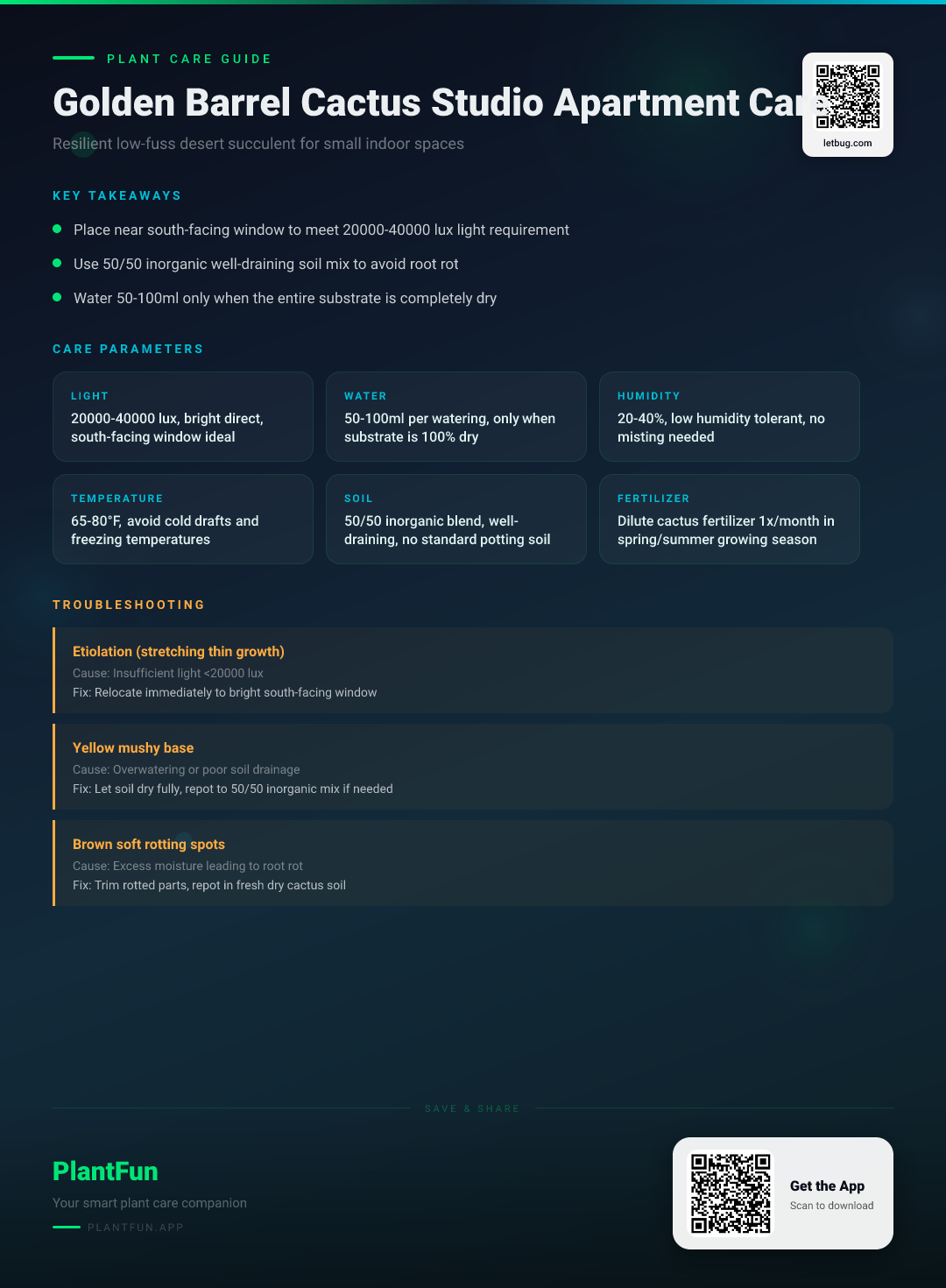
To keep your Golden Barrel Cactus (Echinocactus grusonii) alive in a studio apartment, prioritize two things: high-intensity light and extreme drainage. Place it in a south-facing window where it receives direct sunlight (20,000–40,000 lux). Water sparingly—never keep the soil damp—and only after the substrate has fully dried out. Avoid decorative pots without drainage holes, as stagnant moisture is the primary killer of this species.
Quick Care Card: Essential Metrics
| Feature | Requirement |
|---|---|
| Light | 20,000–40,000 lux (Direct sunlight) |
| Water | 50–100ml; only when 100% dry |
| Humidity | 20–40% |
| Temperature | 65–80°F (18–27°C) |
| Soil | 50/50 inorganic/organic mix |
| Fertilizer | Low-nitrogen, once in spring |
| Toxicity | Non-toxic to humans; sharp spines are a physical hazard (ASPCA, 2026) |
My Experience: The Studio Struggle
When I first brought home my Echinocactus grusonii, I made the mistake of placing it on a stylish bookshelf four feet away from my window. Within a month, the beautiful, spherical shape began to lean and turn pale green. I learned the hard way that cacti for beginners aren’t “set-and-forget” decor; they are high-performance plants that demand significant solar energy. Once I moved it to the windowsill and repotted it into a gritty, porous mix, the growth stabilized.
Why Your Studio Apartment Needs a Golden Barrel
In a small space, large, leafy tropicals can feel overwhelming. The Golden Barrel Cactus offers a structural, slow-growing architectural element that fits perfectly on a windowsill. Its ability to tolerate the lower humidity common in urban heating systems makes it an excellent candidate for the modern studio apartment.
Understanding the Golden Barrel
In its natural habitat in central Mexico, Echinocactus grusonii lives in intense, unfiltered sunlight. Unlike forest cacti, these are true desert dwellers. Your apartment is an artificial environment, so we must bridge the gap between desert heat and indoor conditions through diligent light and drainage management (NC State Extension, 2026).
Light Requirements
Cacti are light-hungry plants. A common misconception is that a bright room is enough. In reality, a cactus needs 20,000 to 40,000 lux. If you live in a studio with limited window space, a south-facing window is non-negotiable. If you cannot provide direct sun, the plant will inevitably lose its form.
The Drainage Equation
Standard potting soil retains too much moisture for this species. To prevent root rot, create a 50/50 blend. Mix one part high-quality cactus potting soil with one part inorganic material like perlite, pumice, or crushed lava rock. This mixture ensures rapid drainage, mimicking the rocky, arid soils of its native environment (Roberts, 2010).
Seasonal Watering Schedule
Watering should be precise. Use a measuring cup to provide 50–100ml of water only when the substrate is bone dry from top to bottom. In winter, growth slows, and the plant requires even less frequent irrigation (NC State Extension, 2026). Always check the soil by inserting a wooden skewer deep into the pot—if it comes out damp, wait another week.
Myth-Busting: Why ‘Cacti Don’t Need Light’ is False
Many believe cacti can survive in dark, forgotten corners. This is the fastest way to kill your plant. Without adequate sunlight, the plant will not photosynthesize properly and will prioritize survival over structure, leading to rapid, weak growth.
Troubleshooting Guide
Etiolation (Stretching)
Symptom: The cactus appears elongated, losing its round shape and turning a pale, sickly green.
Likely cause: Insufficient light intensity (cactus etiolation causes).
Fix:
- Move the plant to the brightest window available.
- Supplement with a grow light if natural light remains below 20,000 lux.
Basal Stem Rot
Symptom: The base of the plant becomes soft, mushy, or discolored.
Likely cause: Overwatering and poor soil aeration (Polizzi & Vitale, 2004).
Fix:
- Remove the plant from the pot immediately.
- Trim away rotting roots and treat the base with a fungicide if necessary.
FAQ
Why is my cactus turning yellow at the base? Yellowing at the base is often an early sign of rot or corking. If it feels mushy, it is likely rotting due to poor drainage (Polizzi & Vitale, 2004). If it is firm and woody, it is natural aging.
Can I keep my Golden Barrel Cactus in an apartment without a south window? Technically yes, but you must invest in high-output full-spectrum LED grow lights to meet the required light thresholds for indoor succulent maintenance.
How often should I fertilize my cactus during the growing season? Fertilize only once or twice during the peak growing season (late spring) using a balanced, low-nitrogen cactus fertilizer. Excess nitrogen promotes weak, fast growth.
Seasonal Care Calendar
- Spring: Increase light exposure; water once every two weeks once signs of growth appear.
- Summer: Keep the plant in full sun; monitor for extreme heat and ensure air circulation.
- Autumn: Gradually reduce watering as temperatures drop.
- Winter: Maintain at 65°F; provide 50ml of water only once a month.
Common Mistakes to Avoid
- Mistake: Using decorative pots with no drainage hole. What happens: Water collects at the bottom, leading to root rot. Instead: Use terracotta pots with drainage holes.
- Mistake: Over-misting to mimic humidity. What happens: Fungal growth and stem damage. Instead: Keep the plant in a dry, low-humidity area.
References
- Polizzi, G.; Vitale, A. (2004). First Report of Basal Stem Rot of Golden Barrel Cactus Caused by Fusarium oxysporum f. sp. opuntiarum in Italy. Plant Disease. https://doi.org/10.1094/pdis.2004.88.1.85a. Accessed 2026-03-18.
- Roberts, E. (2010). Cactus Tips from a Master Grower. Cactus and Succulent Journal. https://doi.org/10.2985/015.082.0109. Accessed 2026-03-18.
- ASPCA. (2026). Toxic and Non-Toxic Plants List — ASPCA. https://www.aspca.org/pet-care/animal-poison-control/toxic-and-non-toxic-plants. Accessed 2026-03-18.
- NC State Extension. (2026). Golden Barrel Cactus — NC State Extension Gardener Plant Toolbox. https://plants.ces.ncsu.edu/plants/cactus-care/. Accessed 2026-03-18.
Optional Helper: Plantfun.App
Plantfun.App identifies your plants by photo, diagnoses pests and diseases with clear fixes, and creates personalised watering and light schedules that adapt to your home conditions — a handy companion for putting this guide into daily practice.
Found an error or have suggestions? We'd love your feedback.
Need help identifying this problem?
Get instant identification, personalized care schedules, and effective pest treatment plans directly on your phone.
Sponsored • We may earn a commission from app downloads
Related Guides
Echinocactus Grusonii in a Low-Light Apartment: The Complete Resilient Growth Care Plan
Revive your Golden Barrel cactus with this science-backed growth plan. Learn exact light, soil, and water thresholds to prevent stretching in your apartment.
Care GuideGolden Barrel Cactus in a Low-Light Apartment: The Only Care Guide You’ll Need
Prevent etiolation and mushy stems with our specific Golden Barrel Cactus care guide. Master precise water, light, and soil metrics for a thriving apartment.
Care GuideGolden Barrel Cactus in a Studio Apartment: The Ultimate Low-Maintenance Care Guide
Master your Golden Barrel Cactus care with this simple, 5-step apartment guide. Learn exact light, soil, and watering cycles to ensure long-term resilience.
Pest ControlAnts on Plants: What They Mean and What to Do
Ants usually aren't eating your plant. They are farming other pests.