
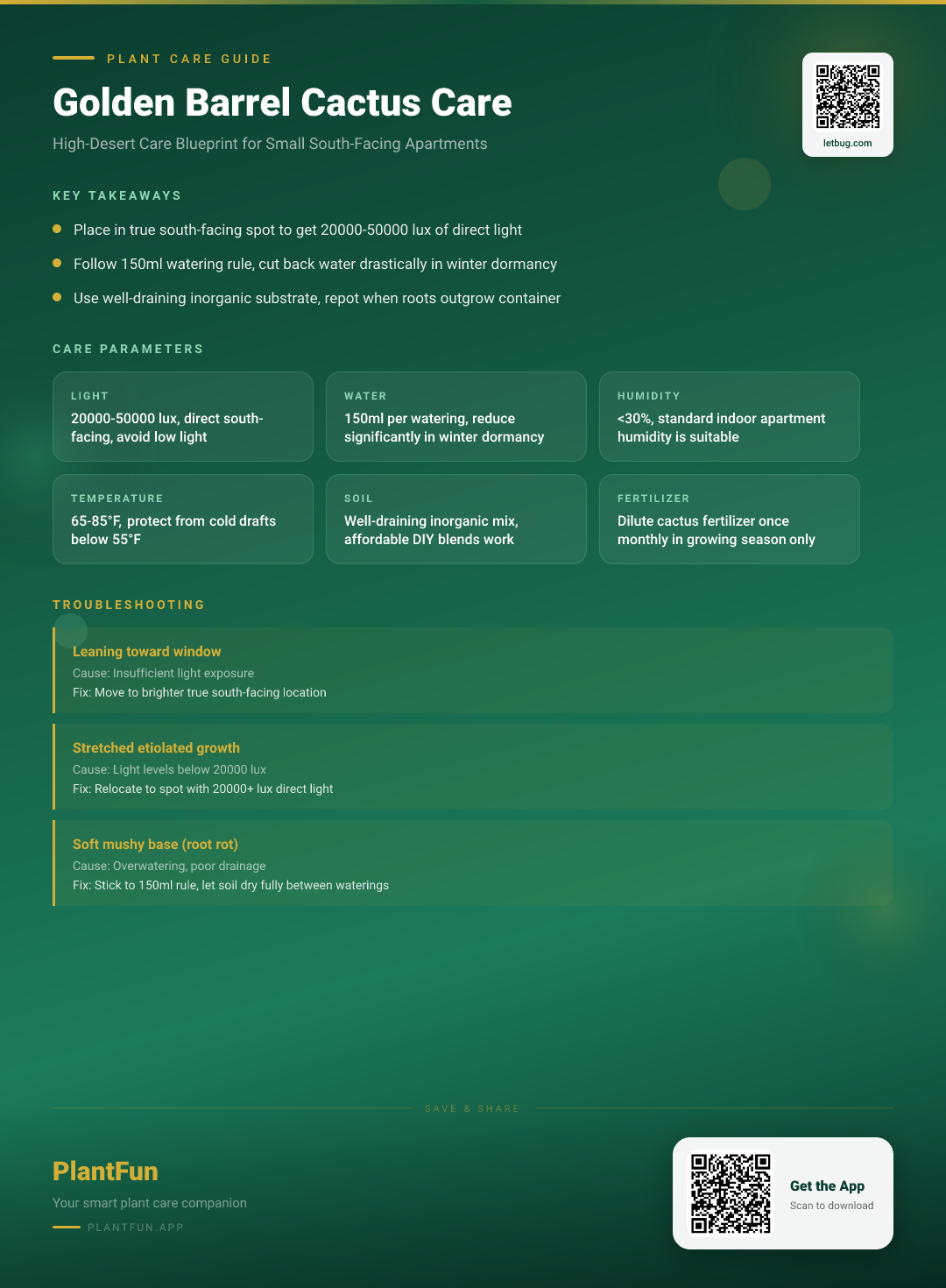
Key Takeaways
- Check soil moisture before watering — overwatering is the #1 killer of houseplants.
- Ensure your plant gets the right amount of light for its species.
- Be patient with recovery — most plants need 2–4 weeks to bounce back.
Quick Care Card: Essential Thresholds
| Feature | Requirement |
|---|---|
| Light | 20,000–50,000 lux (Direct South exposure) |
| Water | 150ml per session (Deep soak, seasonal) |
| Temperature | 65°F–85°F (18°C–29°C) |
| Humidity | <30% (Dry environment) |
| Soil | Inorganic-heavy, fast-draining mix |
| Fertilizer | Dilute 10-10-10 at 1/4 strength (Spring only) |
| Toxicity | Non-toxic (but physically hazardous due to spines) |
TL;DR: The High-Desert Blueprint for Small Apartments
The Golden Barrel cactus (Echinocactus grusonii) is a desert specialist that requires intense solar radiation and minimal moisture. In an apartment, you must simulate the Sonoran Desert: place it directly against a south-facing window, provide at least 20,000 lux of light, and never exceed 150ml of water at once, ensuring the substrate dries completely for weeks between sessions (NC State Extension, 2026). If you lack a south-facing window, this plant will likely etiolate.
Why Golden Barrel Cacti Struggle in Low-Light Apartments
When I first started collecting desert succulents, I made the mistake of placing my Golden Barrel on a coffee table three feet from a window. Within two months, it began to pale and stretch—a process called etiolation. These plants have evolved to handle extreme solar intensity. In a low-light indoor setting, they cannot produce enough energy via photosynthesis to maintain their structural integrity (Roberts, 2010). Without high-intensity light, the plant effectively “starves,” leading to weak, mushy growth that is highly susceptible to pathogens like Fusarium oxysporum (Polizzi & Vitale, 2004).
Mapping Your Space: Finding the ‘True South’ Sweet Spot
To keep your cactus happy, identify the window that receives the longest duration of direct, unfiltered sunlight. In the Northern Hemisphere, this is true south. Use a smartphone light-meter app to verify that you are hitting 20,000 lux at the plant’s surface. If your apartment has obstructions like overhangs or nearby buildings, your cactus must be positioned touching the glass. Avoid curtains or UV-blocking films, which filter the specific wavelengths required for the Golden Barrel’s dense spine development.
Format A: The Complete Scenario Guide - Step-by-Step Watering and Drainage
- The Test: Insert a wooden skewer or chopstick 2 inches into the soil. If it comes out damp or cool to the touch, do not water.
- The Dosage: When the soil is completely bone-dry throughout the container, provide 150ml of water. Pour it slowly around the perimeter of the pot, avoiding the crown (top center) of the cactus to prevent rot.
- The Drainage: After 15 minutes, check your drainage saucer. Any water remaining must be emptied immediately. Standing water is the primary cause of root-related disease (Polizzi & Vitale, 2004).
Seasonal Care Calendar: Adjusting for Radiator Heat and Winter Dormancy
- Spring/Summer (Growth Phase): Increase water frequency to once every 2–3 weeks, provided ambient temperatures remain between 75°F and 85°F.
- Fall (Transition): Reduce water to once a month. The plant is preparing for dormancy.
- Winter (Dormancy): Keep the plant cool (60°F–65°F) and almost completely dry. If your radiator is blasting near the cactus, monitor for shriveling, but do not overwater—this can trigger a fatal cycle of root death (Roberts, 2010).
The 150ml Rule: Why Less is More for Containerized Cacti
In a restricted container, soil holds moisture far longer than in the open desert. The 150ml limit prevents the bottom of the pot from becoming an anaerobic swamp. Always opt for terracotta pots, which allow for natural evaporation through the porous clay walls, keeping the root zone oxygenated.
Common Mistakes: Avoiding Etiolation and Root Rot in Tight Quarters
- Mistake: Watering on a strict time-based calendar (e.g., every Monday). What happens: The plant receives water when the soil is still wet, suffocating the roots. Instead: Only water when the soil passes the skewer test.
- Mistake: Using standard indoor potting soil. What happens: Peat-heavy mixes hold too much water, causing stem rot. Instead: Use a 50/50 mix of perlite and store-bought cactus soil.
- Mistake: Keeping the plant in a dim corner. What happens: The cactus grows thin and pale toward the window (etiolation). Instead: Place directly in the south-facing window sill.
Can I keep my Golden Barrel cactus in an apartment with no balcony?
Yes, provided you have a south-facing window. Without that specific light intensity, the plant will decline. If you have only east or west windows, you may need a high-output LED grow light to bridge the gap.
Why is my cactus leaning toward the window?
This is a classic sign of phototropism. Your cactus is physically stretching its cells in a desperate attempt to find more light. Rotate the pot 90 degrees every week to keep the growth balanced.
How do I know when it’s time to repot my cactus?
Only repot if the roots are circling the drainage hole or if the plant has doubled in diameter. Use a pair of kitchen tongs protected by foam or heavy leather gloves to handle the plant safely.
Budget-Friendly Care: DIY Inorganic Substrate Mixes
To save money, I create my own mix: 40% coarse sand (rinsed), 40% perlite, and 20% organic potting soil. This provides excellent aeration and prevents the water-logging that invites fungal infection (Polizzi & Vitale, 2004).
References
- Polizzi, G., & Vitale, A. (2004). First Report of Basal Stem Rot of Golden Barrel Cactus Caused by Fusarium oxysporum f. sp. opuntiarum in Italy. Plant Disease. https://doi.org/10.1094/pdis.2004.88.1.85a. Accessed 2026-03-14.
- Roberts, E. (2010). Cactus Tips from a Master Grower. Cactus and Succulent Journal. https://doi.org/10.2985/015.082.0109. Accessed 2026-03-14.
- ASPCA. (2026). Toxic and Non-Toxic Plants List — ASPCA. https://www.aspca.org/pet-care/animal-poison-control/toxic-and-non-toxic-plants. Accessed 2026-03-14.
- NC State Extension. (2026). Golden Barrel Cactus — NC State Extension Gardener Plant Toolbox. https://plants.ces.ncsu.edu/plants/barrel-cactus/. Accessed 2026-03-14.
Optional Helper: Plantfun.App
Plantfun.App identifies your plants by photo, diagnoses pests and diseases with clear fixes, and creates personalised watering and light schedules that adapt to your home conditions — a handy companion for putting this guide into daily practice.
Found an error or have suggestions? We'd love your feedback.
Need help identifying this problem?
Get instant identification, personalized care schedules, and effective pest treatment plans directly on your phone.
Sponsored • We may earn a commission from app downloads
Related Guides
Golden Barrel Cactus in a Low-Light Apartment: The Definitive Guide to Resilient Indoor Growth
Revive your Golden Barrel Cactus with precise light calibration and watering cycles. Master the 4 key metrics for resilient growth in any apartment setting today.
Care GuideGolden Barrel Cactus in a Low-Light Apartment: Why Your Plant Stretches and How to Stop It
Rescue your stretching Golden Barrel Cactus with our 4-step light correction plan. Learn exactly how to adjust your home environment for healthy, stout growth.
Care GuideGolden Barrel Cactus in a Low-Light Apartment: A Resilient Growth and Rescue Strategy
Revive your struggling Golden Barrel Cactus with precise light adjustments and soil moisture control. Learn 4 proven steps to stop etiolation and foster growth.
Pest ControlAnts on Plants: What They Mean and What to Do
Ants usually aren't eating your plant. They are farming other pests.