
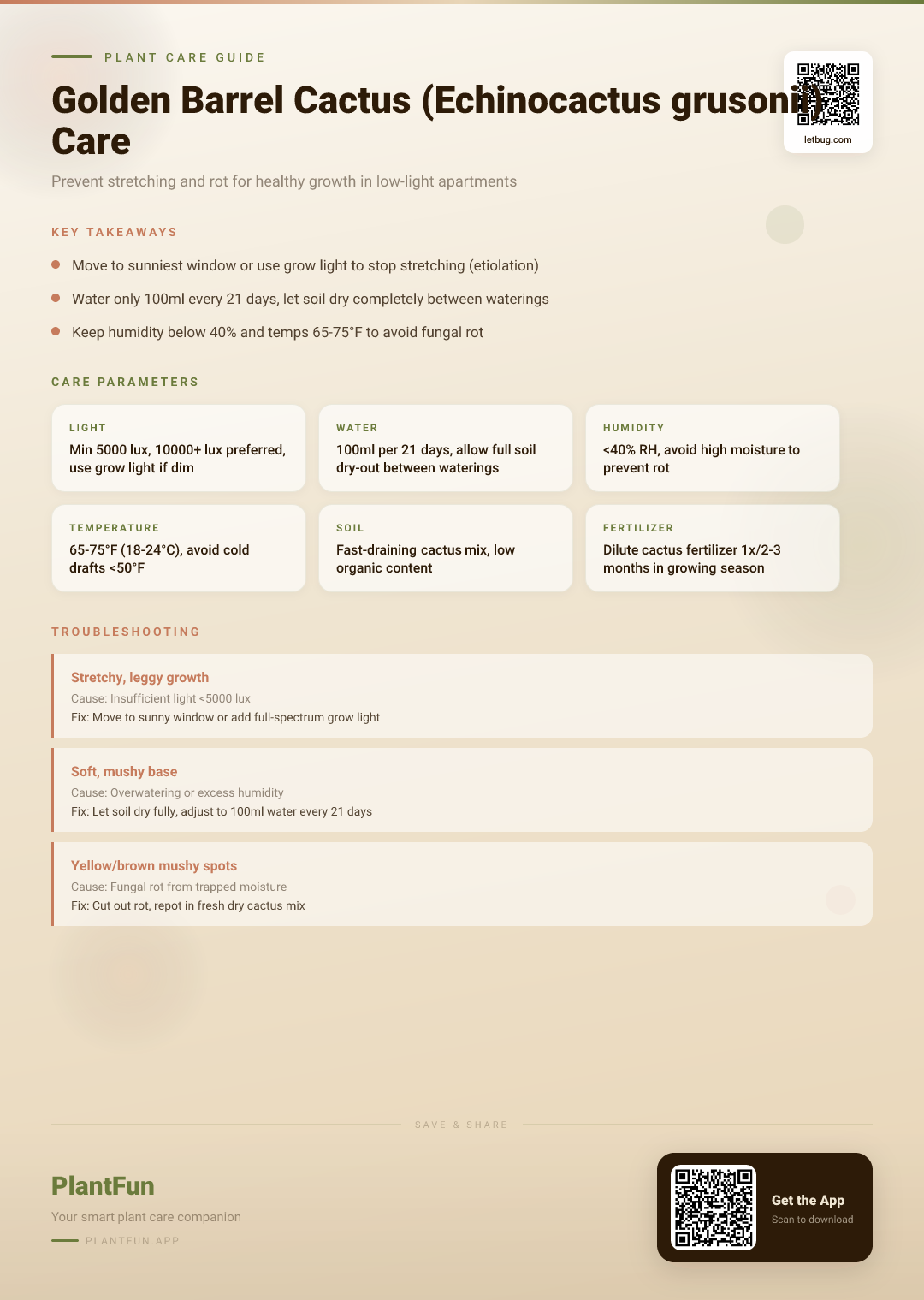
Key Takeaways
- Check soil moisture before watering — overwatering is the #1 killer of houseplants.
- Ensure your plant gets the right amount of light for its species.
- Be patient with recovery — most plants need 2–4 weeks to bounce back.
Quick Care Card: Essential Thresholds for Echinocactus grusonii
| Feature | Requirement |
|---|---|
| Light | Full, direct sun (6+ hours daily) |
| Water | 100ml every 21 days (growing season) |
| Humidity | Below 40% |
| Temperature | 65-75°F (18-24°C) |
| Soil | Well-draining cactus/succulent mix |
| Fertilizer | Low-nitrogen, balanced liquid (summer only) |
| Toxicity | Generally non-toxic to cats/dogs (ASPCA, 2026) |
TL;DR: The Truth About Cacti in Low-Light Apartments
If your Echinocactus grusonii is losing its round shape and becoming elongated, it is starving for light. This process, called etiolation, is irreversible but manageable. To save your plant, move it to your brightest south-facing window, reduce watering to a strict 21-day cycle, and ensure temperatures remain steady between 65-75°F (NC State Extension, 2026). Do not attempt to “feed” your way out of a light deficiency with fertilizer.
Why Your Golden Barrel Cactus is Stretching (Etiolation Explained)
When I first started collecting cacti, I placed a beautiful, spherical Golden Barrel in a north-facing window because I thought it looked “cool” there. Within two months, the crown began thinning and leaning toward the glass. This is etiolation. It happens when a plant detects insufficient light and prioritizes vertical growth in a desperate attempt to “reach” a brighter source (Roberts, 2010). The resulting tissue is weak, pale, and structurally unsound.
Measuring Your Light: Is 5,000 Lux Enough to Prevent Weak Growth?
To thrive, the Golden Barrel needs high-intensity light. While 5,000 lux (the typical level near a bright window) is sufficient for some houseplants, it is the bare minimum for Echinocactus grusonii. Ideally, you want to provide 10,000+ lux. If you don’t have a light meter, use the “shadow test”: if your cactus casts a sharp, crisp shadow in the middle of the day, the light is sufficient. If the shadow is blurry or non-existent, your plant is in the dark.
Step 1: The ‘Window-Side’ Migration Plan for Urban Dwellers
- Identify your home’s “light hotspot”—usually an unobstructed south or west-facing window.
- Place the cactus directly on the windowsill. The glass acts as a light filter; do not set it back on a bookshelf.
- Rotate the pot 90 degrees every two weeks to ensure even, symmetrical growth.
Step 2: Calibrating Your Watering Schedule (100ml per 21 Days)
Many beginners kill their cacti with kindness. In an apartment with low airflow, soil takes longer to dry. Using a measuring cup, provide exactly 100ml of water every 21 days during the active growth season. During winter dormancy, reduce this to once every 6-8 weeks.
Step 3: Temperature Control: Keeping it at 65-75°F (18-24°C)
While these cacti are resilient, extreme apartment fluctuations (like sitting directly over a radiator) cause stress. Keep the plant in a stable environment between 65-75°F (NC State Extension, 2026). Avoid placing it near drafts or heating vents, which can desiccate the plant or trigger premature dormancy.
Step 4: Humidity Management: Keeping it Below 40% to Prevent Rot
High humidity is the silent enemy of the Golden Barrel. Excessive moisture in the air can lead to fungal infections. According to research on basal rot, pathogens like Fusarium oxysporum thrive in humid, poorly ventilated conditions (Polizzi & Vitale, 2004). Keep your cactus in a room with a dehumidifier or excellent natural air circulation.
Can I use a grow light to save my cactus if my window is too dark?
Absolutely. If your apartment lacks southern exposure, a high-output full-spectrum LED grow light is essential. Position the light 6–10 inches above the crown for 12 hours a day. This replaces the missing solar intensity required to prevent etiolation.
Why is my Golden Barrel Cactus turning soft near the base?
Basal Stem Rot
Symptom: The base of the cactus feels mushy or appears dark/discolored.
Likely cause: Overwatering combined with poor drainage, often exacerbated by fungal pathogens (Polizzi & Vitale, 2004).
Fix:
- Stop watering immediately.
- Unpot the plant to inspect the roots; cut away any black or slimy root sections.
- Repot into fresh, sterile, well-draining cactus mix.
How do I tell if my cactus is getting enough sunlight during winter?
If the new growth at the top is the same width and color as the older, lower parts of the plant, it is receiving adequate light. If the top appears lighter green or thinner, it is struggling with the lower light levels of winter and should be moved under a grow light.
Common Mistakes: Stop Treating Your Cactus Like a Tropical Fern
- Mistake: Watering when the top of the soil is slightly dry.
- What happens: The roots stay wet, leading to rot.
- Instead: Use a wooden skewer as a probe; only water when the probe comes out completely dry from the bottom.
- Mistake: Using standard potting soil.
- What happens: The soil holds too much water, suffocating the roots.
- Instead: Use a dedicated cactus mix amended with 30% perlite or pumice for drainage.
Seasonal Care Calendar: From Active Summer Growth to Winter Dormancy
- Spring/Summer: Peak growth. 100ml water every 21 days. Brightest possible light.
- Autumn: Gradually reduce water as temperatures drop.
- Winter: Dormancy. Keep cool (50-60°F) and dry. No fertilizer. This “rest period” is crucial for future health (Roberts, 2010).
References and Botanical Notes
- Polizzi, G., & Vitale, A. (2004). First Report of Basal Stem Rot of Golden Barrel Cactus Caused by Fusarium oxysporum f. sp. opuntiarum in Italy. Plant Disease. https://doi.org/10.1094/pdis.2004.88.1.85a. Accessed 2026-03-13.
- Roberts, E. (2010). Cactus Tips from a Master Grower. Cactus and Succulent Journal. https://doi.org/10.2985/015.082.0109. Accessed 2026-03-13.
- ASPCA. (2026). Toxic and Non-Toxic Plants List — ASPCA. https://www.aspca.org/pet-care/animal-poison-control/toxic-and-non-toxic-plants. Accessed 2026-03-13.
- NC State Extension. (2026). Golden Barrel Cactus — NC State Extension Gardener Plant Toolbox. https://plants.ces.ncsu.edu/plants/cactus-care/. Accessed 2026-03-13.
Optional Helper: Plantfun.App
Plantfun.App identifies your plants by photo, diagnoses pests and diseases with clear fixes, and creates personalised watering and light schedules that adapt to your home conditions — a handy companion for putting this guide into daily practice.
Found an error or have suggestions? We'd love your feedback.
Need help identifying this problem?
Get instant identification, personalized care schedules, and effective pest treatment plans directly on your phone.
Sponsored • We may earn a commission from app downloads
Related Guides
Golden Barrel Cactus in a Low-Light Apartment: The Definitive Guide to Resilient Indoor Growth
Revive your Golden Barrel Cactus with precise light calibration and watering cycles. Master the 4 key metrics for resilient growth in any apartment setting today.
Care GuideGolden Barrel Cactus in a South-Facing Apartment: The Only Care Guide You’ll Ever Need
Master Golden Barrel cactus care with our precise 3-step watering schedule and light mapping. Keep your desert jewel thriving with 20,000+ lux and expert tips.
Care GuideGolden Barrel Cactus in a Low-Light Apartment: A Resilient Growth and Rescue Strategy
Revive your struggling Golden Barrel Cactus with precise light adjustments and soil moisture control. Learn 4 proven steps to stop etiolation and foster growth.
Pest ControlAnts on Plants: What They Mean and What to Do
Ants usually aren't eating your plant. They are farming other pests.