
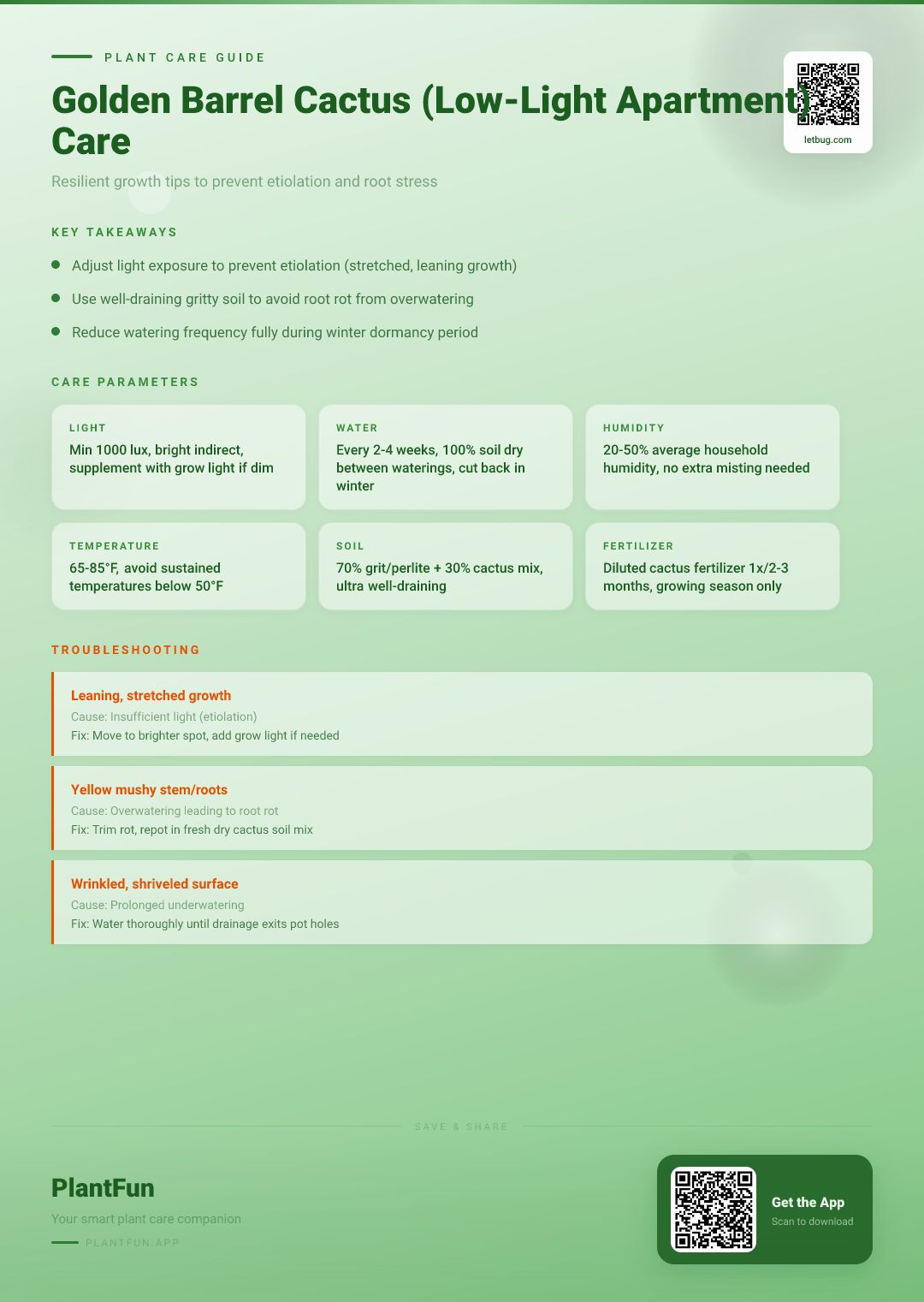
Key Takeaways
- Check soil moisture before watering — overwatering is the #1 killer of houseplants.
- Ensure your plant gets the right amount of light for its species.
- Be patient with recovery — most plants need 2–4 weeks to bounce back.
TL;DR: The Golden Barrel Cactus (Echinocactus grusonii) is not a low-light plant. It requires at least 4–6 hours of direct, intense sunlight. If yours is stretching (etiolation), it is starving. Move it to your brightest window or use a full-spectrum LED grow light immediately. Stop watering until the soil is completely dry, and ensure your pot has adequate drainage to prevent basal rot.
Quick Care Card: Essential Thresholds for Success
| Feature | Requirement |
|---|---|
| Light | 6+ hours direct sunlight (2,000–5,000+ lux) |
| Water | Every 3–4 weeks in summer; dormant in winter |
| Humidity | Low (30–50%) |
| Temperature | 65°F–85°F (18°C–29°C) |
| Soil | Inorganic, gritty cactus mix (1:1 perlite/potting soil) |
| Fertilizer | Low-nitrogen succulent feed, once in spring |
| Toxicity | Non-toxic to cats and dogs (ASPCA, 2026) |
Understanding the Golden Barrel Cactus (Echinocactus grusonii) Physiology
When I first started my indoor gardening journey, I placed a beautiful, spherical Golden Barrel in a shadowy corner of my living room, assuming it would thrive on the ‘neglect’ often attributed to desert plants. I was wrong. The Echinocactus grusonii is a high-light specialist that relies on CAM (Crassulacean Acid Metabolism) to conserve water while processing intense solar radiation (NC State Extension, 2026). When light is insufficient, the plant cannot photosynthesize effectively, leading to a physiological breakdown that makes it susceptible to opportunistic pathogens like Fusarium oxysporum (Polizzi & Vitale, 2004).
The ‘Apartment Myth’: Why Low Light Is Killing Your Cactus
A common misconception is that cacti are ‘set-it-and-forget-it’ plants for dim apartments. In reality, a low-light apartment is a death trap for a barrel cactus. Without high-intensity light, the cactus will attempt to ‘reach’ for a light source, resulting in weak, pale, and elongated growth (Roberts, 2010). This state, known as etiolation, is irreversible and permanently compromises the plant’s structural integrity.
Symptom-to-Action: Identifying Etiolation and Root Stress
Etiolation (Stretching)
Symptom: The cactus appears elongated, losing its classic spherical shape, and often leans.
Likely cause: Chronic lack of photosynthetic light.
Fix:
- Move the plant to a south-facing window immediately.
- Supplement with a 20W full-spectrum LED light placed 6-10 inches above the crown for 12 hours a day.
Basal Rot (Softness)
Symptom: The base of the plant feels squishy, brown, or mushy to the touch.
Likely cause: Overwatering in low-light conditions leading to anaerobic soil environments (Polizzi & Vitale, 2004).
Fix:
- Remove the plant from the pot and inspect roots for dark, slimy growth.
- Repot into dry, sterilized substrate and hold all water for 3 weeks to allow callousing.
Step-by-Step Rescue: From Potting Mix Adjustment to Light Supplementation
- Assess the Substrate: If the soil remains moist 5 days after watering, it is too dense. Mix 50% grit (pumice or perlite) with 50% cactus-specific potting soil.
- Verify Drainage: Ensure the container has at least one hole. I personally prefer unglazed terra cotta because it allows the substrate to breathe.
- Sanitize: If rot is present, use a clean knife to cut away damaged tissue until you reach healthy, white flesh. Dust the cut with cinnamon or sulfur powder.
- Bridge the Gap: If you cannot provide natural light, use a lux meter to ensure your grow area reaches at least 2,000 lux (185 foot-candles). Anything below 500 lux is insufficient for long-term health.
The 4-Step Resilience Protocol: Lighting, Irrigation, and Thermal Regulation
- Light Mapping: Move the cactus to the absolute brightest spot in your home. Rotate the pot 90 degrees every month to ensure even development.
- Watering Technique: Use the ‘soak and dry’ method. Only water when the soil is 100% dry. I use a moisture probe to ensure the center of the root ball is dry before adding water.
- Thermal Management: Keep the plant away from cold drafts in winter. A cactus in dormancy does not need heat, but it does need protection from freezing temperatures (NC State Extension, 2026).
- Nutrition: Do not fertilize if the plant is showing signs of stress or rot. Wait until active growth is observed in late spring.
Voice Search FAQ: Why is my Golden Barrel Cactus leaning toward the window?
This is a classic sign of phototropism. The plant is desperately reaching for the highest light intensity available. If you don’t adjust the light, the cactus will weaken and eventually become prone to stem rot.
Voice Search FAQ: How do I know if my cactus is thirsty or rotting?
A thirsty cactus will look slightly sunken or wrinkled, and the soil will be bone dry. A rotting cactus will feel soft or mushy at the base, even if the soil is dry, because the damage has already occurred at the root level.
Seasonal Maintenance: Adjusting Care for Indoor Winter Dormancy
During winter, the Golden Barrel enters a period of dormancy. Reduce your watering frequency significantly—I often go 6–8 weeks without watering during December and January. If you keep the plant in a cool, bright room, it will stay dormant and avoid etiolation (Roberts, 2010).
Choosing the Correct Substrate: Drainage Ratios for Indoor Containers
The secret to successful indoor cactus care is soil aeration. I recommend a mixture of 1 part coco coir, 1 part perlite, and 1 part horticultural sand. This creates the necessary pore space for oxygen to reach the roots, which is the most critical factor in preventing soil-borne diseases (Polizzi & Vitale, 2004).
Tools of the Trade: Using Lux Meters and Moisture Probes
Don’t guess; measure. A basic lux meter allows you to see exactly how much light a specific corner receives. If your shelf receives less than 1,000 lux, it is not a location where a Golden Barrel can survive. Similarly, a moisture probe helps you avoid the common mistake of ‘over-loving’ your plant with frequent, shallow waterings.
Common Mistakes: The Perils of Over-Potting and Frequent Watering
- Mistake: Using a pot that is too large. What happens: Excess soil retains too much water, leading to root rot. Instead: Use a pot only 1-2 inches wider than the root ball.
- Mistake: Watering on a schedule. What happens: The plant receives water when it doesn’t need it. Instead: Water based on soil dryness, confirmed by a moisture probe or the ‘finger test.‘
References and Botanical Resources
- Polizzi, G., & Vitale, A. (2004). First Report of Basal Stem Rot of Golden Barrel Cactus Caused by Fusarium oxysporum f. sp. opuntiarum in Italy. Plant Disease. https://doi.org/10.1094/pdis.2004.88.1.85a. Accessed 2026-03-15.
- Roberts, E. (2010). Cactus Tips from a Master Grower. Cactus and Succulent Journal. https://doi.org/10.2985/015.082.0109. Accessed 2026-03-15.
- ASPCA. (2026). Toxic and Non-Toxic Plants List — ASPCA. https://www.aspca.org/pet-care/animal-poison-control/toxic-and-non-toxic-plants. Accessed 2026-03-15.
- NC State Extension. (2026). Golden Barrel Cactus — NC State Extension Gardener Plant Toolbox. https://plants.ces.ncsu.edu/plants/cactus-care/. Accessed 2026-03-15.
Optional Helper: Plantfun.App
Plantfun.App identifies your plants by photo, diagnoses pests and diseases with clear fixes, and creates personalised watering and light schedules that adapt to your home conditions — a handy companion for putting this guide into daily practice.
Found an error or have suggestions? We'd love your feedback.
Need help identifying this problem?
Get instant identification, personalized care schedules, and effective pest treatment plans directly on your phone.
Sponsored • We may earn a commission from app downloads
Related Guides
Golden Barrel Cactus in a Low-Light Apartment: Why Your Plant Stretches and How to Stop It
Rescue your stretching Golden Barrel Cactus with our 4-step light correction plan. Learn exactly how to adjust your home environment for healthy, stout growth.
Care GuideGolden Barrel Cactus in a South-Facing Apartment: The Only Care Guide You’ll Ever Need
Master Golden Barrel cactus care with our precise 3-step watering schedule and light mapping. Keep your desert jewel thriving with 20,000+ lux and expert tips.
Care GuideGolden Barrel Cactus in a Low-Light Apartment: The Definitive Guide to Resilient Indoor Growth
Revive your Golden Barrel Cactus with precise light calibration and watering cycles. Master the 4 key metrics for resilient growth in any apartment setting today.
Pest ControlAnts on Plants: What They Mean and What to Do
Ants usually aren't eating your plant. They are farming other pests.