
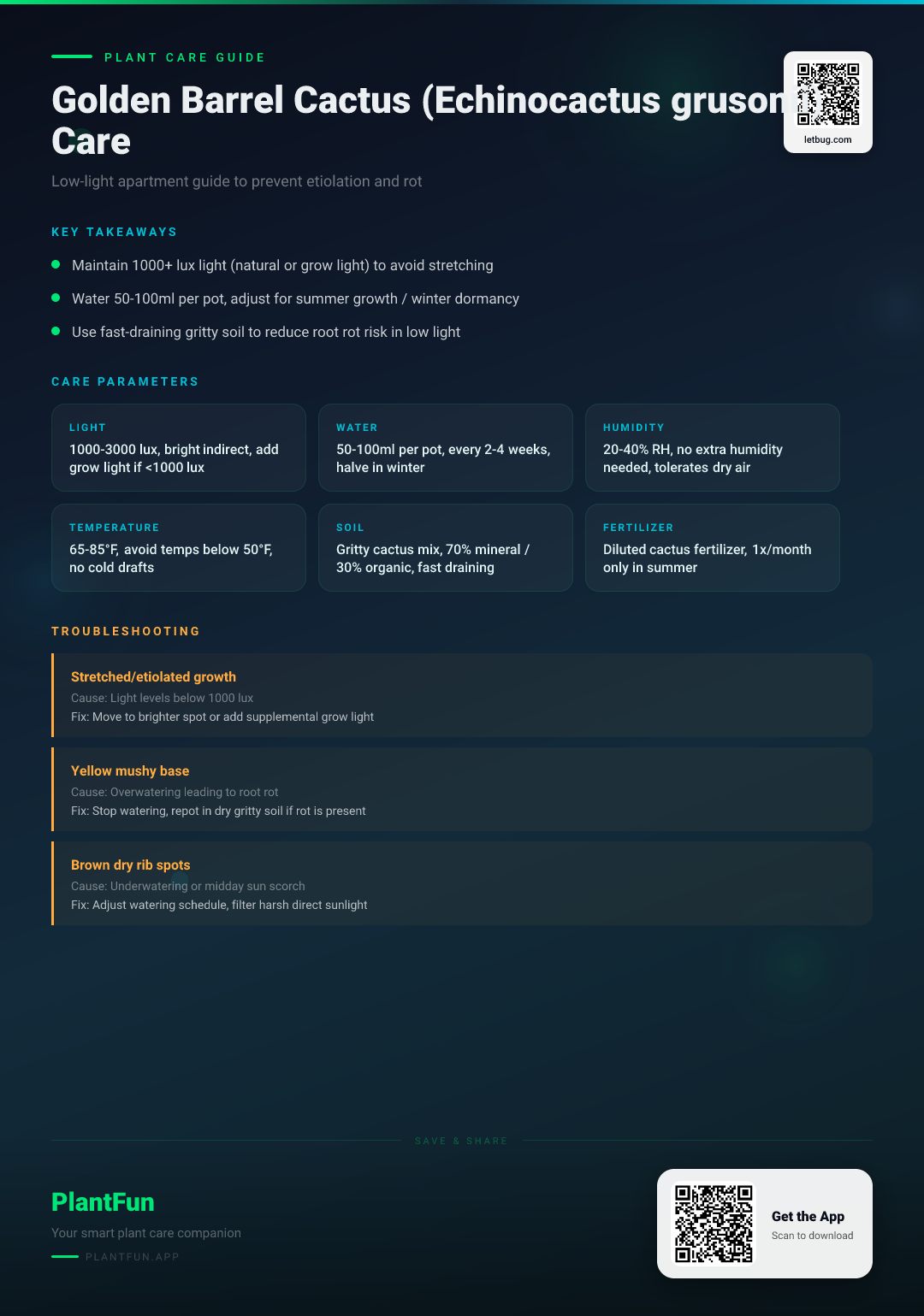
Key Takeaways
- Check soil moisture before watering — overwatering is the #1 killer of houseplants.
- Ensure your plant gets the right amount of light for its species.
- Be patient with recovery — most plants need 2–4 weeks to bounce back.
Quick Care Card: Essential Thresholds for Golden Barrel Success
| Feature | Requirement |
|---|---|
| Light | 10,000–20,000+ lux (Direct sun) |
| Water | 50-100ml only when soil is 100% dry |
| Humidity | Low (below 40%) |
| Temperature | 70°F–85°F (Summer), 50°F–60°F (Winter) |
| Soil | Highly porous, gritty cactus mix |
| Fertilizer | Diluted cactus-specific, monthly (Summer only) |
| Toxicity | Non-toxic to humans; use caution with pets (ASPCA, 2026) |
TL;DR: The Golden Barrel Reality Check for Urban Spaces
Can you keep a Echinocactus grusonii in a low-light apartment? Honestly, no. These desert natives require intense, direct solar radiation to maintain their iconic, globose shape. If your apartment lacks a south-facing window with unobstructed exposure, the plant will inevitably enter a state of etiolation—stretching toward the light in a desperate attempt to survive. To keep one, you must supplement natural light with high-output LEDs and strictly manage water to prevent fungal decay.
Why Your Cactus is Stretching (Etiolation): The Science of Light Starvation
When I first got my Echinocactus grusonii, I placed it in a “bright” corner of my bedroom. Within weeks, the plant began losing its symmetrical, barrel-like geometry, stretching upward into a pale, thin column. This is etiolation—a plant’s physiological response to insufficient light.
Plants utilize photosynthesis to create energy; when light is limited, they prioritize vertical growth to “reach” for a more favorable position (NC State Extension, 2026). Unfortunately, this growth is weak and cannot be reversed. Once your cactus stretches, that tissue is permanently thin and structurally compromised.
Step 1: Maximizing Lux—Moving Beyond the ‘Sunny Window’ Myth
Many apartment dwellers mistakenly believe that if a room is “bright enough to read in,” it is bright enough for a cactus. This is a common pitfall. A sunny windowsill might provide 2,000 lux on a cloudy day, but a desert environment provides 50,000+ lux. To succeed indoors, you must aim for at least 10,000 lux. If you cannot place your plant within 12 inches of a south or west-facing window, you are essentially starving the plant of its necessary energy (Roberts, 2010).
Step 2: Hydration Science—Calculating Water per Pot Volume (50-100ml ranges)
In a low-light urban environment, evaporation is sluggish. Overwatering is the fastest way to kill a Golden Barrel.
- The Finger Test: Insert your finger two inches into the substrate. If you feel any dampness, withhold water.
- The Dosage: For a standard 6-inch pot, never exceed 50-100ml of water.
- The Pour: Pour slowly around the perimeter of the pot, avoiding the crown of the plant to prevent moisture-related rot (Polizzi & Vitale, 2004).
Step 3: Soil Composition for Rapid Drainage in Apartment Conditions
Standard potting soil retains far too much moisture for desert succulents. I recommend a mixture of 50% inorganic grit (pumice or perlite) and 50% peat-free succulent soil. This ensures that when you do water, the liquid passes through the root zone rapidly, preventing the stagnant conditions that foster pathogens (Polizzi & Vitale, 2004).
Step 4: Seasonal Adjustments (Winter Dormancy vs. Summer Growth Cycles)
Cacti require a dormant period. During winter, reduce light exposure slightly and cease all fertilization. Watering should be reduced to a “sip” every 4-6 weeks—just enough to prevent the roots from desiccating (Roberts, 2010). Increasing water during low-light winter months is a primary cause of decay.
Common Mistakes: Identifying and Reversing Root Rot Early
Root Rot
Symptom: The base of the cactus feels soft or mushy to the touch.
Likely cause: Overwatering in combination with poor drainage.
Fix:
- Remove the plant from the pot and inspect the roots for dark, slimy growth.
- Use sterile shears to trim away affected root sections.
- Repot in fresh, dry, fast-draining substrate and hold all water for 14 days.
FAQ: Why is my cactus turning yellow at the base?
Yellowing at the base, or “corking,” is often natural aging. However, if the yellow tissue is soft or smells foul, it is likely basal stem rot (Polizzi & Vitale, 2004). Check your soil moisture immediately.
FAQ: How do I know if my apartment has enough light for a cactus?
If your plant is leaning toward the light or losing its spines’ density, your apartment light is likely insufficient. You can measure light intensity using a standard light meter or mobile app; if your reading is consistently below 5,000 lux, you need supplemental grow lights.
FAQ: Can I use tap water for my Golden Barrel Cactus?
Tap water is generally acceptable, but if your local supply is heavily treated with chlorine or minerals, let it sit in an open container for 24 hours before use. This allows volatile compounds to dissipate and the water to reach room temperature, which is less shocking to the root system.
Expert Tips: Utilizing Supplemental Grow Lights for Resilient Growth
If you are committed to keeping a Golden Barrel, invest in full-spectrum LED grow lights. I keep mine on a 12-hour timer, positioned 6–10 inches above the cactus. This mimics the high-intensity sunlight required to maintain the tight, rigid spine growth seen in nature (Roberts, 2010). If you want to learn more about optimizing indoor environments for succulents, check our dedicated resources.
References
- Polizzi, G., & Vitale, A. (2004). First Report of Basal Stem Rot of Golden Barrel Cactus Caused by Fusarium oxysporum f. sp. opuntiarum in Italy. Plant Disease. https://doi.org/10.1094/pdis.2004.88.1.85a. Accessed 2026-03-19.
- Roberts, E. (2010). Cactus Tips from a Master Grower. Cactus and Succulent Journal. https://doi.org/10.2985/015.082.0109. Accessed 2026-03-19.
- ASPCA. (2026). Toxic and Non-Toxic Plants List — ASPCA. https://www.aspca.org/pet-care/animal-poison-control/toxic-and-non-toxic-plants. Accessed 2026-03-19.
- NC State Extension. (2026). Golden Barrel Cactus — NC State Extension Gardener Plant Toolbox. https://plants.ces.ncsu.edu/plants/cactus-care/. Accessed 2026-03-19.
Optional Helper: Plantfun.App
Plantfun.App identifies your plants by photo, diagnoses pests and diseases with clear fixes, and creates personalised watering and light schedules that adapt to your home conditions — a handy companion for putting this guide into daily practice.
Found an error or have suggestions? We'd love your feedback.
Need help identifying this problem?
Get instant identification, personalized care schedules, and effective pest treatment plans directly on your phone.
Sponsored • We may earn a commission from app downloads
Related Guides
Echinocactus Grusonii in a Low-Light Apartment: The Complete Resilient Growth Care Plan
Revive your Golden Barrel cactus with this science-backed growth plan. Learn exact light, soil, and water thresholds to prevent stretching in your apartment.
Care GuideGolden Barrel Cactus in a Low-Light Apartment: Why Your Plant Stretches and How to Stop It
Rescue your stretching Golden Barrel Cactus with our 4-step light correction plan. Learn exactly how to adjust your home environment for healthy, stout growth.
Care GuideGolden Barrel Cactus in a Studio Apartment: The Ultimate Low-Maintenance Care Guide
Master your Golden Barrel Cactus care with this simple, 5-step apartment guide. Learn exact light, soil, and watering cycles to ensure long-term resilience.
Pest ControlAnts on Plants: What They Mean and What to Do
Ants usually aren't eating your plant. They are farming other pests.