
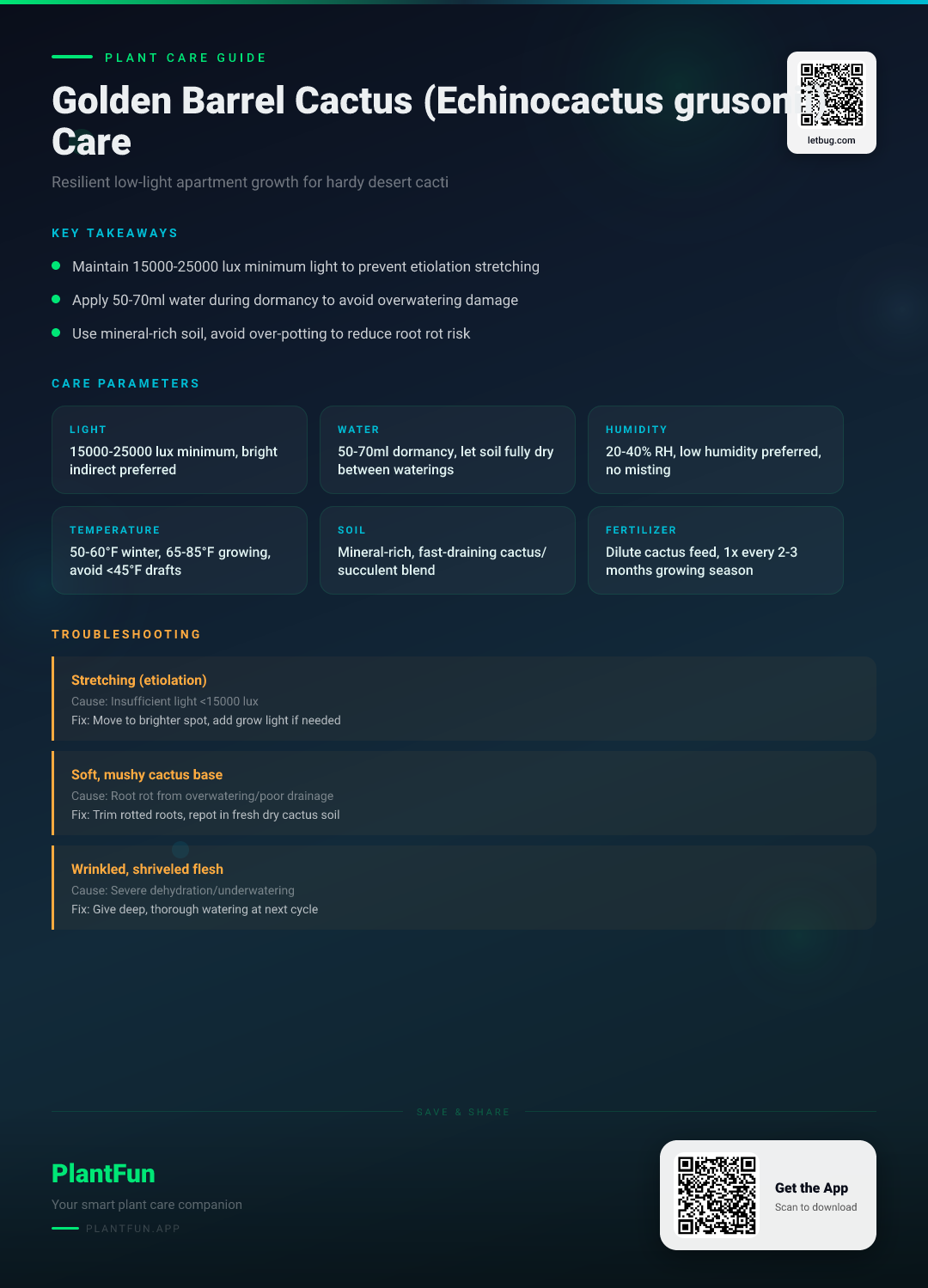
Key Takeaways
- Check soil moisture before watering — overwatering is the #1 killer of houseplants.
- Ensure your plant gets the right amount of light for its species.
- Be patient with recovery — most plants need 2–4 weeks to bounce back.
Quick Care Card: Essential Thresholds for Echinocactus grusonii
| Feature | Requirement |
|---|---|
| Light | 15,000–25,000 Lux (Bright, direct) |
| Water | 50-70ml, strictly during active growth |
| Humidity | 20-30% (Low) |
| Temperature | 50–60°F (Winter dormancy) |
| Soil | Mineral-heavy, fast-draining blend |
| Fertilizer | Low-nitrogen cactus feed (Spring only) |
| Toxicity | Non-toxic to humans; sharp spines are a physical hazard |
TL;DR: The Reality of Apartment Cactus Care
Many believe the Echinocactus grusonii is a “set and forget” plant. In reality, an apartment-bound Golden Barrel is fighting an uphill battle for energy. To succeed, you must provide high-intensity light (at least 15,000 lux) and strictly limit water. Avoid the trap of “loving it to death” with excess moisture, which often leads to lethal fungal issues (Polizzi & Vitale, 2004). Keep it cool in winter and dry throughout the year to foster true resilience.
My Experience: The “Stretched” Awakening
When I first brought home my Echinocactus grusonii, I placed it on a bookshelf six feet from a window. I thought, “It’s a cactus, it’ll be fine.” Within three months, the top of my once-spherical specimen began to pale and elongate toward the window—a classic sign of etiolation. I learned the hard way that these plants aren’t “low-light” decor; they are high-performance sun-seekers. Since moving mine to a south-facing ledge and adjusting my irrigation, it has regained its compact, robust structure.
Why Your Golden Barrel Cactus is Stretching (Etiolation)
Etiolation occurs when the plant lacks sufficient photons to trigger chlorophyll production and structural integrity. Instead of growing wide, it elongates in a desperate, weak attempt to “reach” the light source. Once a cactus etiolates, that growth is permanent. You cannot “shrink” it back; you can only provide better light for new, healthy growth.
Light Requirements: Achieving the 15,000-25,000 Lux Minimum
To thrive, the Golden Barrel needs more than just a bright room. It requires high-intensity light. If you cannot provide a south-facing window, you will likely need a full-spectrum LED grow light set to an intensity of at least 15,000-25,000 lux. A simple phone light-meter app can help you gauge your specific windowsill’s output. If you are reading below 10,000 lux, your cactus is essentially starving (NC State Extension, 2026).
The Watering Protocol: Measuring the 50-70ml Threshold for Dormancy
In an apartment, humidity is often higher and airflow lower than in the desert. Never rely on a calendar. Instead, use the 50-70ml threshold: during the growing season (Spring/Summer), add only enough water to lightly dampen the substrate, avoiding saturation. In winter, cease watering almost entirely. Over-watering is the primary cause of death for indoor cacti (Roberts, 2010).
Soil Science: Creating the Perfect Mineral-Rich Substrate Blend
Standard potting soil retains too much moisture for Echinocactus grusonii. I mix my own using a 1:1:1 ratio:
- 1 part coarse horticultural sand (or grit)
- 1 part perlite or pumice
- 1 part commercial cactus potting mix This ensures rapid drainage and prevents the roots from sitting in stagnant, moisture-laden pockets.
Seasonal Shifts: Adjusting Temperature for Winter Resilience (50-60°F)
Cacti require a dormant phase to maintain their metabolic health. During winter, aim for a cooler environment (50–60°F). This rest period encourages the plant to “harden off” and prevents premature growth that leads to weakness. If your apartment is consistently 75°F+ in winter, be extra careful to keep the soil completely dry to prevent rot.
Troubleshooting: Why is my cactus turning soft at the base?
Symptom: The base feels spongy or discolored (brown/black) rather than firm to the touch.
Likely cause: Fungal infection or systemic rot caused by excess soil moisture (Polizzi & Vitale, 2004).
Fix:
- Remove the cactus from the pot immediately.
- Inspect the roots for mushy, decaying tissue and trim away any rot with sterilized shears.
- Repot in dry, sterile mineral substrate.
- Reduce water drastically.
Can I keep my Golden Barrel Cactus on a north-facing windowsill?
Only if you use a high-powered grow light. A north-facing window typically lacks the direct-sun intensity required for Echinocactus grusonii. Without supplemental light, the plant will inevitably etiolate. If you have low light levels, check out our guide on choosing low-light resilient houseplants instead.
How do I know if my cactus is getting enough light?
- Color: It should be a vibrant, deep green (or a slight golden hue depending on age).
- Shape: It should remain spherical or flattened, not columnar.
- Spines: Healthy light levels produce dense, robust spine growth.
Step-by-Step Diagnosis: Identifying Root Rot vs. Dehydration
- Check the firmness: A healthy cactus is firm. A dehydrated cactus will look slightly shriveled but feel light. A rotted cactus will feel squishy.
- The Finger Test: Stick your finger 2 inches into the soil. If it is damp, stop watering. If it is bone-dry and the plant is shriveled, provide 50ml of water.
- Root Check: Gently unpot. White, firm roots are healthy. Dark, slimy, or smelly roots are a sign of rot (Polizzi & Vitale, 2004).
Common Mistakes to Avoid
- Mistake: Using a pot without drainage holes.
- What happens: Water pools at the bottom, leading to immediate root asphyxiation.
- Instead: Always use a terra cotta pot with at least one large drainage hole.
- Mistake: Over-potting.
- What happens: Excess soil volume holds too much water, staying wet for weeks.
- Instead: Choose a pot only 1-2 inches wider than the cactus root ball.
References and Botanical Guidelines
- Polizzi, G., & Vitale, A. (2004). First Report of Basal Stem Rot of Golden Barrel Cactus Caused by Fusarium oxysporum f. sp. opuntiarum in Italy. Plant Disease. https://doi.org/10.1094/pdis.2004.88.1.85a. Accessed 2026-03-16.
- Roberts, E. (2010). Cactus Tips from a Master Grower. Cactus and Succulent Journal. https://doi.org/10.2985/015.082.0109. Accessed 2026-03-16.
- ASPCA. (2026). Toxic and Non-Toxic Plants List — ASPCA. https://www.aspca.org/pet-care/animal-poison-control/toxic-and-non-toxic-plants. Accessed 2026-03-16.
- NC State Extension. (2026). Golden Barrel Cactus — NC State Extension Gardener Plant Toolbox. https://plants.ces.ncsu.edu/plants/cactus-care/. Accessed 2026-03-16.
Optional Helper: Plantfun.App
Plantfun.App identifies your plants by photo, diagnoses pests and diseases with clear fixes, and creates personalised watering and light schedules that adapt to your home conditions — a handy companion for putting this guide into daily practice.
Found an error or have suggestions? We'd love your feedback.
Need help identifying this problem?
Get instant identification, personalized care schedules, and effective pest treatment plans directly on your phone.
Sponsored • We may earn a commission from app downloads
Related Guides
Golden Barrel Cactus in a Low-Light Apartment: Why Your Plant Stretches and How to Stop It
Rescue your stretching Golden Barrel Cactus with our 4-step light correction plan. Learn exactly how to adjust your home environment for healthy, stout growth.
Care GuideGolden Barrel Cactus in a South-Facing Apartment: The Only Care Guide You’ll Ever Need
Master Golden Barrel cactus care with our precise 3-step watering schedule and light mapping. Keep your desert jewel thriving with 20,000+ lux and expert tips.
Care GuideGolden Barrel Cactus in a Low-Light Apartment: A Resilient Growth and Rescue Strategy
Revive your struggling Golden Barrel Cactus with precise light adjustments and soil moisture control. Learn 4 proven steps to stop etiolation and foster growth.
Pest ControlAnts on Plants: What They Mean and What to Do
Ants usually aren't eating your plant. They are farming other pests.