
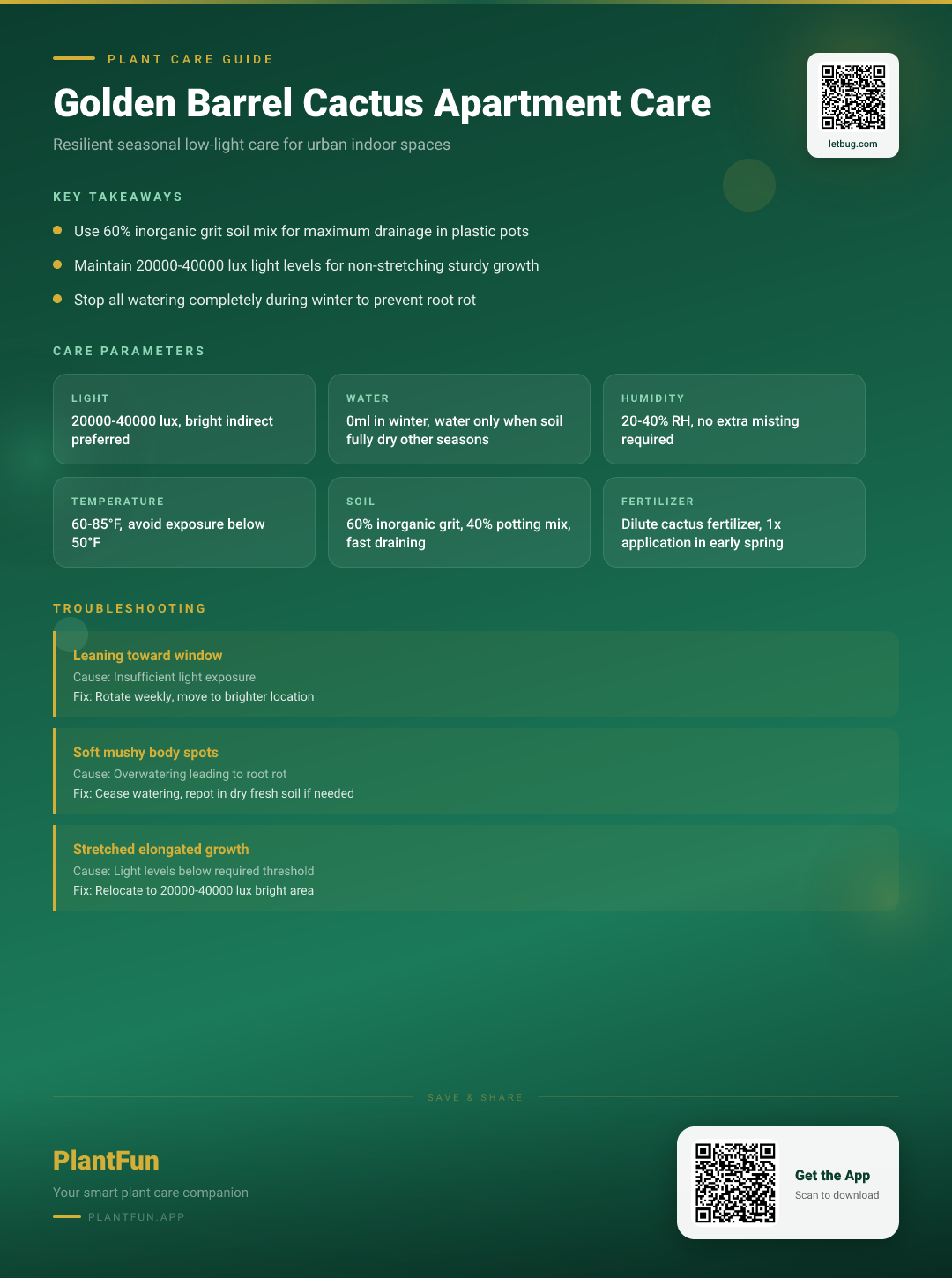
Key Takeaways
- Check soil moisture before watering — overwatering is the #1 killer of houseplants.
- Ensure your plant gets the right amount of light for its species.
- Be patient with recovery — most plants need 2–4 weeks to bounce back.
Quick Care Card: Essential thresholds for Echinocactus grusonii
| Feature | Requirement |
|---|---|
| Light | 15,000–20,000 Lux (Direct South Window or Grow Light) |
| Water | 100–150ml when top 3 inches of soil are dry |
| Humidity | <40% RH (Low humidity is preferred) |
| Temperature | 65–75°F (Day); 50–55°F (Night in winter) |
| Soil | Fast-draining gritty mix (pumice/coarse sand/potting soil) |
| Fertilizer | Low-nitrogen succulent feed in peak growth only |
| Toxicity | Generally considered non-toxic, but watch for spines (ASPCA, 2026) |
Why Your Apartment Challenges the Golden Barrel Cactus
When I first started collecting cacti in my tiny city apartment, I assumed the Echinocactus grusonii would be the easiest plant to keep alive. I placed it in a dim corner, thinking its desert heritage made it invincible. I was wrong. My cactus started losing its classic spherical shape and began reaching—a process known as etiolation. Apartment living often provides stagnant air and filtered, weak light, which are the antithesis of the intense, high-UV environment these plants require (NC State Extension, 2026). Without intervention, the biological clock of your cactus becomes disrupted, leading to potential structural failure and susceptibility to fungal issues (Polizzi & Vitale, 2004).
TL;DR: The 3 Rules for Cactus Resilience in Small Spaces
- Maximize Light: Treat your cactus like a sun-worshipper. If you don’t have a south-facing window, use a full-spectrum LED grow light.
- Controlled Hydration: Never water based on a calendar. Only add 100-150ml of water once the soil is completely dry for at least 3 inches down.
- Respect Dormancy: Reduce watering significantly in winter to simulate a natural rest period, which prevents weak, elongated growth.
Light Requirements: Achieving 15,000-20,000 Lux indoors
In my experience, low light is the silent killer of the Golden Barrel. These plants need intense light to maintain their chlorophyll balance and rigid cellular structure. If you are tracking light levels, aim for 15,000-20,000 lux. In a typical apartment, this requires the plant to be within 6 inches of a south-facing window or under an artificial light source for 12-14 hours daily (Roberts, 2010).
Hydration Science: Water with 100-150ml when top 3 inches of soil are dry
I recommend using the “finger probe” test: if you can’t feel moisture in the top 3 inches of soil, it is time to water. Do not soak the pot to the point of standing water. Instead, use a measuring cup to apply 100-150ml of water directly to the soil. This prevents the root system from sitting in stagnant moisture, which is the primary cause of stem rot (Polizzi & Vitale, 2004).
Temperature & Humidity: Maintaining 65-75°F and <40% RH for dormant health
Cacti thrive in dry, warm conditions. In your home, keep the humidity below 40%. High humidity combined with cooler temperatures can cause the plant to retain moisture, leading to fungal pathogens. I keep mine in a room that stays around 65-75°F. During the winter, moving your plant to a slightly cooler room (50-55°F) encourages a healthy dormancy period, which helps the plant reset for spring growth (NC State Extension, 2026).
Spring & Summer: The Peak Growth Routine
This is when your cactus should be actively drinking. I increase my watering frequency slightly, ensuring the soil dries out fully between applications. If you notice new golden spines appearing at the crown, your plant is happy. I provide a diluted, low-nitrogen fertilizer once during early summer to support this phase.
Autumn & Winter: Managing the Mandatory Dormancy Phase
As daylight decreases, your cactus slows its metabolism. Stop fertilizing entirely and cut water back by half. Overwatering during this dormant period is the most common reason for plant loss in urban environments.
Common Mistakes: Why overwatering is the #1 apartment cactus killer
- Mistake: Watering on a schedule (e.g., every Monday).
- What happens: The soil stays moist, leading to root asphyxiation and rot.
- Instead: Water only when the plant shows signs of dehydration (a slight softening or “give” in the stem).
FAQ: Why is my Golden Barrel Cactus leaning toward the window?
This is a classic case of phototropism. The plant is desperately reaching for a more intense light source to survive. You should rotate the pot a quarter-turn every week to encourage even growth, but ultimately, you must move the plant closer to the light source.
FAQ: How do I know if my cactus is getting enough light?
A healthy Golden Barrel should be a deep green color with vibrant golden spines. If the crown starts to turn pale green or the plant begins to stretch upwards instead of staying compact, the light levels are insufficient.
FAQ: Can I use a regular houseplant fertilizer for my cactus?
Avoid using standard houseplant fertilizers, as they are typically too high in nitrogen. Nitrogen promotes soft, succulent growth that makes the cactus prone to rot and further etiolation. Use a specialized cactus or succulent fertilizer with a low NPK ratio (Roberts, 2010).
Troubleshooting: Recognizing early signs of etiolation vs. sun stress
Etiolation (Light Starvation)
Symptom: The plant takes on a stretched or “spindly” appearance with pale skin.
Likely cause: Persistent lack of direct sunlight.
Fix:
- Gradually move the plant to a brighter location.
- Introduce an artificial grow light to supplement natural light levels.
Sun Stress (Sunburn)
Symptom: White or brown corky patches appearing on the surface.
Likely cause: Sudden exposure to intense sun without acclimation.
Fix:
- Provide a sheer curtain to diffuse the light for 2 weeks.
- Gradually move the plant closer to the window until it adapts.
Root Rot
Symptom: The base of the cactus turns mushy or dark.
Likely cause: Overwatering or poor soil drainage.
Fix:
- Unpot the plant and trim away any black, squishy roots.
- Replant in fresh, dry, gritty cactus mix and wait 7 days before the next light watering.
References
- Polizzi, G., & Vitale, A. (2004). First Report of Basal Stem Rot of Golden Barrel Cactus Caused by Fusarium oxysporum f. sp. opuntiarum in Italy. Plant Disease. https://doi.org/10.1094/pdis.2004.88.1.85a. Accessed 2026-03-17.
- Roberts, E. (2010). Cactus Tips from a Master Grower. Cactus and Succulent Journal. https://doi.org/10.2985/015.082.0109. Accessed 2026-03-17.
- ASPCA. (2026). Toxic and Non-Toxic Plants List — ASPCA. https://www.aspca.org/pet-care/animal-poison-control/toxic-and-non-toxic-plants. Accessed 2026-03-17.
- NC State Extension. (2026). Golden Barrel Cactus — NC State Extension Gardener Plant Toolbox. https://plants.ces.ncsu.edu/plants/cactus-care/. Accessed 2026-03-17.
Optional Helper: Plantfun.App
Plantfun.App identifies your plants by photo, diagnoses pests and diseases with clear fixes, and creates personalised watering and light schedules that adapt to your home conditions — a handy companion for putting this guide into daily practice.
Found an error or have suggestions? We'd love your feedback.
Need help identifying this problem?
Get instant identification, personalized care schedules, and effective pest treatment plans directly on your phone.
Sponsored • We may earn a commission from app downloads
Related Guides
Golden Barrel Cactus in a Low-Light Apartment: Why Your Plant Stretches and How to Stop It
Rescue your stretching Golden Barrel Cactus with our 4-step light correction plan. Learn exactly how to adjust your home environment for healthy, stout growth.
Care GuideGolden Barrel Cactus in a South-Facing Apartment: The Only Care Guide You’ll Ever Need
Master Golden Barrel cactus care with our precise 3-step watering schedule and light mapping. Keep your desert jewel thriving with 20,000+ lux and expert tips.
Care GuideGolden Barrel Cactus in a Low-Light Apartment: A Resilient Growth and Rescue Strategy
Revive your struggling Golden Barrel Cactus with precise light adjustments and soil moisture control. Learn 4 proven steps to stop etiolation and foster growth.
Pest ControlAnts on Plants: What They Mean and What to Do
Ants usually aren't eating your plant. They are farming other pests.