
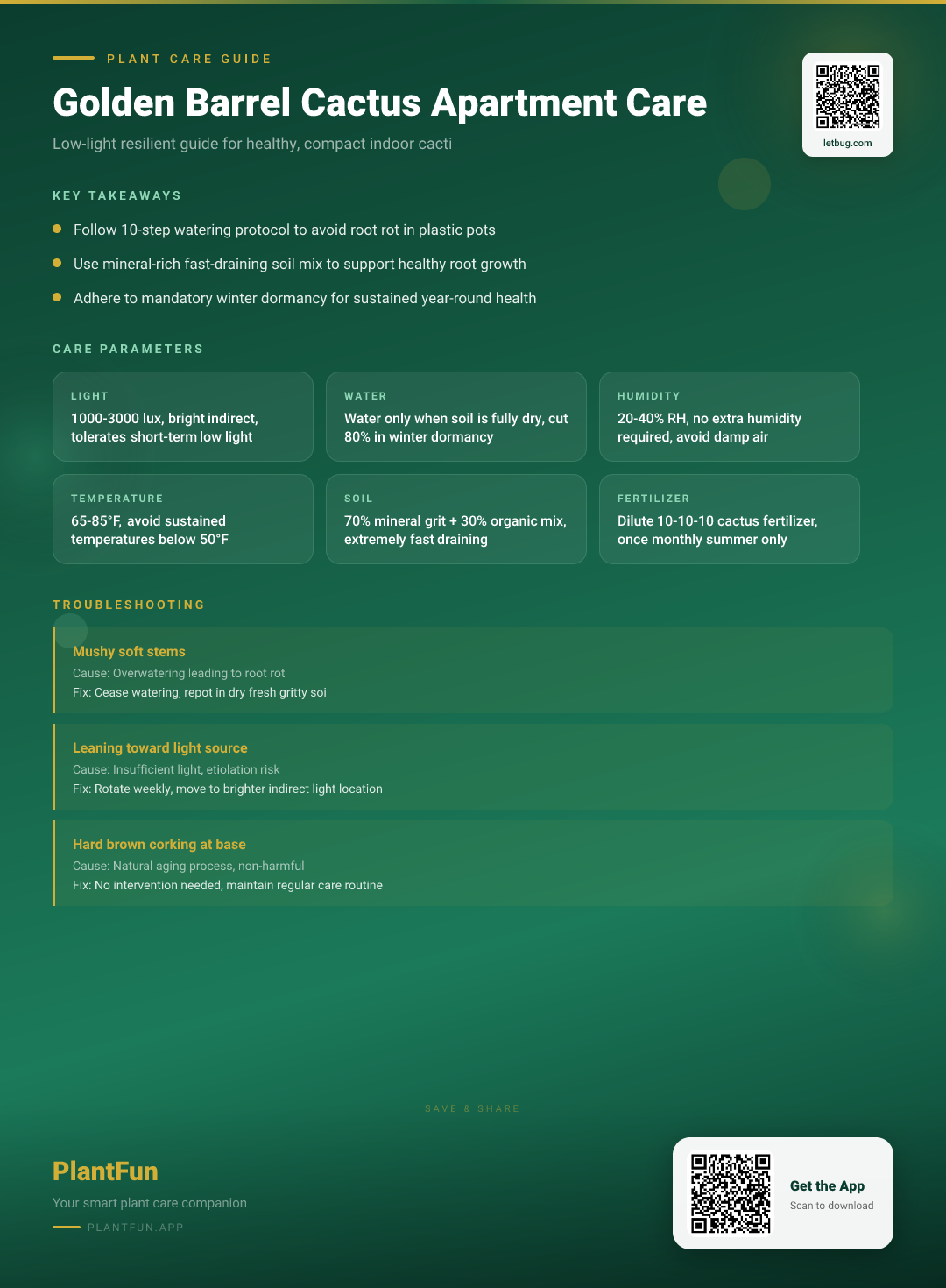
Key Takeaways
- Check soil moisture before watering — overwatering is the #1 killer of houseplants.
- Ensure your plant gets the right amount of light for its species.
- Be patient with recovery — most plants need 2–4 weeks to bounce back.
Quick Care Card: Essential Parameters for Golden Barrel Success
| Parameter | Requirement |
|---|---|
| Light | 6-8+ hours of direct sun (or high-output grow light) |
| Water | Soak thoroughly, then allow 100% of soil to dry |
| Humidity | Low (30-40%) |
| Temperature | 65°F - 85°F (Summer) / 50°F - 55°F (Winter) |
| Soil | Highly inorganic, fast-draining gritty mix |
| Fertilizer | Low-nitrogen succulent fertilizer, once in spring |
| Toxicity | Non-toxic to humans; keep away from pets (ASPCA, 2026) |
TL;DR: The Reality of Cactus Care in Apartment Living
Growing a Echinocactus grusonii (Golden Barrel) in an apartment is entirely possible, but only if you acknowledge its high-light requirements. If your plant is stretching, it is starving for light, not craving water. The “set-it-and-forget-it” myth is dangerous; these plants require a strict seasonal watering cycle and near-total soil desiccation to avoid fungal pathogens (Polizzi & Vitale, 2004). If you cannot provide a south-facing window, artificial supplemental lighting is mandatory for structural integrity.
Why Your Cactus Isn’t Growing: The Science of Etiolation and Light
When I first started collecting cacti, I kept my Golden Barrel on a bookshelf three feet from a north-facing window. Within weeks, the top grew thin and pale. This is called etiolation. The plant is desperately reaching for light, stretching its cells to find a photon source. According to the NC State Extension (2026), these desert natives evolved to withstand intense solar radiation; typical indoor environments, even bright ones, are often significantly lower in light intensity than their native habitats. Without high light, photosynthesis slows, the plant weakens, and it becomes highly susceptible to opportunistic pests and diseases.
Measurement Thresholds: Defining the Apartment ‘Ideal’
To keep your cactus compact and spherical, you need to hit specific thresholds. Aim for a minimum of 2,000 foot-candles (approx. 21,500 lux) for 6 to 8 hours daily. If you are using a smartphone light meter app to test your space, don’t measure the light at the window glass—measure it at the surface of the cactus. If your reading is consistently below 500 foot-candles, you must supplement with a full-spectrum LED grow light placed 6-12 inches above the crown.
The 10-Step Watering Protocol: Avoiding Root Rot in Plastic Pots
- Use a pot with at least 3-4 large drainage holes.
- Ensure the pot is only 1-2 inches wider than the root ball.
- Wait until the soil is bone-dry from top to bottom.
- Use a wooden skewer as a “dipstick” to test for moisture 2 inches down.
- Flush the soil thoroughly until water drains freely from the base.
- Let the plant sit in the sink for 20 minutes to finish draining.
- Never let the pot sit in a saucer of standing water; this leads to Fusarium infections (Polizzi & Vitale, 2004).
- If your apartment has low airflow, point a small fan toward the plant post-watering.
- Wipe any water off the crown (the top center) to prevent rot.
- Do not water again until the plant shows signs of slight contraction.
Soil Science: Creating the Perfect Mineral-Rich Mix for Drainage
Do not use standard potting soil; it holds too much moisture. I recommend a mix of 50% professional-grade cactus soil and 50% inorganic additives like pumice or coarse poultry grit. This high-mineral ratio ensures rapid drainage and prevents the roots from sitting in the anaerobic conditions that invite fatal fungal growth (Roberts, 2010).
Seasonal Adjustments: Why Winter Dormancy is Non-Negotiable
During winter, the days are shorter, and your Golden Barrel enters a metabolic rest period. If you keep watering it during this time, you are forcing growth when the plant has no solar energy to support it. From November to March, reduce watering to once every 6-8 weeks—or stop entirely if your room is cool (around 50°F). This rest is essential for blooming and overall health.
Troubleshooting Guide: Identifying Mushy Stems vs. Corking
Mushy Base
Symptom: The bottom of the cactus feels soft or “squishy” to the touch.
Likely cause: Root rot caused by overwatering or poor drainage.
Fix:
- Remove the cactus from the pot immediately.
- Use a sterilized knife to cut away any black, rotting roots.
- Let the roots air-dry for 3 days before repotting into fresh, dry grit mix.
Corking
Symptom: The base of the plant is turning woody, brown, and hard.
Likely cause: Natural aging of the plant epidermis.
Fix:
- No action required; it is a normal protective layer.
FAQ: Why is my cactus leaning toward the window?
This is a classic case of phototropism. The plant is leaning because it is searching for higher light intensity. To fix this, rotate your pot 180 degrees every week to maintain uniform growth. If the lean is severe, you may need to move it to a brighter location or use a grow light.
FAQ: How often should I fertilize my cactus during the summer?
Apply a low-nitrogen, high-potassium liquid fertilizer diluted to half-strength exactly once in early summer. Never fertilize during the winter dormancy period; it can shock the roots and cause salt buildup (Roberts, 2010).
Common Mistakes to Avoid: The Dangers of ‘Helpful’ Over-Care
- Mistake: Misting the cactus.
- What happens: Fungal spores thrive in the damp, stagnant air on the cactus skin.
- Instead: Maintain dry, low-humidity air.
- Mistake: Repotting into a massive pot to “give it room to grow.”
- What happens: Excess soil stays wet for weeks, leading to root rot.
- Instead: Keep the root ball snug in a small pot.
References: Scholarly Insights for Indoor Succulent Cultivation
- ASPCA. (2026). Toxic and Non-Toxic Plants List — ASPCA. https://www.aspca.org/pet-care/animal-poison-control/toxic-and-non-toxic-plants. Accessed 2026-03-19.
- Polizzi, G., & Vitale, A. (2004). First Report of Basal Stem Rot of Golden Barrel Cactus Caused by Fusarium oxysporum f. sp. opuntiarum in Italy. Plant Disease. https://doi.org/10.1094/pdis.2004.88.1.85a. Accessed 2026-03-19.
- Roberts, E. (2010). Cactus Tips from a Master Grower. Cactus and Succulent Journal. https://doi.org/10.2985/015.082.0109. Accessed 2026-03-19.
- NC State Extension. (2026). Golden Barrel Cactus — NC State Extension Gardener Plant Toolbox. https://plants.ces.ncsu.edu/plants/cactus-care/. Accessed 2026-03-19.
Optional Helper: Plantfun.App
Plantfun.App identifies your plants by photo, diagnoses pests and diseases with clear fixes, and creates personalised watering and light schedules that adapt to your home conditions — a handy companion for putting this guide into daily practice.
Found an error or have suggestions? We'd love your feedback.
Need help identifying this problem?
Get instant identification, personalized care schedules, and effective pest treatment plans directly on your phone.
Sponsored • We may earn a commission from app downloads
Related Guides
Golden Barrel Cactus in a Studio Apartment: The Ultimate Low-Maintenance Care Guide
Master your Golden Barrel Cactus care with this simple, 5-step apartment guide. Learn exact light, soil, and watering cycles to ensure long-term resilience.
Care GuideEchinocactus Grusonii in a Low-Light Apartment: The Complete Resilient Growth Care Plan
Revive your Golden Barrel cactus with this science-backed growth plan. Learn exact light, soil, and water thresholds to prevent stretching in your apartment.
Care GuideGolden Barrel Cactus in a Low-Light Apartment: The Only Care Guide You’ll Need
Prevent etiolation and mushy stems with our specific Golden Barrel Cactus care guide. Master precise water, light, and soil metrics for a thriving apartment.
Pest ControlAnts on Plants: What They Mean and What to Do
Ants usually aren't eating your plant. They are farming other pests.