
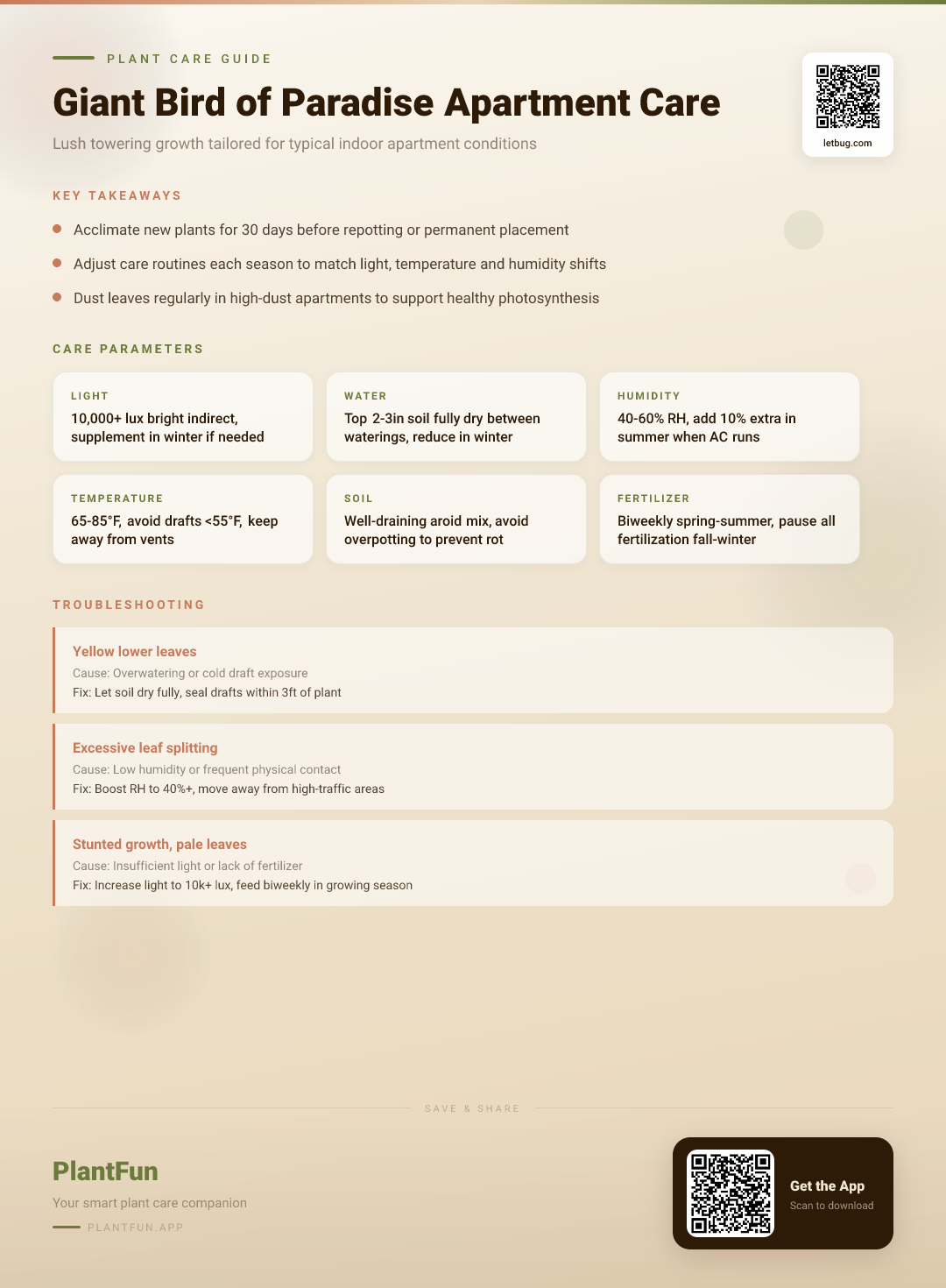
Key Takeaways
- Check soil moisture before watering — overwatering is the #1 killer of houseplants.
- Ensure your plant gets the right amount of light for its species.
- Be patient with recovery — most plants need 2–4 weeks to bounce back.
Quick Care Card
Print this table for fast, no-guess reference tailored specifically to 500–800 sq ft North American apartment conditions:
| Care Parameter | Apartment-Specific Measurable Threshold |
|---|---|
| Light | 10,000–25,000 lux for a minimum of 4 hours daily (NC State Extension, 2026) |
| Water | Only when the top 2–3 inches of soil are completely dry (adjust based on season) |
| Humidity | 40–60% ideal; 30% acceptable for short periods |
| Temperature | 65–85°F (18–29°C); avoid sustained temps below 55°F (13°C) |
| Soil | 60% standard indoor potting mix, 20% perlite, 20% orchid bark for drainage (best soil for Bird of Paradise in apartments) |
| Fertilizer | Half-strength 10-10-10 NPK every 2 weeks only during spring and summer growing seasons |
| Toxicity | Toxic to cats, dogs, and horses if ingested (ASPCA, 2026) |
Why This Guide Is Different
Generic Giant Bird of Paradise care guides are written for ideal greenhouse conditions, where light, humidity, and temperature stay consistent year-round. Typical apartments have fluctuating conditions: drafty single-pane windows, dry forced-air heat, frequent AC use in summer, and limited bright light space that rarely matches greenhouse levels. This guide cuts through vague advice like “bright indirect light” to deliver exact, testable thresholds calibrated for Strelitzia nicolai apartment care, no specialized growing gear required. If you’re new to measuring light levels, check out our guide to measuring light for houseplants to get accurate readings for your space.
New Plant Initial Setup Walkthrough
Follow these steps for your first 30 days with a new Giant Bird of Paradise to avoid shock and set it up for long-term success:
- Days 1–14: Acclimation period Keep the plant in its original nursery pot, place it 3–5 feet away from your brightest window, and avoid moving it. Do not repot or fertilize during this time. Test for draft exposure: hold your hand at plant height for 1 minute, if you feel cold or hot moving air, move the plant to a more protected spot.
- Day 14: Repotting check Gently remove the root ball from the pot. If roots are circling the bottom or growing out of drainage holes, repot into a pot only 2 inches wider than the nursery pot using the soil mix listed in the quick care card. For more tips on well-draining soil mixes, see our guide to soil for large houseplants. If the plant is not root bound, leave it in its original pot for another 3–6 months.
- Day 30: Permanent placement Use a free light meter app to confirm your chosen spot gets at least 4 hours of 10,000+ lux daily. Ensure the plant is at least 3 feet away from heating vents, AC units, and drafty windows.
Spring Care Routine Checklist
Spring is the peak growing season for Giant Bird of Paradise, so adjust your routine to support fast new growth:
- Adjust watering: Check soil moisture every 5 days, water when the top 2 inches of soil are completely dry (1 inch sooner than winter schedules).
- Start fertilizing: Use half-strength 10-10-10 NPK every 2 weeks, starting when daily sunlight hits 12 hours in your region. This is the easiest answer for how to make Bird of Paradise grow faster, per NC State Extension (2026).
- Inspect for repotting needs: If the soil dries out completely in less than 2 days after watering, or roots are growing out of drainage holes, size up to a 2-inch wider pot.
- Wipe all leaves with a damp microfiber cloth to remove winter dust buildup and improve light absorption.
Summer Care Routine Checklist
Summer brings heatwaves and frequent AC use that can stress your plant if you don’t adjust your routine:
- Humidity boost: Mist leaves 2x weekly or use a pebble tray under the pot to raise relative humidity by 10% to hit the 50–60% ideal range for Bird of Paradise humidity needs.
- Follow a Bird of Paradise summer watering schedule: Check soil every 3 days during heatwaves over 90°F, water when the top 1.5 inches of soil are dry. If you run AC daily, check soil every 4 days, as AC dries out air and soil faster.
- Pest prevention: Wipe leaves weekly with 1% diluted neem oil to prevent spider mites, which thrive in dry, air-conditioned apartment air.
- Rotate the plant 180 degrees every 2 weeks to ensure even, upright growth on all sides.
Fall Care Routine Checklist
Prep your plant for shorter days and colder temperatures with these steps:
- Pause fertilization starting when daily sunlight drops below 10 hours (usually mid-October for most North American zones).
- Seal drafty windows within 3 feet of your plant with weather stripping or a draft stopper. Bird of Paradise draft tolerance is very low, and sustained cold drafts below 55°F can cause permanent leaf damage (NC State Extension, 2026).
- Adjust watering: Go back to watering only when the top 3 inches of soil are completely dry, as growth slows significantly in fall.
- Trim any fully yellow or brown lower leaves with sterile pruning shears to redirect energy to healthy growth.
Winter Care Routine Checklist
Winter is the highest-risk season for indoor Giant Bird of Paradise, thanks to dry forced-air heat and low light levels:
- Meet Giant Bird of Paradise light requirements: If your brightest window delivers less than 10,000 lux for 4 hours daily, place a standard LED grow light 2 feet above the plant and run it for 6 hours daily to hit the minimum threshold. More winter care tips can be found in our winter houseplant care guide.
- Avoid overwatering: Only water when the top 4 inches of soil are completely dry. For most apartment dwellers, this means watering every 2–3 weeks. Overwatering is the #1 cause of death for this plant during winter, per NC State Extension (2026).
- Keep the plant at least 3 feet away from heating vents, as hot dry air will cause brown leaf edges.
- Do not repot or propagate during winter, as the plant is dormant and will not recover from root disturbance quickly.
Common Apartment-Specific Mistakes to Avoid
- Mistake: Placing your plant directly on a windowsill next to a drafty old window. What happens: Cold drafts cause leaf browning, stunted growth, and even root shock. Instead: Keep the plant at least 1 foot away from drafty windows, and use a draft stopper if needed.
- Mistake: Overpotting your plant in a pot more than 2 inches larger than the root ball. What happens: Excess soil holds too much moisture, leading to root rot, the most common killer of indoor Strelitzia nicolai. Instead: Only size up 2 inches at a time when repotting, and use the well-draining soil mix listed in the quick care card.
- Mistake: Watering on a fixed weekly schedule instead of checking soil moisture. What happens: You will overwater in winter and underwater in summer, leading to yellow leaves or brown edges. Instead: Use the finger test: stick your finger 2–3 inches into the soil, only water if it is completely dry. This answers the common question of how often to water Bird of Paradise for apartment conditions.
- Mistake: Skipping leaf dusting in dusty urban apartments. What happens: Dust blocks light absorption, leading to stunted growth and no new leaves in spring. Instead: Wipe leaves with a damp cloth every 2–4 weeks depending on dust levels.
- Mistake: Assuming north-facing windows provide enough light for growth. What happens: North-facing windows only deliver 2,000–5,000 lux, which is well below the 10,000 lux minimum, leading to weak, leggy growth.
FAQ
Q: Can I keep my Giant Bird of Paradise in a room with only north-facing windows?
A: Yes, but you will need to supplement with a grow light to hit the 10,000 lux minimum for 4 hours daily. North-facing windows typically only deliver 2,000–5,000 lux, which is too low for consistent growth, so this is the only workaround for can Bird of Paradise grow in low light apartments.
Q: Why is my Bird of Paradise leaves splitting even if I water it correctly?
A: Some splitting is natural: this plant evolved split leaves to let wind pass through in its native South African habitat. Excessive splitting in apartments is almost always caused by humidity below 40% or exposure to strong drafts from AC or windows. Boost humidity to 50% and move the plant away from draft sources to reduce unnecessary splitting.
Q: How often should I dust my Bird of Paradise leaves in a dusty apartment?
A: If you live in a high-traffic urban area, near a construction site, or keep your windows open often, dust leaves every 2 weeks. If your apartment is low-dust, every 4 weeks is sufficient. Regular dusting improves light absorption and helps your plant grow faster.
Troubleshooting Quick Reference
Yellow Lower Leaves
Symptom: Occasional yellowing of older lower leaves, or multiple yellow leaves appearing at the same time.
Likely cause: Occasional yellow lower leaves are normal seasonal shedding; multiple yellow leaves are almost always overwatering leading to early root rot.
Fix:
- Stop watering immediately, check if the soil is waterlogged, and repot into fresh dry soil if the roots are brown and mushy.
- Adjust your watering schedule to only water when the top 2–3 inches of soil are completely dry.
Brown Leaf Edges
Symptom: Crispy, light brown edges on otherwise green, healthy leaves.
Likely cause: Humidity below 40% or exposure to direct hot air from heating vents or AC units.
Fix:
- Add a pebble tray under the pot or mist leaves 2x weekly to raise humidity to 40% minimum.
- Move the plant at least 3 feet away from any heating or AC vents.
No New Growth
Symptom: No new large unfurled leaves appear for 3+ months during spring and summer growing season.
Likely cause: Insufficient light (below 10,000 lux for 4 hours daily) or lack of fertilization during the growing season.
Fix:
- Use a light meter app to confirm your plant is getting enough light, supplement with a grow light if needed.
- Fertilize with half-strength 10-10-10 NPK every 2 weeks during spring and summer.
Bacterial Leaf Spot
Symptom: Dark, water-soaked spots on leaves that grow larger over time, often with a yellow halo.
Likely cause: Infection by Xanthomonas campestris, spread by overwatering and wet leaves (Chase, 1987).
Fix:
- Remove all infected leaves with sterile pruning shears, dispose of them in the trash (do not compost).
- Avoid getting leaves wet when watering, and reduce watering frequency to let the top 3 inches of soil dry out between waterings.
References
- NC State Extension. (2026). Giant Bird of Paradise — NC State Extension Gardener Plant Toolbox. https://plants.ces.ncsu.edu/plants/paradise-care/. Accessed 2026-02-25.
- Chase, A. (1987). Leaf Spot and Blight of Strelitzia reginae (Bird-of-Paradise) Caused by Xanthomonas campestris. Plant Disease. https://doi.org/10.1094/pd-71-0845. Accessed 2026-02-25.
- Bird, D. (1994). DNA Sequence and Expression Analysis of Root-Knot Nematode-Elicited Giant Cell Transcripts. Molecular Plant-Microbe Interactions. https://doi.org/10.1094/mpmi-7-0419. Accessed 2026-02-25.
- ASPCA. (2026). Toxic and Non-Toxic Plants List — ASPCA. https://www.aspca.org/pet-care/animal-poison-control/toxic-and-non-toxic-plants. Accessed 2026-02-25.
Optional Helper: Plantfun.App
Plantfun.App identifies your plants by photo, diagnoses pests and diseases with clear fixes, and creates personalised watering and light schedules that adapt to your home conditions — a handy companion for putting this guide into daily practice.
Found an error or have suggestions? We'd love your feedback.
Need help identifying this problem?
Get instant identification, personalized care schedules, and effective pest treatment plans directly on your phone.
Sponsored • We may earn a commission from app downloads
Related Guides
The Complete Bird of Paradise Care Guide for Typical Apartments: Resilient Growth Tips That Work
Keep your Bird of Paradise thriving in even the dimmest typical apartment. Get exact light levels, water amounts, and a 2-minute weekly check to avoid yellow leaves and boost resilient growth.
Care GuideThe Complete Giant Bird of Paradise Care Guide for Urban Apartments: Seasonal Tips for Resilient Growth
Grow a lush, resilient giant bird of paradise even in a small urban apartment. Get exact light levels, watering amounts, and a seasonal care calendar to avoid common growth problems.
Care GuideThe Budget Bird of Paradise Care Checklist for Resilient Growth in Small Urban Apartments
Grow a lush, full Bird of Paradise in your small urban apartment without overspending. Grab our free printable checklist, exact light/water thresholds, and zero fancy gear required to keep it thriving year-round.
Pest ControlAnts on Plants: What They Mean and What to Do
Ants usually aren't eating your plant. They are farming other pests.