
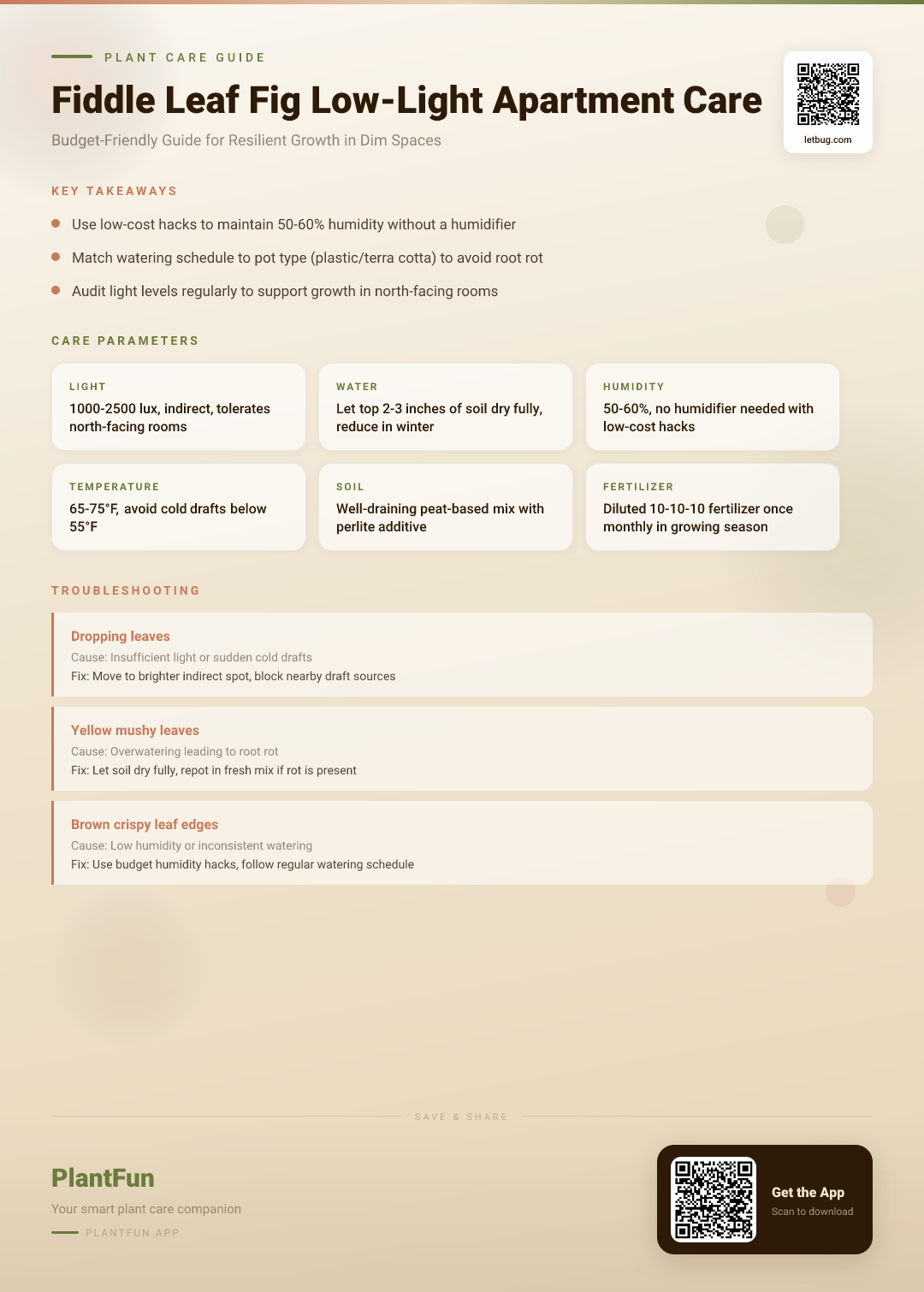
Key Takeaways
- Check soil moisture before watering — overwatering is the #1 killer of houseplants.
- Ensure your plant gets the right amount of light for its species.
- Be patient with recovery — most plants need 2–4 weeks to bounce back.
Quick Care Card: Essential Thresholds for Apartment Success
| Feature | Requirement |
|---|---|
| Light | Bright, indirect (500–1,000 foot-candles) |
| Water | When top 2-3 inches are dry (NC State Extension, 2026) |
| Humidity | 50-60% relative humidity |
| Temperature | 65°F–75°F (18°C–24°C) |
| Soil | Well-draining, peat-based mix |
| Fertilizer | Balanced liquid feed, diluted by half |
| Toxicity | Toxic to cats and dogs (ASPCA, 2026) |
TL;DR: The Reality of Keeping Ficus lyrata in Dimmer Spaces
Can you keep a Fiddle Leaf Fig in an apartment? Yes. The secret isn’t an expensive grow light or premium fertilizer; it’s light optimization. When I first started my indoor plant journey, I treated my Ficus lyrata like a desert cactus, over-watering it until it dropped half its leaves. Resilience comes from stabilizing light intake and strictly monitoring moisture. Keep it near a window, avoid drafts, and only water when the top two inches of soil are dry.
Why Your Fiddle Leaf Fig Struggles in Typical Apartments
Most apartment dwellers struggle with Ficus lyrata because they underestimate the plant’s metabolic demands. These plants are native to lowland rainforests (PlantwisePlus Knowledge Bank, 2022). In a standard apartment, low light prevents the plant from processing the water you provide, leading to stagnant soil and root decay. Unlike outdoor specimens, indoor plants lack the air circulation needed to evaporate moisture quickly, which is why your choice of pot and soil volume matters more than fancy add-ons.
The Light Audit: Mapping Lux for Optimal Photosynthesis
Photosynthesis is the engine of your plant’s growth. In a low-light apartment, you must maximize the available photon flux.
- Distance: Place your plant within 3 feet of a south or west-facing window.
- Cleanliness: Dust the leaves weekly. A thin layer of dust can reduce light absorption by up to 20%.
- Rotation: Turn the pot 90 degrees every time you water to ensure even exposure.
Watering Mastery: Avoiding Root Rot in Plastic vs. Terra Cotta Pots
How often to water Fiddle Leaf Fig? It depends on your pot. I find that plastic pots hold moisture longer, which is risky for beginners. Terra cotta allows the root zone to breathe.
- The Finger Test: Insert your index finger 2-3 inches deep. If it feels cool or damp, wait.
- The Weight Test: Lift the pot. If it feels significantly lighter than when freshly watered, it is time.
Overwatering remains the leading cause of “sudden death” in indoor Ficus lyrata (NC State Extension, 2026). If you suspect overwatering, check for yellowing leaves or a musky smell in the soil.
Budget-Friendly Humidity Hacks: How to Maintain 50-60% Without a Humidifier
Expensive humidifiers aren’t necessary. You can create a micro-climate using simple household items:
- The Pebble Tray: Place your pot on a tray filled with pebbles and enough water to reach just below the base of the pot. As the water evaporates, it creates a localized humid zone.
- Group Planting: Cluster your Fiddle Leaf near other leafy plants. They transpire, creating a collective humidity bubble.
Seasonal Growth Calendar: Adjusting for Winter Low-Light Dips
- Spring/Summer: Growth phase. Increase water frequency slightly, but never let the soil sit in water.
- Autumn/Winter: Dormancy phase. Reduce water by 30-50% (NC State Extension, 2026). Because light levels drop in winter, the plant cannot photosynthesize at high rates; therefore, it needs less fuel (water).
Troubleshooting Guide: Why Is My Fiddle Leaf Fig Dropping Leaves?
Yellowing Lower Leaves
Symptom: Lower leaves turn yellow and drop off.
Likely cause: Overwatering leading to root suffocation.
Fix:
- Stop watering immediately.
- Inspect the drainage holes for blockage.
Brown Crispy Edges
Symptom: Dry, crispy leaf margins on otherwise green foliage.
Likely cause: Low humidity or inconsistent watering.
Fix:
- Implement a pebble tray system.
- Ensure you are watering deeply enough to reach the bottom roots.
Sudden Leaf Drop
Symptom: Healthy-looking leaves falling in large numbers.
Likely cause: Environmental shock (drafts or moved location).
Fix:
- Stop moving the plant; it hates change.
- Verify the temperature is not fluctuating due to AC or heating vents.
Voice Search FAQ: Can I keep my Fiddle Leaf Fig in a north-facing living room?
Yes, but you must keep it pressed right against the window. North-facing light is the weakest, so the plant will struggle to grow quickly. You might see “leggy” growth, where the stems stretch to reach the light.
Voice Search FAQ: How do I know if I’m overwatering my plant in the winter?
Check for signs of overwatering Fiddle Leaf Fig: if the soil is still wet after 10 days, or if the stem feels soft near the base, your plant is struggling to process the water. In winter, lean toward the “under-watered” side to prevent root rot.
Common Mistakes to Avoid: The ‘Too Much Care’ Trap
- Mistake: Frequent fertilizing. What happens: Salt buildup in the soil burns roots. Instead: Only fertilize once in early spring using a balanced, water-soluble fertilizer.
- Mistake: Repotting too often. What happens: Fiddle Leaf Figs are sensitive to root disturbance. Instead: Only repot when roots are visibly circling the bottom of the current container.
References: Botanical Standards for Ficus Lyrata
- PlantwisePlus Knowledge Bank. (2022). Ficus lyrata (fiddle-leaf fig). https://doi.org/10.1079/pwkb.species.24125. Accessed 2026-03-19.
- Astuti, E.; Mufrodi, Z. (2019). The Utilization of Fiddle-Leaf Fig Waste Into Food Preservative. Jurnal Bahan Alam Terbarukan. https://doi.org/10.15294/jbat.v8i1.19859. Accessed 2026-03-19.
- ASPCA. (2026). Toxic and Non-Toxic Plants List — ASPCA. https://www.aspca.org/pet-care/animal-poison-control/toxic-and-non-toxic-plants. Accessed 2026-03-19.
- NC State Extension. (2026). Fiddle Leaf Fig — NC State Extension Gardener Plant Toolbox. https://plants.ces.ncsu.edu/plants/fig-care/. Accessed 2026-03-19.
Optional Helper: Plantfun.App
Plantfun.App identifies your plants by photo, diagnoses pests and diseases with clear fixes, and creates personalised watering and light schedules that adapt to your home conditions — a handy companion for putting this guide into daily practice.
Found an error or have suggestions? We'd love your feedback.
Need help identifying this problem?
Get instant identification, personalized care schedules, and effective pest treatment plans directly on your phone.
Sponsored • We may earn a commission from app downloads
Related Guides
Fiddle Leaf Fig in a Dim Apartment: The Budget-Friendly Strategy for Resilient Growth
Transform your struggling Fiddle Leaf Fig into a resilient giant. Master precise watering, light placement, and budget-friendly feeding to see vibrant new growth.
Care GuideFiddle Leaf Fig in a Small Apartment: The Essential Care Guide for Resilient Growth
Maximize your Fiddle Leaf Fig’s health in tight spaces. Master exact lighting, weekly watering schedules, and small-apartment pruning for a lush, vertical tree.
Care GuideFiddle Leaf Fig Care in Low-Light Apartments: A Seasonal Routine for Resilient Growth
Transform your Fiddle Leaf Fig into a resilient apartment statement piece. Master exact water schedules, light thresholds, and seasonal care routines today.
Pest ControlAnts on Plants: What They Mean and What to Do
Ants usually aren't eating your plant. They are farming other pests.