
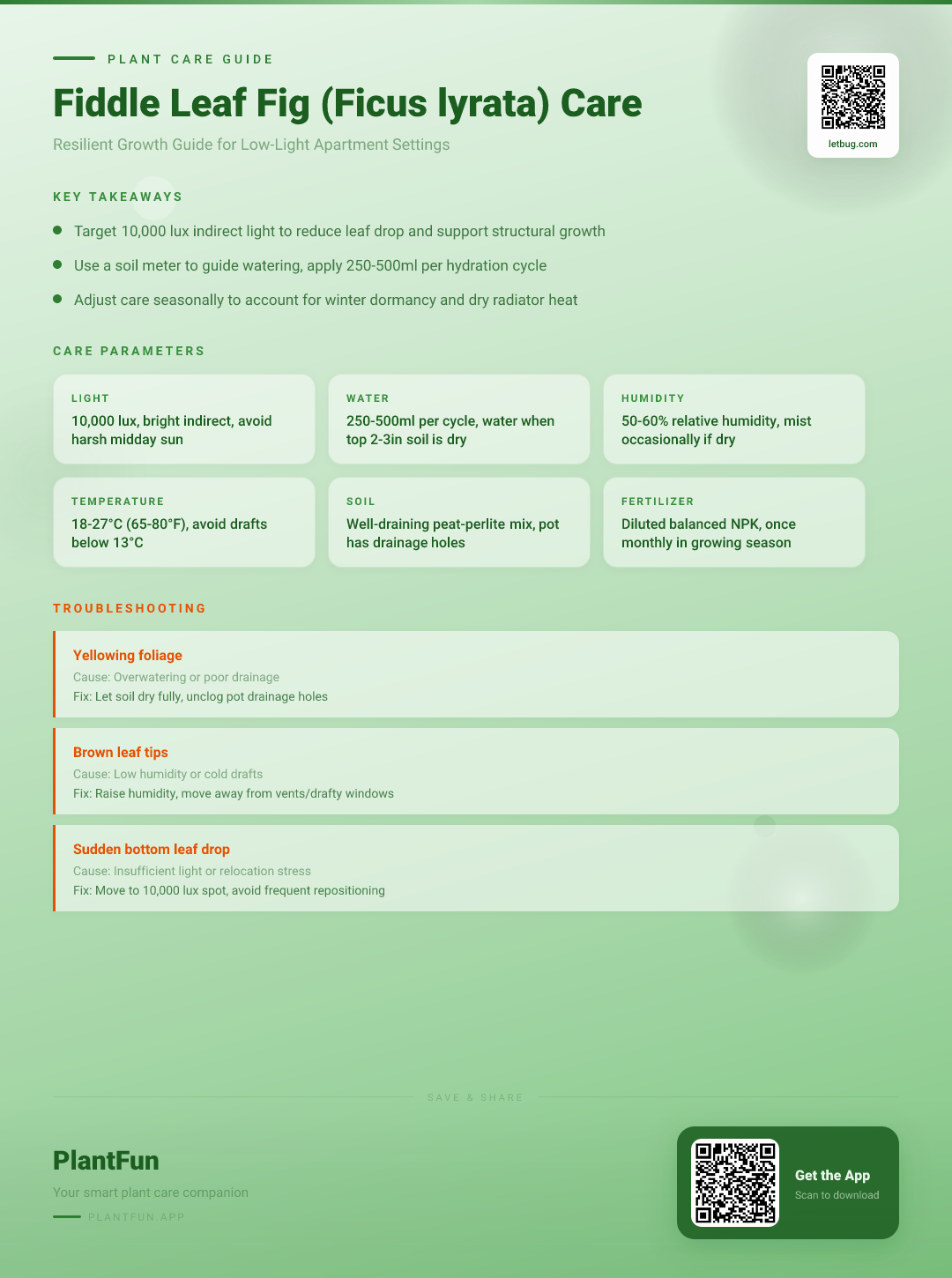
Key Takeaways
- Check soil moisture before watering — overwatering is the #1 killer of houseplants.
- Ensure your plant gets the right amount of light for its species.
- Be patient with recovery — most plants need 2–4 weeks to bounce back.
TL;DR: The Apartment Strategy
Stop watering on a calendar; start watering based on soil moisture at the root level. Your Fiddle Leaf Fig (Ficus lyrata) needs bright, indirect light (aim for 10,000 lux) and consistent humidity between 50-60% (PlantwisePlus Knowledge Bank, 2022). If your plant is dropping leaves, it is likely signaling a struggle with irregular watering or insufficient light intensity typical in urban dwellings. Move it closer to a window, check soil moisture with a finger test before adding 250-500ml of water, and avoid drafty vents.
Quick Care Card: Essential Data
| Feature | Requirement |
|---|---|
| Light | 10,000 Lux (Bright, indirect) |
| Watering | 250-500ml per cycle (Observation-based) |
| Humidity | 50-60% (Use a pebble tray or humidifier) |
| Temperature | 18-27°C (Avoid cold drafts) |
| Soil | Well-draining, peat-based mix |
| Fertilizer | Balanced NPK during growing season |
| Toxicity | Toxic to cats and dogs (ASPCA, 2026) |
My Experience: The “Hope-Based” Mistake
When I first brought my Ficus lyrata into my apartment, I treated it like a houseguest who only needed a “weekly check-in.” I watered it every Sunday like clockwork, regardless of the season or the cloudy weather we had that week. Within a month, I saw yellowing leaves and brown spots. I was drowning the roots. I realized then that in an apartment, where light is limited, the plant’s metabolic rate slows down. I shifted to an observation-driven approach—if the top two inches of soil aren’t dry, the plant doesn’t get water. That single change saved my plant’s life.
The Low-Light Challenge: Why Apartment Fiddle Leaf Figs Struggle
Apartments are notorious for “dim corners.” While we might think a spot is bright, Ficus lyrata evolved in high-light tropical environments (NC State Extension, 2026). When light is insufficient, the plant cannot photosynthesize effectively, leading to energy depletion and leaf abscission (the fancy term for leaf drop). The lack of airflow in enclosed living spaces can further exacerbate root issues if the soil stays wet for too long.
Understanding Your Light: How to Measure and Maximize 10,000 Lux Indoors
Light intensity is the most critical variable. You can use a smartphone light meter app to check if your spot hits 10,000 lux. If you are consistently below this, the plant will struggle to maintain its foliage density.
- North-facing windows: Usually inadequate; consider supplemental LED grow lights.
- South/West-facing windows: Ideal, but use a sheer curtain to prevent direct leaf scorch.
- Maximizing light: Clean your windows. A layer of dust can reduce light transmission by up to 20%.
Hydration Science: Why ‘Once a Week’ Kills Your Ficus and How to Use a Soil Meter
Watering should be dictated by evaporation rates, not the calendar. Use a moisture meter or the finger test: insert your finger into the soil up to the second knuckle. If you feel moisture, wait. When you do water, saturate the soil until water runs freely through the drainage holes, then discard excess water from the saucer. This practice prevents the root rot often caused by stagnant, waterlogged soil (NC State Extension, 2026).
Step-by-Step Care Guide: From Weekly Cleaning to Structural Pruning
- Cleaning: Wipe leaves with a damp cloth every 14 days. This removes dust that blocks sunlight.
- Rotation: Turn the pot 90 degrees every time you water to ensure even growth toward the light source.
- Pruning: If the plant becomes “leggy,” perform structural pruning just above a node (where a leaf meets the stem) to encourage branching.
Voice Search FAQ
- Why is my Fiddle Leaf Fig losing its bottom leaves? This is often a sign of uneven watering or insufficient light at the base of the plant. Check your light levels and ensure the root ball isn’t staying soggy.
- Can I move my Fiddle Leaf Fig into a room with only north-facing windows? You can, but you will likely need to supplement with a high-output grow light to maintain the 10,000 lux threshold.
- How do I know if my apartment has enough light for a Ficus lyrata? If you cannot read a book comfortably in the spot at midday without artificial light, it is likely too dark for a healthy Fiddle Leaf Fig.
Seasonal Care Calendar: Adapting Your Routine
- Spring/Summer: Increase watering frequency as light levels and temperatures rise. Feed monthly with a balanced fertilizer.
- Autumn/Winter: Growth slows down significantly. Reduce watering frequency. Keep the plant away from radiator heat, which creates the dry, low-humidity air that causes leaf edges to crisp.
Common Mistakes to Avoid
- Mistake: Using a pot without drainage holes. What happens: Water accumulates at the bottom, leading to root rot. Instead: Always use a nursery pot inside a decorative cachepot.
- Mistake: Relocating the plant frequently. What happens: The plant suffers “relocation stress,” resulting in leaf drop. Instead: Find one bright spot and keep it there.
Troubleshooting: Interpreting Brown Spots vs. Yellowing Foliage
Leaf Yellowing
Symptom: Lower leaves turn yellow and eventually fall off.
Likely cause: Overwatering or poor drainage.
Fix:
- Check soil moisture; let it dry out more between waterings.
- Ensure the pot has proper drainage holes.
Brown Spots on Leaves
Symptom: Patches of dark brown/black appear on leaves.
Likely cause: Root health issues often caused by excessive moisture or fungal pathogens (Astuti & Mufrodi, 2019).
Fix:
- Assess the root system for signs of decay.
- Improve airflow around the plant.
References
- PlantwisePlus Knowledge Bank. (2022). Ficus lyrata (fiddle-leaf fig). https://doi.org/10.1079/pwkb.species.24125. Accessed 2026-03-18.
- Astuti, E.; Mufrodi, Z. (2019). The Utilization of Fiddle-Leaf Fig Waste Into Food Preservative. Jurnal Bahan Alam Terbarukan. https://doi.org/10.15294/jbat.v8i1.19859. Accessed 2026-03-18.
- ASPCA. (2026). Toxic and Non-Toxic Plants List — ASPCA. https://www.aspca.org/pet-care/animal-poison-control/toxic-and-non-toxic-plants. Accessed 2026-03-18.
- NC State Extension. (2026). Fiddle Leaf Fig Care — NC State Extension Gardener Plant Toolbox. https://plants.ces.ncsu.edu/plants/fig-care/. Accessed 2026-03-18.
Optional Helper: Plantfun.App
Plantfun.App identifies your plants by photo, diagnoses pests and diseases with clear fixes, and creates personalised watering and light schedules that adapt to your home conditions — a handy companion for putting this guide into daily practice.
Found an error or have suggestions? We'd love your feedback.
Need help identifying this problem?
Get instant identification, personalized care schedules, and effective pest treatment plans directly on your phone.
Sponsored • We may earn a commission from app downloads
Related Guides
Fiddle Leaf Fig in a Small Apartment: The Essential Care Guide for Resilient Growth
Maximize your Fiddle Leaf Fig’s health in tight spaces. Master exact lighting, weekly watering schedules, and small-apartment pruning for a lush, vertical tree.
Care GuideThe Complete Fiddle Leaf Fig Care Checklist for Resilient Growth in Small Urban Apartments
Stop guessing at Fiddle Leaf Fig care for your small urban apartment. Get 7 actionable, measurable checklist items that prevent leaf drop and promote lush, resilient growth all year long.
Care GuideFiddle Leaf Fig in a Typical Apartment: The Complete Seasonal Care Guide for Resilient Growth
Transform your Fiddle Leaf Fig into a thriving centerpiece. Follow our seasonal care checklist for exact light levels and watering triggers to prevent leaf drop.
Pest ControlAnts on Plants: What They Mean and What to Do
Ants usually aren't eating your plant. They are farming other pests.