
Key Takeaways
- Check soil moisture before watering — overwatering is the #1 killer of houseplants.
- Ensure your plant gets the right amount of light for its species.
- Be patient with recovery — most plants need 2–4 weeks to bounce back.
TL;DR: To keep your Fiddle Leaf Fig thriving in an apartment, provide 15,000-25,000 lux of bright indirect light, maintain 50-60% humidity, and water only when the top 2-3 inches of soil are dry. Avoid drafts and overwatering, which are the leading causes of leaf drop. Always ensure your pot has drainage, as the Ficus lyrata is highly sensitive to root rot (NC State Extension, 2026).
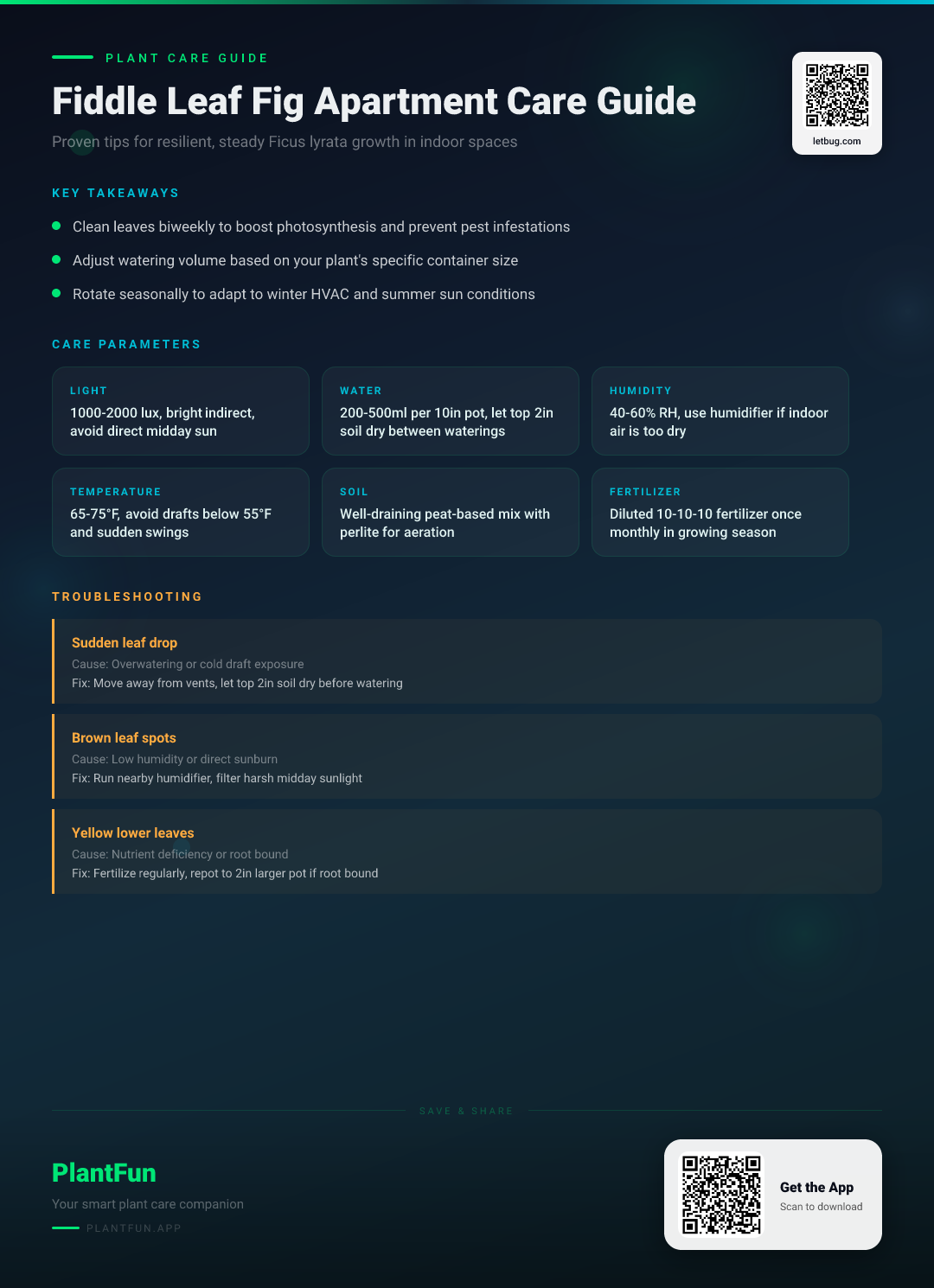
Quick Care Card: The Fiddle Leaf Fig Apartment Essentials
| Feature | Requirement |
|---|---|
| Light | 15,000-25,000 lux (Bright Indirect) |
| Water | When top 2-3 inches of soil are dry (every 10-14 days) |
| Humidity | 50-60% Relative Humidity |
| Temperature | 65-80°F (18-27°C) |
| Soil | Fast-draining, chunky aroid mix |
| Fertilizer | Balanced liquid fertilizer monthly (Spring/Summer) |
| Toxicity | Toxic to cats and dogs (ASPCA, 2026) |
My Experience
When I first brought home my first Ficus lyrata, I made the classic mistake of placing it directly in front of a drafty, west-facing apartment window during winter. Within weeks, the bottom leaves began to yellow and drop. I learned the hard way that this plant doesn’t just need light; it needs consistency. By shifting it to a more stable location and adjusting my watering to match the evaporation rate of my dry apartment, I turned a struggling stick into a structural masterpiece.
Why Apartments Challenge the Fiddle Leaf Fig: Understanding Native Needs vs. Your Living Room
In its native tropical environment, the Fiddle Leaf Fig grows as an epiphyte, often starting in the canopy of other trees. It is accustomed to high ambient humidity and filtered, bright light. In an apartment, these conditions are often replaced by inconsistent airflow from HVAC systems and low light levels. Failing to replicate these canopy conditions is why many struggle with Ficus lyrata care for beginners.
Measuring Your Environment: Lux, Humidity, and Temperature Ranges
To succeed, you must think like a scientist. Use a light meter app to ensure your spot hits the 15,000-25,000 lux threshold. If your home falls below 65°F (18°C), the plant’s metabolism slows, increasing the risk of root rot. For accurate humidity, keep a digital hygrometer nearby to ensure you hit that 50-60% target (PlantwisePlus Knowledge Bank, 2022).
The Watering Science: Calculating Milliliters for Your Container Size
Watering isn’t about a schedule; it’s about hydration. For a standard 10-inch nursery pot, I typically use roughly 500-700ml of room-temperature water. Always wait until the top 2-3 inches feel dry to the touch. This method prevents the moisture stagnation that leads to leaf spot (NC State Extension, 2026).
Correcting the Most Common Apartment Mistakes: A Diagnostic Checklist
- Mistake: Using a pot without drainage holes. What happens: Water pools at the bottom, rotting the roots. Instead: Use a nursery pot inside a decorative cachepot.
- Mistake: Placing the plant near a radiator or AC vent. What happens: Sudden temp swings cause leaf abscission. Instead: Keep at least 5 feet away from HVAC vents.
- Mistake: Infrequent dusting. What happens: Photosynthesis is inhibited by debris. Instead: Wipe leaves with a damp cloth every two weeks.
Why is my Fiddle Leaf Fig dropping leaves suddenly?
Symptom: Leaves yellow and fall off, usually starting from the bottom.
Likely cause: Overwatering or a sudden environmental change (like moving the plant).
Fix:
- Check the root ball for signs of rot (mushy, dark roots).
- Ensure you are waiting for the top 2 inches of soil to dry before the next watering.
How do I know if my Fiddle Leaf Fig needs more sunlight?
Symptom: Small leaf growth and leggy, stretched-out stems.
Likely cause: Insufficient light intensity (under 10,000 lux).
Fix:
- Move the plant within 2-3 feet of a south or east-facing window.
- Supplement with a full-spectrum LED grow light if necessary.
Can I use a humidifier to fix brown spots on my Fiddle Leaf Fig?
Symptom: Dry, crispy brown edges or spots.
Likely cause: Low ambient humidity or inconsistent watering.
Fix:
- Place a dedicated humidifier nearby to maintain 50-60% humidity.
- Group with other plants to create a micro-climate (PlantwisePlus Knowledge Bank, 2022).
The Seasonal Rotation Plan: Adjusting Care from Winter HVAC to Summer Balconies
In summer, your plant thrives with more light and faster growth. In winter, pull it back from cold glass surfaces. According to the NC State Extension (2026), winter requires significantly less water due to the reduced rate of transpiration in cooler temperatures.
Step-by-Step Recovery: Saving a Root-Bound or Overwatered Ficus lyrata
- Remove the plant from the pot and inspect the root system.
- Trim any black, mushy roots using sanitized shears.
- Repot in fresh, well-draining soil (aroid mix with bark and perlite).
- Water sparingly until the plant shows new growth.
Maintenance Techniques: Cleaning Leaves for Optimal Photosynthesis
Dust blocks light. I use a microfiber cloth dipped in diluted neem oil or water to gently clean both sides of the leaves once every two weeks. This simple task is often the difference between a stalled plant and one that thrives (Astuti & Mufrodi, 2019).
Advanced Care: When to Fertilize and Prune for a Bushy Shape
To encourage branching, I prune the leader (the top growing point) in early spring. This forces the plant to divert energy to dormant nodes further down the stem, resulting in a fuller, bushier appearance.
Optional Helper: Plantfun.App
Plantfun.App identifies your plants by photo, diagnoses pests and diseases with clear fixes, and creates personalised watering and light schedules that adapt to your home conditions — a handy companion for putting this guide into daily practice.
Summary: The Resilient Plant Owner’s Workflow
- Check moisture weekly.
- Wipe leaves bi-weekly.
- Rotate the pot 90 degrees every time you water to ensure even growth.
- Monitor for pests, especially spider mites, which love the dry air of apartments.
References
- PlantwisePlus Knowledge Bank. (2022). Ficus lyrata (fiddle-leaf fig). https://doi.org/10.1079/pwkb.species.24125. Accessed 2026-03-14.
- Astuti, E.; Mufrodi, Z. (2019). The Utilization of Fiddle-Leaf Fig Waste Into Food Preservative. Jurnal Bahan Alam Terbarukan. https://doi.org/10.15294/jbat.v8i1.19859. Accessed 2026-03-14.
- ASPCA. (2026). Toxic and Non-Toxic Plants List — ASPCA. https://www.aspca.org/pet-care/animal-poison-control/toxic-and-non-toxic-plants. Accessed 2026-03-14.
- NC State Extension. (2026). Fiddle Leaf Fig — NC State Extension Gardener Plant Toolbox. https://plants.ces.ncsu.edu/plants/fig-care/. Accessed 2026-03-14.
Found an error or have suggestions? We'd love your feedback.
Need help identifying this problem?
Get instant identification, personalized care schedules, and effective pest treatment plans directly on your phone.
Sponsored • We may earn a commission from app downloads
Related Guides
The Complete Fiddle Leaf Fig Care Checklist for Resilient Growth in Small Urban Apartments
Stop guessing at Fiddle Leaf Fig care for your small urban apartment. Get 7 actionable, measurable checklist items that prevent leaf drop and promote lush, resilient growth all year long.
Care GuideFiddle Leaf Fig in a Typical Apartment: The Complete Seasonal Care Guide for Resilient Growth
Master Fiddle Leaf Fig care with our seasonal calendar. Discover 4 precise light, water, and humidity thresholds that guarantee growth in your apartment today.
Care GuideFiddle Leaf Fig in a Dim Apartment: The Budget-Friendly Strategy for Resilient Growth
Transform your struggling Fiddle Leaf Fig into a resilient giant. Master precise watering, light placement, and budget-friendly feeding to see vibrant new growth.
Pest ControlAnts on Plants: What They Mean and What to Do
Ants usually aren't eating your plant. They are farming other pests.