
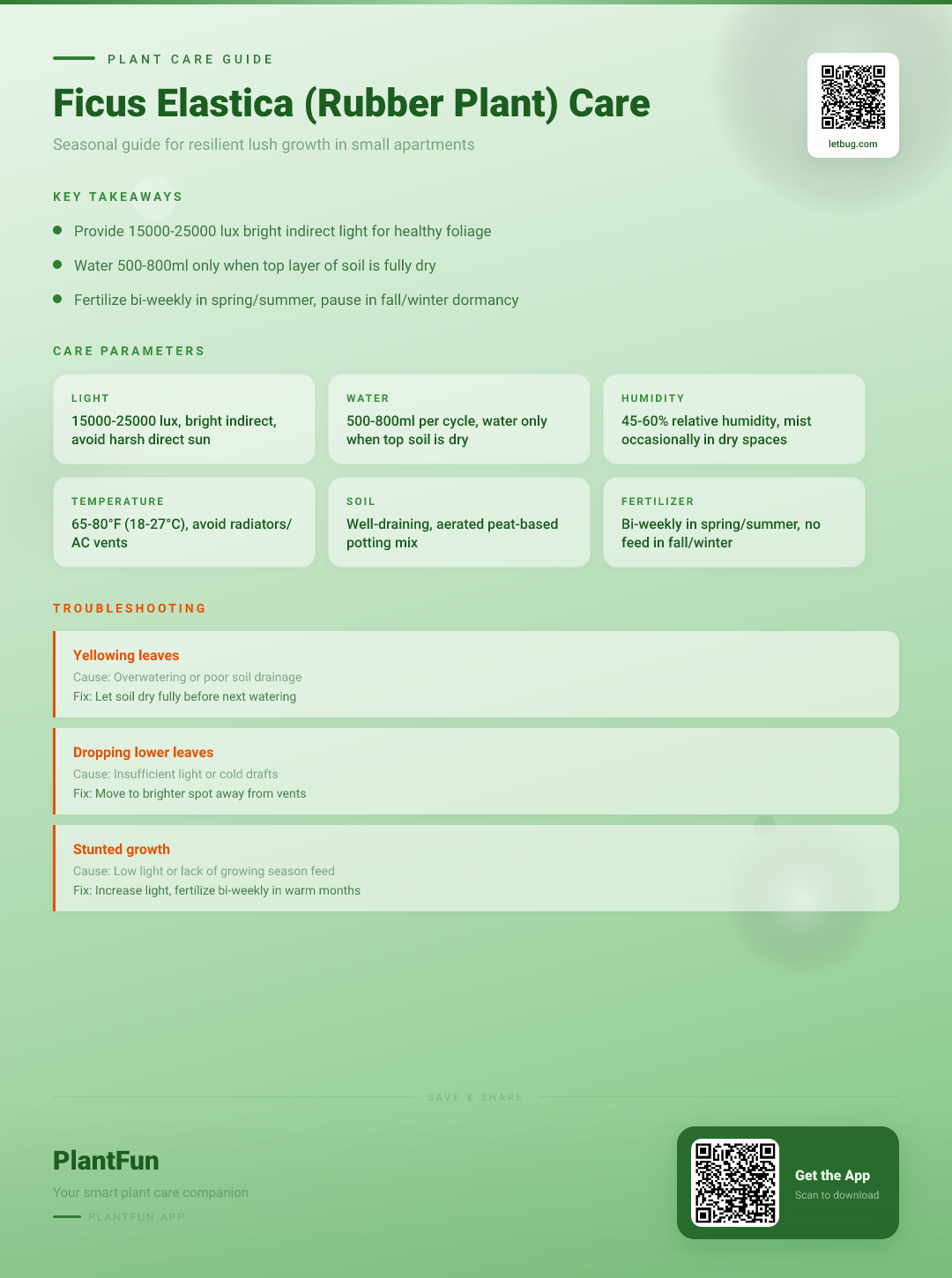
Key Takeaways
- Check soil moisture before watering — overwatering is the #1 killer of houseplants.
- Ensure your plant gets the right amount of light for its species.
- Be patient with recovery — most plants need 2–4 weeks to bounce back.
TL;DR: To keep your Ficus elastica thriving in an apartment, place it in bright, indirect light (15,000–25,000 lux). Water with 500ml–800ml only when the top 2 inches of soil are dry. Maintain 45–60% humidity and avoid drafts. Remember, this plant is toxic to pets (ASPCA, 2026).
Quick Care Card: Essential Thresholds for Ficus Elastica
| Factor | Requirement |
|---|---|
| Light | 15,000–25,000 lux (Bright, indirect) |
| Water | 500ml–800ml when top 2” soil is dry |
| Humidity | 45–60% |
| Temperature | 65–80°F (18–27°C) |
| Soil | Well-draining, peat-based mix |
| Fertilizer | Balanced liquid feed, bi-weekly in summer |
| Toxicity | Toxic to cats and dogs (ASPCA, 2026) |
My Experience
When I first brought my Ficus elastica into my studio apartment, I made the mistake of placing it directly in a north-facing corner thinking it would “adapt.” Within a month, it became leggy and dropped its bottom leaves. I learned that in small spaces, light intensity drops off rapidly away from windows. I had to move it to a pedestal near my largest window to hit that 15,000 lux threshold. Now, it is a centerpiece of my living space.
Why Your Apartment is Perfect (and Tricky) for a Rubber Plant
Apartments provide consistent temperatures, which the Ficus elastica loves (NC State Extension, 2026). However, the trade-off is often lower light levels and poor airflow. Managing your rubber plant in a small apartment requires being intentional about its placement and routine.
Measuring Light: Aiming for 15,000-25,000 Lux in Limited Spaces
In a small apartment, you cannot rely on “bright light” being everywhere. I recommend using a light meter app to ensure your plant receives 15,000–25,000 lux. If you notice your plant leaning heavily toward the window, it is signaling a lack of intensity; rotate it weekly to ensure even growth.
Watering Mechanics: Why 500ml-800ml Matters Based on Soil Dryness
I avoid a strict weekly schedule. Instead, I perform the “finger test”: stick your finger 2 inches into the soil. If it feels dry, apply 500ml–800ml of water. This specific range helps prevent waterlogging, which is a common cause of root stress in containers.
Maintaining 45-60% Relative Humidity in Dry Urban Environments
Heating systems in winter can drop indoor humidity below 30%. I use a small pebble tray or a humidifier to keep the ambient moisture between 45% and 60%, which is ideal for the foliage’s health (NC State Extension, 2026).
Temperature Control: Keeping Between 65-80°F (18-27°C) Year-Round
Fluctuations are the enemy. Keep your plant away from direct airflow from heaters or AC units to prevent thermal shock, which can cause sudden leaf drop.
Spring & Summer: Boosting Growth with Bi-Weekly Fertilization
During the active growing season, the plant’s metabolic rate increases. I provide a balanced liquid fertilizer diluted to half-strength every two weeks to support robust leaf development.
Autumn & Winter: The Dormancy Routine for Minimalist Growth
As light intensity decreases, so should your care. Reduce water frequency and stop fertilizing entirely. Allow the soil to dry out a bit more between waterings to reflect the plant’s slower growth rate.
FAQ: Why is my Rubber Plant dropping lower leaves in my living room?
Leaf drop is often a reaction to environmental instability, such as sudden shifts in light or temperature. Ensure the plant isn’t getting hit by cold drafts, and check that your soil isn’t staying soggy (Esser, 1981).
FAQ: Can I keep my Rubber Plant near a radiator or AC vent?
No. This causes rapid moisture loss and temperature stress. Always aim to place your Ficus in a stable microclimate away from active climate control vents.
Troubleshooting: Correcting Yellowing Leaves and Stunted Growth
Yellowing Lower Leaves
Symptom: The oldest leaves turn yellow and fall off.
Likely cause: Overwatering leading to root suffocation.
Fix:
- Check for drainage in the pot.
- Allow the soil to dry further before the next watering.
Stunted Growth
Symptom: The plant stops producing new leaves even in summer.
Likely cause: Insufficient light or root-bound conditions.
Fix:
- Increase light exposure to at least 15,000 lux.
- Check if roots are circling the bottom of the pot and consider repotting.
Common Apartment Mistakes: Cleaning Dust and Preventing Overcrowding
- Mistake: Letting dust build up on leaves. What happens: Photosynthesis is blocked. Instead: Wipe leaves with a damp cloth every two weeks.
- Mistake: Crowding the plant with other items. What happens: Poor airflow increases disease risk (Esser, 1981). Instead: Give your plant at least 12 inches of clearance on all sides.
References
- PlantwisePlus Knowledge Bank. (2022). Ficus elastica (rubber plant). https://doi.org/10.1079/pwkb.species.24090. Accessed 2026-03-19.
- Esser, R. (1981). Distribution of Aphelenchoides fragariae in Leaves of Ficus elastica and Asplenium nidus. Plant Disease. https://doi.org/10.1094/pd-65-425. Accessed 2026-03-19.
- ASPCA. (2026). Toxic and Non-Toxic Plants List — ASPCA. https://www.aspca.org/pet-care/animal-poison-control/toxic-and-non-toxic-plants. Accessed 2026-03-19.
- NC State Extension. (2026). Ficus Elastica — NC State Extension Gardener Plant Toolbox. https://plants.ces.ncsu.edu/plants/plant-care/. Accessed 2026-03-19.
Optional Helper: Plantfun.App
Plantfun.App identifies your plants by photo, diagnoses pests and diseases with clear fixes, and creates personalised watering and light schedules that adapt to your home conditions — a handy companion for putting this guide into daily practice.
Found an error or have suggestions? We'd love your feedback.
Need help identifying this problem?
Get instant identification, personalized care schedules, and effective pest treatment plans directly on your phone.
Sponsored • We may earn a commission from app downloads
Related Guides
Ficus elastica 'Burgundy' Care in Low-Light Apartments: A Seasonal Guide for Resilient Growth
Transform your Ficus elastica into a thriving apartment centerpiece. Learn exact light, water, and seasonal schedules to prevent leaf drop and boost growth now.
Care GuideThe Complete Ficus Elastica (Rubber Plant) Care Guide for Small Apartments: Get Lush Resilient Growth
Grow a lush, resilient rubber plant even in your small apartment. Get exact light levels, watering amounts, and space-saving tips for glossy, low-fuss foliage that won’t outgrow its nook.
Care GuideThe Complete Rubber Plant Care Guide for Small Urban Apartments: Lush Resilient Growth
Grow a lush, compact rubber plant even in a tiny apartment. Get exact light levels, watering amounts, space-saving pruning tips, and a free printable care checklist to skip guesswork.
Pest ControlAnts on Plants: What They Mean and What to Do
Ants usually aren't eating your plant. They are farming other pests.