
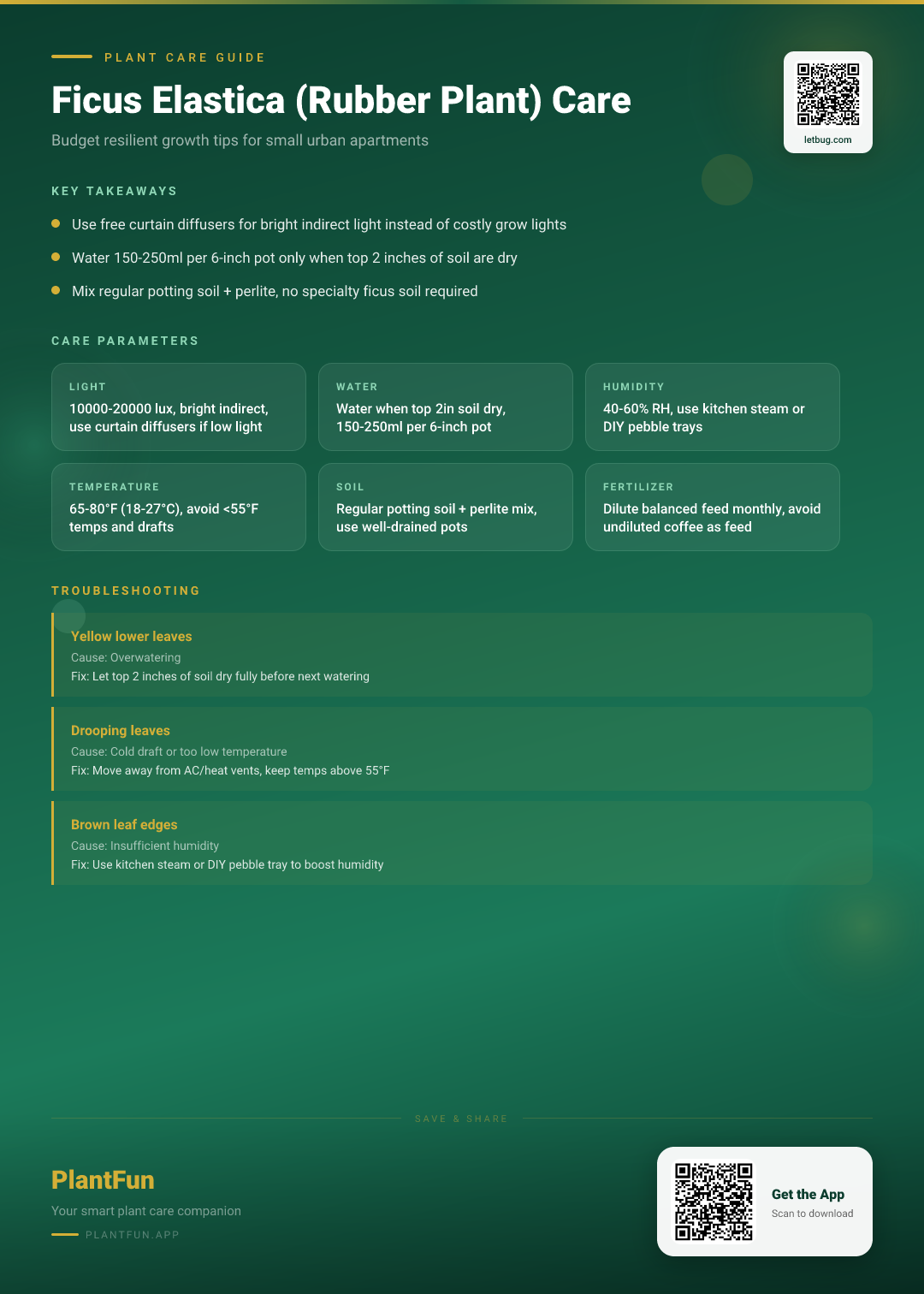
Key Takeaways
- Check soil moisture before watering — overwatering is the #1 killer of houseplants.
- Ensure your plant gets the right amount of light for its species.
- Be patient with recovery — most plants need 2–4 weeks to bounce back.
Quick Care Card
| Care Factor | Measurable Threshold for Small Apartments |
|---|---|
| Light | 10,000-20,000 lux bright indirect light (PlantwisePlus Knowledge Bank, 2022) |
| Water | Water only when top 2 inches of soil are dry; 150-250ml per watering for 6-inch pots |
| Humidity | 40-60% relative humidity (PlantwisePlus Knowledge Bank, 2022) |
| Temperature | 65-80°F (18-27°C); never expose to temps below 55°F (13°C) |
| Soil | 2 parts regular all-purpose potting soil + 1 part perlite (no specialty ficus mix needed) |
| Fertilizer | Once every 3 months in growing season, using free homemade compost tea |
| Toxicity | Toxic to cats, dogs, and humans if ingested (ASPCA, 2026) |
Why Rubber Plants Are Perfect for Typical Apartment Conditions
Native to Southeast Asian forest understories, ficus elastica evolved to tolerate fluctuating light, humidity, and temperature conditions that match exactly what most small urban apartments offer (PlantwisePlus Knowledge Bank, 2022). Their upright growth habit means they take up minimal floor space, and they require far less frequent maintenance than finicky tropical plants like calatheas or fiddle leaf figs.
Myth vs Reality: Myth: Rubber plants need constant high humidity and perfectly stable temperatures to thrive. Reality: They can tolerate 30-70% RH and 60-85°F temperature swings common in apartment buildings with only minor, zero-cost adjustments.
Note: Keep plants out of reach of pets and small children, as their sap causes mild gastrointestinal irritation if eaten (ASPCA, 2026).
Step 1: Apartment Light Placement Guide
Rubber plant light requirements sit at 10,000-20,000 lux of bright indirect light, the sweet spot for most apartment window locations (PlantwisePlus Knowledge Bank, 2022). This is the light level 3-5 feet away from a south or west-facing window, or right on the sill of a north-facing window.
Quick test: Hold your hand up at midday where you plan to place the plant. If you see a faint, soft shadow, the light is perfect. If the shadow is sharp and dark, the light is too direct and will burn leaves.
Budget hack: If your only window gets harsh direct sun, use sheer curtains you already own to diffuse the light, no expensive grow lights required. If you have very limited natural light, a spare LED desk lamp left on for 8 hours a day will meet the minimum 10,000 lux requirement.
Step 2: Exact Watering Schedule for Apartments
Wondering how often to water rubber plant in an apartment? Follow this science-backed rule: water only when the top 2 inches of soil are completely dry (PlantwisePlus Knowledge Bank, 2022).
Quick test: Stick your index finger all the way down to the second knuckle into the soil. If the soil is dry at that depth, it’s time to water. For a standard 6-inch pot, use 150-250ml of water (about half a standard coffee mug) per watering, enough to moisten the root ball without saturating the soil.
Seasonal adjustments:
- Rubber plant summer watering schedule: Check soil every 7-10 days, use the full 250ml per watering when dry
- Winter: Check soil every 14-21 days, use only 150ml per watering when dry
If you struggle with overwatering, check our guide to preventing root rot in indoor plants for more zero-cost tips.
Step 3: Budget Humidity Hacks for Dry Apartment Air
Rubber plant humidity needs sit at 40-60% RH, a range most apartments fall below in winter when heating runs constantly (PlantwisePlus Knowledge Bank, 2022). Skip expensive humidifiers and use these free hacks:
- Place the plant near your kitchen stove when you cook: the steam from boiling water or cooking adds 10-15% local humidity for free
- DIY pebble tray: Use a leftover takeout tray, fill with washed pebbles from your yard or sidewalk, add water until it reaches halfway up the pebbles, and set the pot on top. Evaporation from the tray boosts humidity directly around the plant
- Group it with other houseplants you already own: plants release moisture through transpiration, creating a naturally more humid microclimate
Step 4: Temperature Rules for Fluctuating Apartment Thermostats
The ideal temperature range for rubber plants is 65-80°F (18-27°C), and they will suffer damage if exposed to temperatures below 55°F (13°C) for more than 2 hours (PlantwisePlus Knowledge Bank, 2022).
Wondering why is my rubber plant dropping leaves? The most common cause is placement within 3 feet of drafty AC vents, heating units, or exterior doors. Sudden 10+ degree temperature swings shock the plant, causing it to drop leaves to conserve energy. Move the plant at least 3 feet away from all vents and drafty openings to stop leaf drop.
Step 5: Low-Cost Soil & Potting Tips
You don’t need expensive specialty ficus soil for healthy growth. This rubber plant soil mix DIY uses items you already have or can get for free:
- 2 parts regular all-purpose potting soil (you can reuse leftover soil from old plants, just sift out dead roots first)
- 1 part perlite (collect free perlite from yard waste piles, or crush clean styrofoam packaging into small pellets as a zero-cost alternative)
For pots, shop at local thrift stores for ceramic or plastic pots. If the pot doesn’t have a drainage hole, drill one yourself using a standard tile/glass drill bit you already own, no need to buy new expensive planters. Only repot every 2-3 years, when you see roots growing out of the drainage holes, to avoid shocking the plant.
For more small-space potting tips, check our guide to small apartment plant placement hacks.
Seasonal Care Calendar
Adjust your care routine to match typical apartment climate changes throughout the year:
- Jan-Feb (Winter dormancy): Follow rubber plant winter care for apartments rules: water only every 2-3 weeks, skip fertilizer, keep plants at least 3 feet away from space heaters
- Mar-May (Spring growing season): Check soil every 7-10 days, start fertilizing once every 3 months, prune leggy growth to keep the plant compact for small spaces
- Jun-Aug (Summer): Use 250ml of water per watering for 6-inch pots, rotate the plant 15 degrees every week to encourage even growth, use sheer curtains to diffuse direct midday sun
- Sep-Nov (Fall): Reduce watering frequency, stop fertilizing by mid-October, prune any yellow or damaged leaves before winter hits
Common Budget Mistakes to Avoid
- Mistake: Using undiluted leftover coffee as fertilizer to save money What happens: High acidity in undiluted coffee burns root tips, causing brown leaf tips and stunted growth Instead: Dilute leftover coffee 1:10 with water, use only once every 2 months in growing season, or make free compost tea from kitchen scraps for a more balanced nutrient source
- Mistake: Overwatering to skip buying plant food, assuming extra water carries extra nutrients What happens: Soggy soil causes root rot, the leading cause of rubber plant death in apartments (PlantwisePlus Knowledge Bank, 2022) Instead: Follow the exact watering schedule, and use free homemade compost tea for nutrients as outlined in our DIY houseplant fertilizer guide
- Mistake: Repotting too often to save on potting mix, reusing old soil without sifting What happens: Compacted old soil reduces drainage, and repotting before the root ball fills the current pot shocks the plant, leading to leaf drop Instead: Only repot every 2-3 years, sift old soil to remove dead roots before mixing with perlite for better drainage
FAQ
Why is my rubber plant dropping leaves in my apartment?
The most common causes are sudden temperature swings from drafty vents, overwatering, or light levels below 10,000 lux (PlantwisePlus Knowledge Bank, 2022). First check if your plant is within 3 feet of an AC or heating vent, then test the soil moisture 2 inches deep, then measure light levels with a free phone lux meter app to identify the issue.
Can I keep my rubber plant in a dark apartment corner?
Rubber plants can survive light levels as low as 5,000 lux for short periods, but they will grow slowly and become leggy if kept below 10,000 lux long term (PlantwisePlus Knowledge Bank, 2022). If your corner gets no natural light, you can use a spare LED desk lamp you already own for 8 hours a day instead of buying a specialty grow light to meet the minimum light requirement.
How often should I fertilize my rubber plant on a budget?
You only need to fertilize once every 3 months during the spring and summer growing season. The cheapest, zero-cost option is to make compost tea from kitchen scraps: steep 1 cup of chopped banana peels and crushed eggshells in 1 gallon of water for 3 days, strain, and use half of that mix per 6-inch pot. No commercial fertilizer is required for healthy growth.
Troubleshooting Quick Reference
Yellow Lower Leaves
Symptom: Older leaves at the bottom of the plant turn soft yellow and fall off without any brown spots.
Likely cause: Overwatering leading to early root rot.
Fix:
- Stop watering immediately, let the top 3 inches of soil dry completely before watering again
- If the soil is soggy, tip the pot sideways to drain excess water from the drainage holes
Brown Leaf Tips
Symptom: Crispy brown edges on the tips of new and old leaves, no yellow halo around the brown area.
Likely cause: Humidity below 40% or exposure to drafty air from vents. This is one of the most common rubber plant brown tips causes for apartment dwellers.
Fix:
- Move the plant at least 3 feet away from all AC/heating vents and exterior doors
- Place the pot on a DIY pebble tray to boost local humidity by 10-15%
Stunted Leggy Growth
Symptom: New leaves are smaller than older leaves, and the stem grows long and thin with large gaps between leaves.
Likely cause: Light levels below 10,000 lux for 4+ weeks.
Fix:
- Move the plant to a spot 3-5 feet from a south or west-facing window, or place it right on a north-facing windowsill
- Prune the top 2 inches of the leggy stem to encourage bushier, more compact growth that fits small apartment spaces. This is also how to make rubber plant grow faster and fuller without any special supplies
Brown Spots on Leaves
Symptom: Dark brown, mushy spots on the center of leaves, often surrounded by a yellow halo.
Likely cause: Fungal leaf spot from excess water sitting on leaves, or sunburn from direct unfiltered sunlight.
Fix:
- Trim off affected leaves with clean kitchen scissors, wipe the blades with rubbing alcohol between cuts
- Avoid getting water on the leaves when watering, and use a sheer curtain to diffuse direct midday sun
References
- ASPCA. (2026). Toxic and Non-Toxic Plants List — ASPCA. https://www.aspca.org/pet-care/animal-poison-control/toxic-and-non-toxic-plants. Accessed 2026-03-07.
- PlantwisePlus Knowledge Bank. (2022). Ficus elastica (rubber plant). https://doi.org/10.1079/pwkb.species.24090. Accessed 2026-03-07.
- Levines, M. (1921). Studies on Plant Cancers—II. Mycologia. https://doi.org/10.1080/00275514.1921.12016853. Accessed 2026-03-07.
Optional Helper: Plantfun.App
Plantfun.App identifies your plants by photo, diagnoses pests and diseases with clear fixes, and creates personalised watering and light schedules that adapt to your home conditions — a handy companion for putting this guide into daily practice.
Found an error or have suggestions? We'd love your feedback.
Need help identifying this problem?
Get instant identification, personalized care schedules, and effective pest treatment plans directly on your phone.
Sponsored • We may earn a commission from app downloads
Related Guides
The Complete Rubber Plant Care Checklist for Resilient Growth in Small Urban Apartments
Stop stunting your rubber plant’s growth in your apartment. Get 8 actionable care steps, exact light and water thresholds, and a free printable checklist for lush, resilient foliage year-round.
Care GuideThe Complete Rubber Plant Care Checklist for Year-Round Resilient Growth in Typical Apartments
Grow a lush, unkillable rubber plant in your apartment. Get exact light levels, watering amounts, and a free seasonal checklist to avoid yellow leaves and stunted growth all year long.
Care GuideThe Complete Rubber Plant Care Guide for Small Apartments: Tips for Resilient, Lush Growth
Grow a lush, thriving rubber plant even in a cramped city apartment. Get exact light levels, watering amounts, space-saving hacks, and a seasonal care calendar for resilient, pest-free growth all year.
Pest ControlAnts on Plants: What They Mean and What to Do
Ants usually aren't eating your plant. They are farming other pests.