
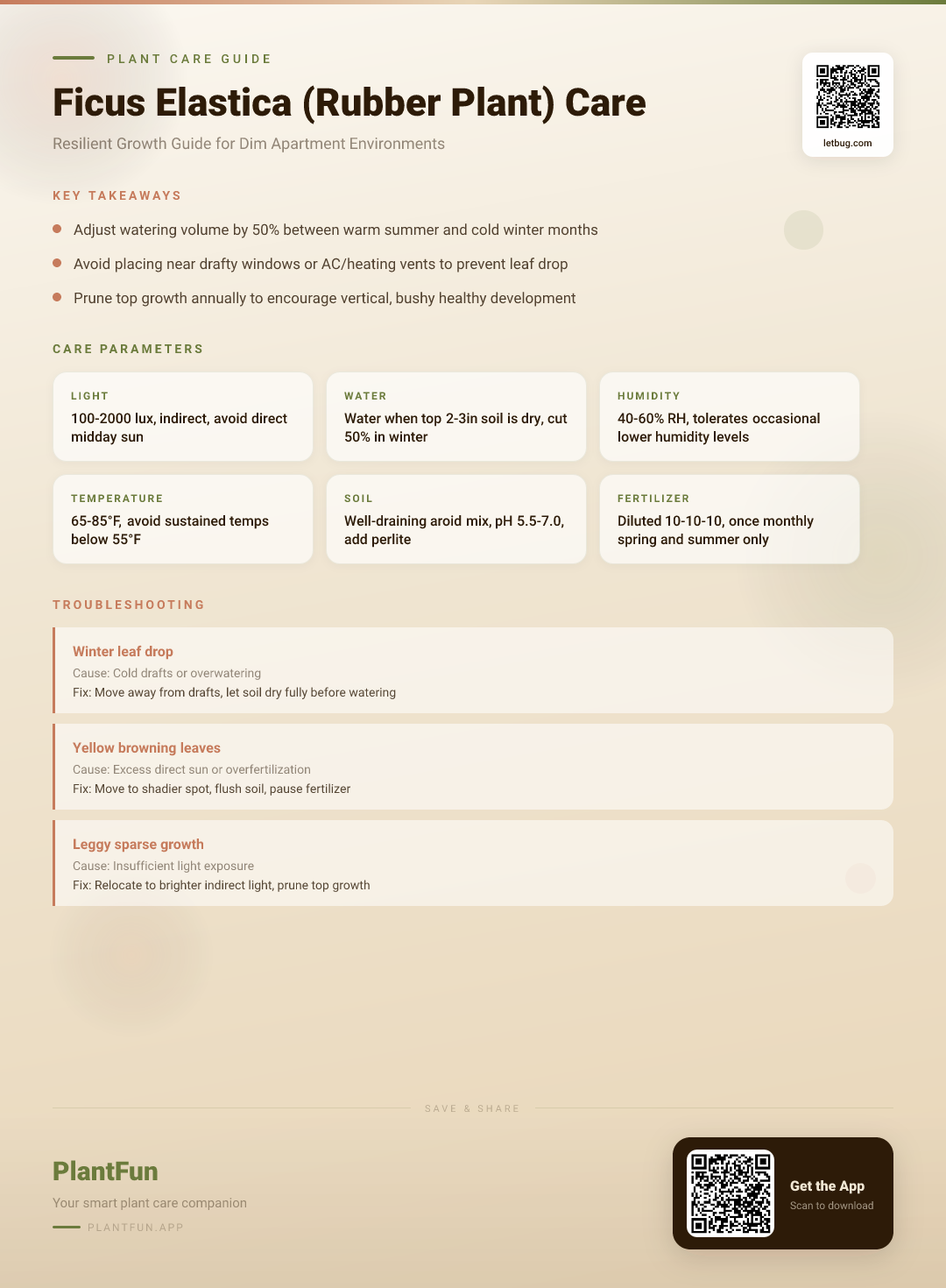
Key Takeaways
- Check soil moisture before watering — overwatering is the #1 killer of houseplants.
- Ensure your plant gets the right amount of light for its species.
- Be patient with recovery — most plants need 2–4 weeks to bounce back.
TL;DR: Your Rubber Plant can survive in low-light apartments by mimicking a dry tropical forest cycle. During winter, reduce watering significantly and provide the highest available light. During summer, allow for more frequent hydration as light levels rise. Never let the plant sit in standing water, and keep a consistent temperature above 65°F (18°C).
Quick Care Card: Essential Data for Ficus Elastica
| Feature | Requirement |
|---|---|
| Light | Bright, indirect (10,000–20,000 lux) |
| Water | Allow top 2-3 inches of soil to dry out |
| Humidity | 40%–60% (average household) |
| Temperature | 65°F–85°F (18°C–29°C) |
| Soil | Well-draining, peat-based mix with perlite |
| Fertilizer | Balanced liquid feed, monthly during active growth |
| Toxicity | Toxic to cats and dogs (ASPCA, 2026) |
Why Your Rubber Plant Struggles in Typical Apartments
When I first bought my Ficus elastica, I made the mistake of placing it in a deep corner of my living room, assuming its dark, waxy leaves meant it enjoyed the shadows. Within a month, the lower leaves began yellowing and dropping. The reality is that while the Rubber Plant is often sold as a “low-light” tolerant species, it is actually a tree that naturally thrives in tropical, sun-drenched environments (NC State Extension, 2026). Apartments typically lack the intense, broad-spectrum light that supports the heavy leaf production this plant requires for structural integrity.
The Science of Resilience: Natural Habitat vs. The Living Room Corner
Understanding the biology of Ficus elastica is key to keeping it alive. In its natural environment, the tree employs a robust vascular system to transport nutrients to its large, leathery leaves (PlantwisePlus Knowledge Bank, 2022). When light is insufficient, the plant ceases “expensive” energy-intensive processes, such as maintaining lower, less-efficient leaves, leading to leaf drop. Furthermore, pathogens such as leaf-spotting nematodes can become more problematic if the plant is chronically stressed by low light and inconsistent moisture (Esser, 1981).
Measuring Your Space: Light, Humidity, and Temperature Thresholds
If you are living in an apartment, you must optimize your “micro-climate.” Aim for 10,000 to 20,000 lux; you can use a smartphone light meter app to confirm if your corner meets this threshold. If you fall below 5,000 lux, you will notice significant stem elongation (etiolation) as the plant stretches for the sun.
The Seasonal Routine: Adjusting Your Care Calendar for Winter and Summer
- Summer (Growth Phase): Increase water as the plant pushes new leaves. Ensure you are providing consistent indirect light to sustain this growth.
- Winter (Dormancy Phase): Growth slows drastically. Reduce watering by 50% and avoid fertilizing. The biggest risk here is cold drafts from windows or doors, which can trigger stress-induced leaf drop (NC State Extension, 2026).
Step-by-Step: Watering Metrics and Soil Health Assessment
- Use a moisture meter or your finger to check the soil depth. If it feels dry 3 inches down, it is time to water.
- Flush the pot with 200-500ml of water (depending on pot size) until water drains from the bottom.
- Never leave the plant in a saucer of water; root rot is the primary killer of indoor Rubber Plants.
- If your soil remains soggy for more than 48 hours, ensure you are using well-draining soil amended with extra perlite.
Can I keep my Rubber Plant in a dark corner of my bedroom?
Technically, it will survive for a short time, but it will not thrive. If your bedroom has minimal natural light, I highly recommend using a dedicated plant-specific LED grow light to supplement its needs.
Why is my Rubber Plant dropping leaves during the winter months?
Leaf drop is usually a sign of environmental shock. Common culprits include drastic temperature fluctuations or moving the plant to a new location where light levels have suddenly plummeted (NC State Extension, 2026).
How do I know if my Rubber Plant is getting enough light?
Look for “compact growth.” If the distance between the nodes (where leaves meet the stem) is more than 3-4 inches, your plant is begging for more light. A healthy, happy plant will have short, tight spacing between leaves.
Pro-Level Resilience: When to Prune and How to Encourage Vertical Growth
If your plant becomes “leggy,” don’t be afraid to prune. Use a clean, sharp blade to cut just above a node. This signals the plant to branch out, potentially creating a bushier, more attractive specimen. Always wear gloves, as the sap is a skin irritant.
Common Mistakes That Kill Rubber Plants in Small Spaces
- Mistake: Overwatering in low-light conditions. What happens: Roots suffocate and die. Instead: Only water when the soil feels dry to the touch.
- Mistake: Ignoring plant hygiene. What happens: Dust buildup on leaves prevents photosynthesis. Instead: Wipe leaves monthly with a damp cloth.
- Mistake: Placing near heat vents. What happens: Rapid dehydration. Instead: Keep the plant at least 3 feet away from any forced-air heating.
References: Botanical Guidelines and Soil Science Standards
- PlantwisePlus Knowledge Bank. (2022). Ficus elastica (rubber plant). https://doi.org/10.1079/pwkb.species.24090. Accessed 2026-03-19.
- Esser, R. (1981). Distribution of Aphelenchoides fragariae in Leaves of Ficus elastica and Asplenium nidus. Plant Disease. https://doi.org/10.1094/pd-65-425. Accessed 2026-03-19.
- ASPCA. (2026). Toxic and Non-Toxic Plants List — ASPCA. https://www.aspca.org/pet-care/animal-poison-control/toxic-and-non-toxic-plants. Accessed 2026-03-19.
- NC State Extension. (2026). Ficus Elastica — NC State Extension Gardener Plant Toolbox. https://plants.ces.ncsu.edu/plants/ficus-elastica/. Accessed 2026-03-19.
Optional Helper: Plantfun.App
Plantfun.App identifies your plants by photo, diagnoses pests and diseases with clear fixes, and creates personalised watering and light schedules that adapt to your home conditions — a handy companion for putting this guide into daily practice.
Found an error or have suggestions? We'd love your feedback.
Need help identifying this problem?
Get instant identification, personalized care schedules, and effective pest treatment plans directly on your phone.
Sponsored • We may earn a commission from app downloads
Related Guides
Ficus Elastica Care for Apartments: The Seasonal Routine for Resilient Rubber Plant Growth
Boost your Rubber Plant's growth with our seasonal care schedule. Learn exact lux, hydration, and light levels to keep your apartment Ficus thriving year-round.
Care GuideFicus Elastica in Small Apartments: The Essential Rubber Plant Care Guide for Resilient Growth
Transform your Ficus elastica into a resilient centerpiece. Master these 4 exact care thresholds and a simple seasonal routine to ensure lush, consistent growth.
Care GuideFicus Elastica in Small Apartments: The Ultimate Guide to Resilient Rubber Plant Care
Transform your Ficus Elastica into a lush centerpiece. Learn the precise lux levels, watering intervals, and pruning hacks for thriving apartment Rubber Plants.
Pest ControlAnts on Plants: What They Mean and What to Do
Ants usually aren't eating your plant. They are farming other pests.