
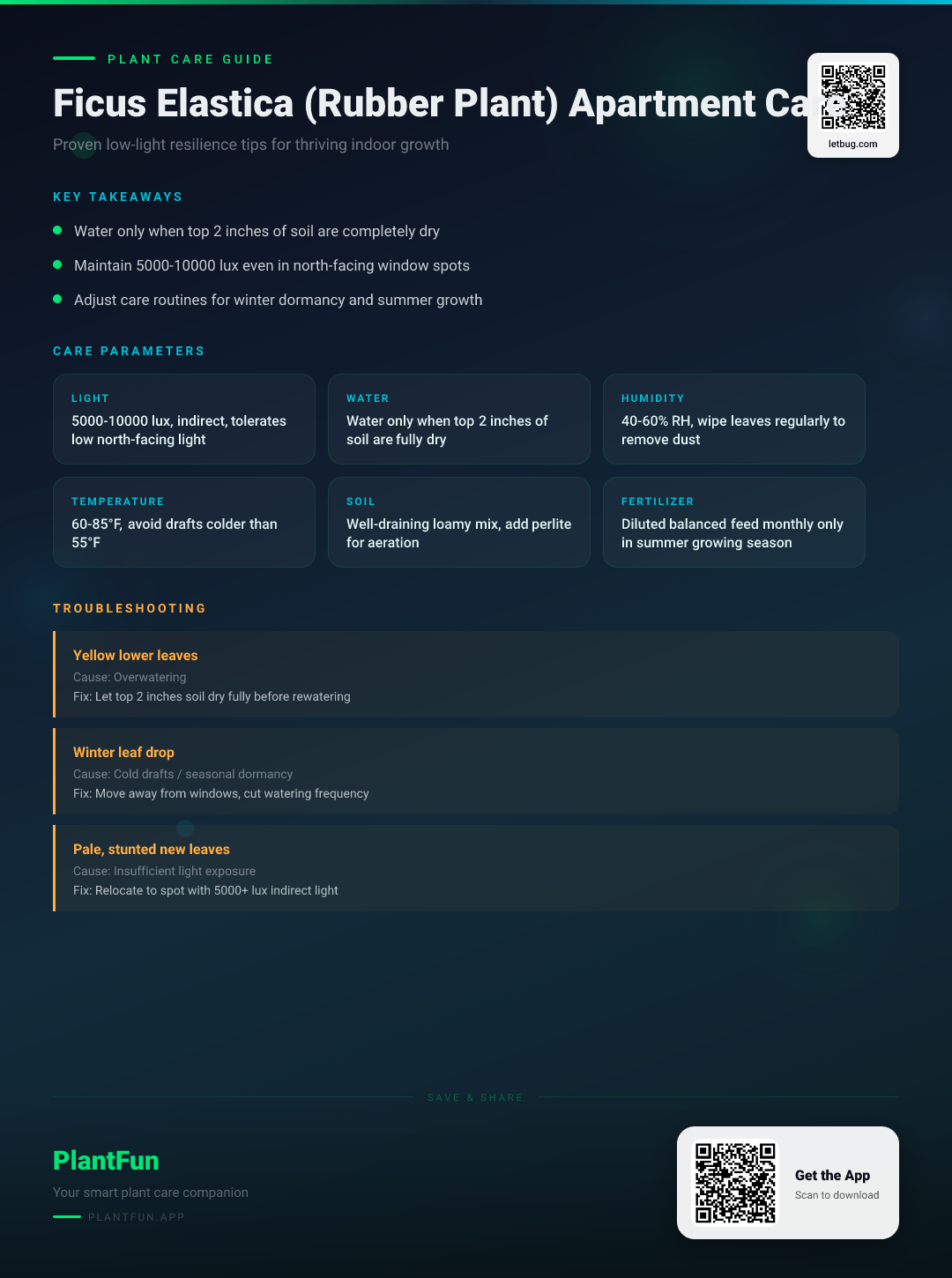
Key Takeaways
- Check soil moisture before watering — overwatering is the #1 killer of houseplants.
- Ensure your plant gets the right amount of light for its species.
- Be patient with recovery — most plants need 2–4 weeks to bounce back.
Ficus Elastica in a Dimly Lit Apartment: The Complete Resilience Care Guide
TL;DR: To keep your Rubber Plant (Ficus elastica) thriving in a dim apartment, prioritize proximity to the nearest window, ensure the top two inches of soil are dry before watering, and drastically reduce moisture during winter. While these plants prefer bright, indirect light, they can adapt to lower light if you eliminate dust from their leaves to maximize photosynthesis (NC State Extension, 2026). Keep them away from pets, as they are toxic if ingested (ASPCA, 2026).
Quick Care Card: Essential Data for Your Ficus Elastica
| Category | Requirement |
|---|---|
| Light | 5,000–10,000 lux (bright, filtered) |
| Watering | When top 2 inches of soil are dry |
| Humidity | 40%–60% (average home) |
| Temperature | 65°F–80°F (18°C–27°C) |
| Soil | Well-draining, peat-based mix |
| Fertilizer | Balanced liquid feed, monthly in summer |
| Toxicity | Toxic to cats and dogs (ASPCA, 2026) |
My Experience
When I first got my own Ficus elastica, I made the mistake of placing it in a dark corner of my studio apartment, thinking it would “adapt” without complaint. Within a month, it dropped its lower leaves like confetti. I learned the hard way that while these plants are resilient, they aren’t magic; they require specific thresholds of light to maintain their metabolism. Once I moved it to a pedestal near my north-facing window, the growth resumed.
Why Your Rubber Plant Struggles in Apartments: The Light-Metabolism Connection
Your rubber plant functions as a solar-powered machine. In a dimly lit apartment, the light intensity is often too low to support the plant’s respiration and growth. When the plant cannot produce enough energy via photosynthesis, it triggers an abscission process—shedding older, less efficient leaves to conserve resources (PlantwisePlus Knowledge Bank, 2022).
Light Requirements: How to Achieve 5,000-10,000 Lux in North-Facing Windows
In an urban environment, light is your most valuable commodity. A north-facing window is sufficient, provided you place the plant within 12–24 inches of the glass. You can measure this using a free light meter app or by observing shadows; if the plant casts a crisp, dark shadow, the light level is likely sufficient. If the shadow is blurry or non-existent, the plant is light-starved.
Watering Mastery: Why the ‘Top 2 Inches Dry’ Rule is Your Best Friend
Overwatering is the fastest way to kill a Ficus elastica. My golden rule: insert your finger into the soil. If it feels moist at the 2-inch depth, wait another 3–4 days. During winter months, the plant’s metabolism slows down, meaning it requires even less water (NC State Extension, 2026).
The Seasonal Care Calendar: Adjusting for Winter Dormancy vs. Summer Growth
- Spring/Summer: This is your growing season. Water when the top 1 inch is dry and apply a balanced fertilizer once per month.
- Autumn/Winter: Growth plateaus. Stop fertilizing entirely and allow the soil to dry out significantly (up to the top 3 inches) before watering.
Step-by-Step: Managing Humidity and Dust for Photosynthetic Efficiency
- Clean the leaves: Dust acts as a barrier to light. Use a damp microfiber cloth to wipe leaves every two weeks.
- Monitor humidity: If your apartment is very dry (below 30%), place the pot on a tray of pebbles and water to increase ambient moisture.
- Rotate regularly: Turn your plant 90 degrees every time you water to ensure even growth on all sides.
FAQ: Can I keep my rubber plant in a corner away from the window?
In most apartments, no. A corner away from the window likely provides less than 500 lux, which is insufficient for the plant to sustain its foliage. It will slowly starve and eventually stop growing.
FAQ: Why is my rubber plant losing lower leaves every winter?
This is typically a light-related response (PlantwisePlus Knowledge Bank, 2022). As days shorten, the plant sheds older leaves that are no longer “profitable” for the plant to maintain. Increase light exposure or use a supplemental grow light.
Troubleshooting: Recognizing the Difference Between Overwatering and Light Stress
Yellowing Lower Leaves
Symptom: Leaves turn yellow and fall off, usually starting from the bottom.
Likely cause: Overwatering.
Fix:
- Check the roots for rot (mushy, dark texture).
- Allow the soil to dry out completely before next watering.
Stunted Growth and Small Leaves
Symptom: New leaves are significantly smaller than older ones.
Likely cause: Insufficient light.
Fix:
- Move the plant closer to the light source.
- Wipe dust off existing leaves to maximize light intake.
The Science of Resilience: When to Fertilize and When to Let It Rest
Physiological resilience in Ficus elastica is tied to its ability to cycle nutrients. Fertilization should only occur when the plant is actively producing new leaves. If the plant is stagnant during winter, forcing fertilizer can lead to salt buildup in the soil, which damages root tips (PlantwisePlus Knowledge Bank, 2022).
Common Mistakes That Kill Apartment Rubber Plants
- Mistake: Placing the plant in a drafty hallway. What happens: Cold drafts cause leaf drop. Instead: Keep away from exterior doors and AC vents.
- Mistake: Using a pot without drainage holes. What happens: Root suffocation. Instead: Always use a pot with at least one drainage hole.
References
- ASPCA. (2026). Toxic and Non-Toxic Plants List — ASPCA. https://www.aspca.org/pet-care/animal-poison-control/toxic-and-non-toxic-plants. Accessed 2026-03-19.
- Esser, R. (1981). Distribution of Aphelenchoides fragariae in Leaves of Ficus elastica and Asplenium nidus. Plant Disease. https://doi.org/10.1094/pd-65-425. Accessed 2026-03-19.
- NC State Extension. (2026). Ficus Elastica — NC State Extension Gardener Plant Toolbox. https://plants.ces.ncsu.edu/plants/ficus-elastica/. Accessed 2026-03-19.
- PlantwisePlus Knowledge Bank. (2022). Ficus elastica (rubber plant). https://doi.org/10.1079/pwkb.species.24090. Accessed 2026-03-19.
Optional Helper: Plantfun.App
Plantfun.App identifies your plants by photo, diagnoses pests and diseases with clear fixes, and creates personalised watering and light schedules that adapt to your home conditions — a handy companion for putting this guide into daily practice.
Found an error or have suggestions? We'd love your feedback.
Need help identifying this problem?
Get instant identification, personalized care schedules, and effective pest treatment plans directly on your phone.
Sponsored • We may earn a commission from app downloads
Related Guides
Ficus elastica 'Burgundy' in a Low-Light Apartment: The Budget-Friendly Resilient Growth Guide
Master your Ficus elastica with this budget-friendly growth plan. Learn the exact 10,000 lux threshold and weekly care cycle to keep your leaves glossy and dark.
Care GuideFicus Elastica Care for Dim City Apartments: The Budget-Friendly Guide to Resilient Growth
Transform your dim apartment into a thriving jungle. Follow this 5-step Rubber Plant care plan to achieve vibrant, glossy growth without expensive specialized gear.
Care GuideFicus Elastica in a Low-Light Apartment: The Complete Care Guide for Resilient Growth
Transform your Ficus elastica with our 4-step apartment care plan. Learn exact watering volumes, light positioning, and humidity hacks for lush indoor growth.
Pest ControlAnts on Plants: What They Mean and What to Do
Ants usually aren't eating your plant. They are farming other pests.