
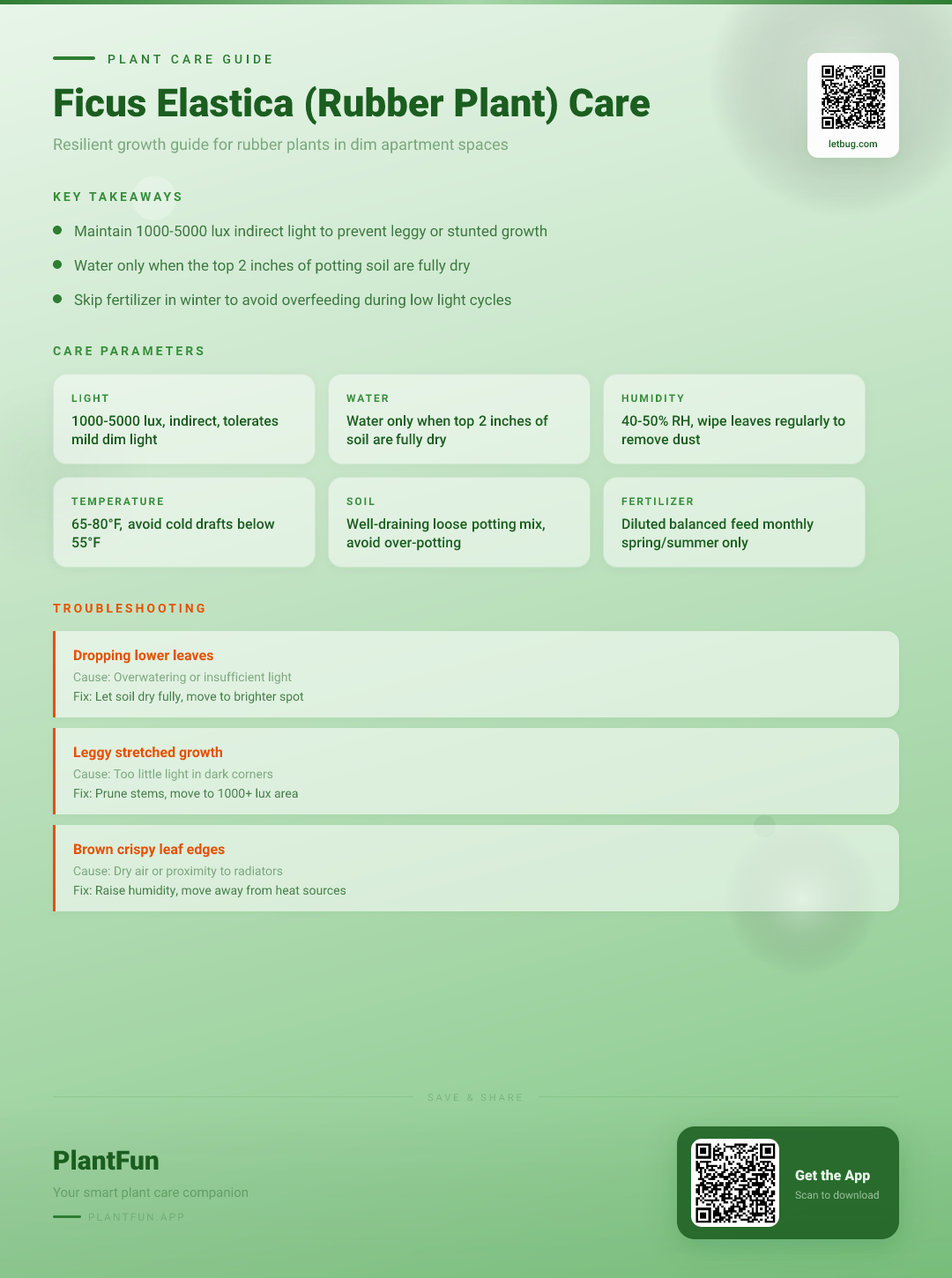
Key Takeaways
- Check soil moisture before watering — overwatering is the #1 killer of houseplants.
- Ensure your plant gets the right amount of light for its species.
- Be patient with recovery — most plants need 2–4 weeks to bounce back.
Quick Care Card: The Essentials
| Feature | Requirement |
|---|---|
| Light | 1,000–5,000 lux (Bright indirect) |
| Water | Allow top 2 inches of soil to dry out |
| Humidity | 40–50% |
| Temperature | 65–80°F (18–27°C) |
| Soil | Well-draining, peat-based mix |
| Fertilizer | Balanced liquid feed, monthly in spring/summer |
| Toxicity | Toxic to cats and dogs (ASPCA, 2026) |
TL;DR: The Reality of Rubber Plants in Dim Apartment Settings
If you live in a low-light apartment, your Ficus elastica can survive—but it won’t thrive on neglect. Success hinges on three pillars: maximizing every available lumen of natural light, strictly avoiding overwatering in low-light conditions, and keeping the leaves dust-free to maximize photosynthesis. When I first started growing rubber plants in my own dim, north-facing city apartment, I learned the hard way that these plants are not “low light” tolerant; they are merely “low light” resilient. Treat them with precision, and they will reward you with deep, glossy foliage even in tight spaces.
Why Your Ficus Elastica Struggles: Understanding Low-Light Physiology
When a plant evolved for bright, tropical canopies is placed in a dim room, it enters a state of shade avoidance. It desperately stretches its internodes (the stem space between leaves) to reach for light, resulting in the dreaded “leggy” look. Because photosynthesis slows down in low light, the plant’s metabolic rate decreases, meaning it requires significantly less water and fewer nutrients. If you continue to water it like a plant in a bright sunroom, the roots will suffer from oxygen deprivation and rot.
Decoding Light Requirements: Moving Beyond ‘Bright Indirect’ to Practical Lux Levels
“Bright indirect light” is often vague. Practically, your Ficus elastica needs at least 1,000 lux to maintain health. Below this, the plant will shed lower leaves to conserve energy. You can measure this using a light meter app on your phone. If your living space is consistently below 500 lux, you must supplement with a full-spectrum LED grow light for 8–10 hours daily to maintain structural integrity (PlantwisePlus Knowledge Bank, 2022).
Precision Watering: Calculating ML Needs Based on Pot Size and Soil Moisture
“How often to water rubber plant” is the most common question I get. The answer is never a calendar date; it is a moisture test.
- Use the “Finger Test”: Insert your index finger two inches into the soil. If it feels damp, wait. If it is dry, proceed.
- Calculate the soak: For a standard 10-inch pot, aim for approximately 250–300ml of water.
- Drainage is non-negotiable: Never let your Ficus sit in a saucer of standing water, which induces root hypoxia.
Step-by-Step Guide: Managing Humidity and Dust for Healthy Foliage
In an apartment, dry air from HVAC systems can cause leaf tips to brown.
- Wipe the leaves: Every two weeks, use a damp microfiber cloth to remove dust. Dust acts as a barrier to light, which is already scarce in your apartment.
- Increase humidity: If your ambient humidity is below 40%, use a small humidifier rather than misting, as misting provides only transient moisture.
- Position strategically: Keep your plant away from direct drafts, whether from air conditioning or heating vents (Esser, 1981).
Seasonal Care Calendar: Adjusting for Reduced Light Cycles in Winter
- Spring/Summer: Growth phase. Fertilize once a month. Light is abundant; plants can tolerate slightly more water.
- Autumn/Winter: Dormancy phase. Stop fertilizing. Reduce watering by 30-50% as the sun’s angle lowers and your apartment receives fewer photons.
Troubleshooting Guide: Why is my rubber plant losing lower leaves?
Yellowing Lower Leaves
Symptom: The bottom-most, oldest leaves turn yellow and drop off.
Likely cause: Typical response to low light or irregular watering cycles.
Fix:
- Assess your light placement; move the plant closer to a window.
- Ensure you are not overwatering when the plant is in a lower-light state.
Brown, Crispy Leaf Edges
Symptom: Edges of the leaves turn brown and brittle.
Likely cause: Low humidity or salt buildup from tap water.
Fix:
- Increase ambient humidity to 40-50%.
- Flush the soil with distilled water to remove mineral accumulation.
Stretching or Leggy Growth
Symptom: Large gaps between leaves; the plant looks sparse.
Likely cause: The plant is searching for light.
Fix:
- Prune the top growth to encourage branching (only in spring).
- Supplement with a grow light.
Drooping Foliage
Symptom: The entire plant looks wilted despite the soil feeling dry.
Likely cause: Chronic underwatering or root system damage.
Fix:
- Check roots for health (should be firm and light-colored).
- Gradually re-establish a consistent watering schedule.
Can I keep my rubber plant near a radiator in my apartment?
Avoid it. Radiators create localized zones of extreme heat and zero humidity. This will dehydrate the leaves rapidly, leading to permanent necrosis (browning) of the foliage. Place your rubber plant at least 5 feet away from any active heating element.
How do I fix a leggy rubber plant in a dark corner?
To make a rubber plant bushy again, you must prune it. During the growing season, cut the main stem back to just above a leaf node. This triggers dormant buds lower on the stem to activate. You must also move the plant into significantly better light; otherwise, the new growth will simply become leggy again.
Common Mistakes: Over-potting and Over-fertilizing in Low Light
- Mistake: Using a pot much larger than the root ball. What happens: Excess soil holds too much water, leading to root rot. Instead: Use a pot only 1–2 inches wider than the previous one.
- Mistake: Fertilizing during winter. What happens: The plant cannot process the minerals, leading to root burn. Instead: Wait until active growth resumes in spring.
References
- PlantwisePlus Knowledge Bank. (2022). Ficus elastica (rubber plant). https://doi.org/10.1079/pwkb.species.24090. Accessed 2026-03-11.
- Esser, R. (1981). Distribution of Aphelenchoides fragariae in Leaves of Ficus elastica and Asplenium nidus. Plant Disease. https://doi.org/10.1094/pd-65-425. Accessed 2026-03-11.
- ASPCA. (2026). Toxic and Non-Toxic Plants List — ASPCA. https://www.aspca.org/pet-care/animal-poison-control/toxic-and-non-toxic-plants. Accessed 2026-03-11.
Optional Helper: Plantfun.App
Plantfun.App identifies your plants by photo, diagnoses pests and diseases with clear fixes, and creates personalised watering and light schedules that adapt to your home conditions — a handy companion for putting this guide into daily practice.
Found an error or have suggestions? We'd love your feedback.
Need help identifying this problem?
Get instant identification, personalized care schedules, and effective pest treatment plans directly on your phone.
Sponsored • We may earn a commission from app downloads
Related Guides
Ficus Elastica in Small Apartments: The Essential Rubber Plant Care Guide for Resilient Growth
Transform your Ficus elastica into a resilient centerpiece. Master these 4 exact care thresholds and a simple seasonal routine to ensure lush, consistent growth.
Care GuideFicus Elastica Care: A Bulletproof Plan for Rubber Plants in Low-Light Apartments
Stop your Ficus elastica from getting leggy. Master the 10,000 lux threshold, precise watering intervals, and pruning hacks to keep your rubber plant compact.
Care GuideThe Complete Ficus Elastica (Rubber Plant) Care Guide for Small Apartments: Get Lush Resilient Growth
Grow a lush, resilient rubber plant even in your small apartment. Get exact light levels, watering amounts, and space-saving tips for glossy, low-fuss foliage that won’t outgrow its nook.
Pest ControlAnts on Plants: What They Mean and What to Do
Ants usually aren't eating your plant. They are farming other pests.