
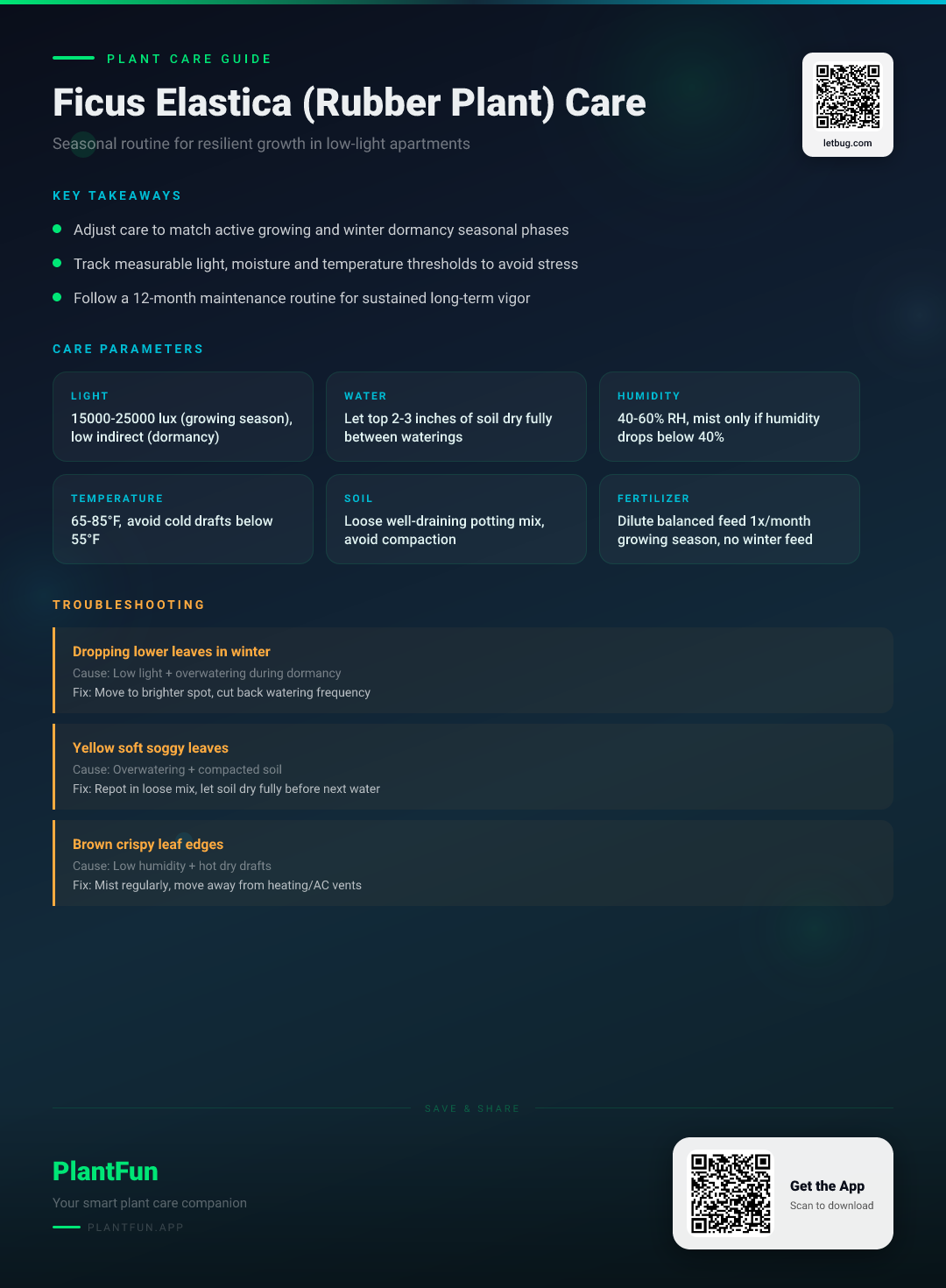
Key Takeaways
- Check soil moisture before watering — overwatering is the #1 killer of houseplants.
- Ensure your plant gets the right amount of light for its species.
- Be patient with recovery — most plants need 2–4 weeks to bounce back.
TL;DR: To keep your Ficus elastica thriving in an apartment, treat it as a seasonal resident. Provide high, indirect light during summer (15,000–25,000 lux) and strictly reduce watering during the low-light winter months. Always use well-draining, chunky soil to prevent root rot, and remember that this plant is toxic to pets if ingested (ASPCA, 2026).
Quick Care Card: The Baseline for Resilient Growth
| Feature | Requirement |
|---|---|
| Light | Bright, indirect (15,000–25,000 lux) |
| Water | Allow top 2 inches of soil to dry out |
| Humidity | 40%–60% (Moderate) |
| Temperature | 60°F–80°F (15°C–27°C) |
| Soil | Well-draining, aroid-style mix |
| Fertilizer | Balanced liquid feed during active growth |
| Toxicity | Toxic to cats and dogs (ASPCA, 2026) |
Why Your Rubber Plant Struggles in Typical Apartment Conditions
When I first bought my rubber plant, I placed it in a dark corner, thinking its reputation as a “low-light plant” meant it thrived in shadows. I was wrong. In reality, Ficus elastica is a tropical tree (NC State Extension, 2026). Apartments often suffer from stagnant air, low light, and temperature fluctuations near windows or vents. These conditions force the plant into a metabolic stall, leading to the dreaded leaf drop that so many owners experience.
Measurable Thresholds: Light, Moisture, and Temperature Standards
To manage this plant successfully, you need to think in metrics. Aim for at least 15,000 lux during its growing season. If your apartment feels dim, a simple lux meter app can confirm if you’re falling below the 10,000 lux minimum required for sustained, healthy growth. Keep the plant away from drafty radiators, as sudden thermal shifts cause the plant to shed foliage as a survival mechanism.
Spring & Summer: Maximizing Growth Phases (15,000-25,000 lux)
This is when your plant is working hard. I move mine to a South-facing window, protected by a sheer curtain to avoid scorching. During this time, the soil should be kept consistently moist but not saturated. If you are struggling with repotting techniques for indoor plants, now is the time to ensure your soil mix includes plenty of perlite or orchid bark to prevent compaction.
Autumn & Winter: Managing Dormancy in Reduced Natural Light
As the sun dips lower, your plant’s metabolism slows down. This is the most critical period for apartment dwellers. You must reduce watering frequency significantly. If you continue to water on a summer schedule, you will invite root rot, a common issue in indoor settings where evaporation rates are slower (PlantwisePlus, 2022).
The Watering Science: How to Measure and Timing Strategies
Do not water on a calendar schedule. Instead, use the “finger test”: stick your finger 2 inches into the soil. If you feel moisture, wait. If it is dry, water until the liquid drains out of the bottom of the pot. Never let the plant sit in a saucer of standing water; this creates the anaerobic conditions that encourage pathogens (Esser, 1981).
Overwatering and Root Rot
Symptom: Lower leaves yellowing and dropping rapidly.
Likely cause: Excess soil moisture creating a low-oxygen environment for roots.
Fix:
- Remove the plant from its pot to inspect the roots; trim any mushy, brown, or foul-smelling roots.
- Repot into a clean container with fresh, fast-draining soil mix.
FAQ: Why is my rubber plant dropping its lower leaves in winter?
It is usually a reaction to reduced light levels. When the plant cannot support all its leaves due to a lack of photosynthesis, it sheds the oldest, bottom leaves. Ensure it is placed in the brightest spot available during these months.
FAQ: How do I know if my apartment has enough light for a rubber plant?
Can I put my rubber plant in a north-facing window? While possible, it may grow slowly. Use a free light meter app to ensure it receives at least 10,000 lux. If it’s lower, consider a supplemental grow light.
FAQ: Should I mist my plant to increase humidity or is that a myth?
It is mostly a myth. Misting provides only temporary humidity and can encourage fungal issues on the foliage (PlantwisePlus, 2022). Instead, use a humidifier or group your plants to create a microclimate.
Common Mistakes: Avoiding Overwatering and Soil Compaction
- Mistake: Using dense potting soil without amendments. What happens: The soil suffocates the roots. Instead: Add 30% perlite to any potting mix.
- Mistake: Letting the plant sit in drainage water. What happens: Root rot (Esser, 1981). Instead: Empty your drip tray 15 minutes after watering.
The 12-Month Maintenance Checklist for Sustained Vigor
- Spring: Refresh the top inch of soil and resume monthly fertilization.
- Summer: Clean leaves with a damp cloth to maximize light absorption.
- Autumn: Gradually decrease watering as light levels drop.
- Winter: Prioritize light and skip fertilizer entirely until spring.
References
- PlantwisePlus Knowledge Bank. (2022). Ficus elastica (rubber plant). https://doi.org/10.1079/pwkb.species.24090. Accessed 2026-03-19.
- Esser, R. (1981). Distribution of Aphelenchoides fragariae in Leaves of Ficus elastica and Asplenium nidus. Plant Disease. https://doi.org/10.1094/pd-65-425. Accessed 2026-03-19.
- ASPCA. (2026). Toxic and Non-Toxic Plants List — ASPCA. https://www.aspca.org/pet-care/animal-poison-control/toxic-and-non-toxic-plants. Accessed 2026-03-19.
- NC State Extension. (2026). Ficus Elastica — NC State Extension Gardener Plant Toolbox. https://plants.ces.ncsu.edu/plants/ficus-elastica/. Accessed 2026-03-19.
Optional Helper: Plantfun.App
Plantfun.App identifies your plants by photo, diagnoses pests and diseases with clear fixes, and creates personalised watering and light schedules that adapt to your home conditions — a handy companion for putting this guide into daily practice.
Found an error or have suggestions? We'd love your feedback.
Need help identifying this problem?
Get instant identification, personalized care schedules, and effective pest treatment plans directly on your phone.
Sponsored • We may earn a commission from app downloads
Related Guides
Ficus Elastica Care for Dim City Apartments: The Budget-Friendly Guide to Resilient Growth
Transform your dim apartment into a thriving jungle. Follow this 5-step Rubber Plant care plan to achieve vibrant, glossy growth without expensive specialized gear.
Care GuideThe Complete Ficus Elastica (Rubber Plant) Care Guide for Small Apartments: Get Lush Resilient Growth
Grow a lush, resilient rubber plant even in your small apartment. Get exact light levels, watering amounts, and space-saving tips for glossy, low-fuss foliage that won’t outgrow its nook.
Care GuideThe Complete Rubber Plant Care Checklist for Resilient Growth in Small Urban Apartments
Stop stunting your rubber plant’s growth in your apartment. Get 8 actionable care steps, exact light and water thresholds, and a free printable checklist for lush, resilient foliage year-round.
Pest ControlAnts on Plants: What They Mean and What to Do
Ants usually aren't eating your plant. They are farming other pests.